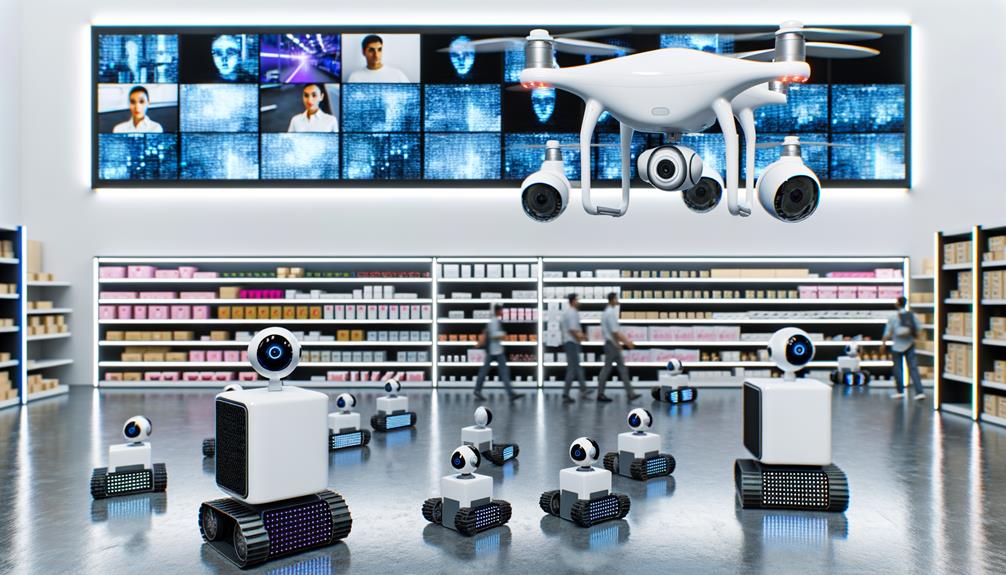


'AI-driven crop monitoring and fertilizer application are revolutionizing precision agriculture. As the market grows towards $19.24 billion by 2030, autonomous drones are becoming ever more vital. Now, I'm watching closely as these advanced technologies blend into AI-driven threat detection. This fusion is pivotal for swift real-time responses to security breaches. To protect this vulnerable sector, robust communication protocols like encryption and authentication are essential. The future looks bright, and I'm excited to see what other cutting-edge advancements emerge.'
Key Takeaways
- Autonomous drones powered by advanced AI enhance crop monitoring, fertilization, and pest control for improved agricultural productivity.
- AI-driven threat detection employs machine learning algorithms for real-time risk identification and swift response to security breaches without human intervention.
- Sophisticated drones integrated with multi-sensor payloads enable comprehensive data collection for variable rate application and automated crop monitoring.
- Secure communication protocols utilizing AES and RSA encryption ensure the confidentiality and integrity of data transmitted by drones during operations.
- The future of flight plan allows for legalising Beyond Visual Line of Sight (BVLOS) flights, enabling drones to operate autonomously in security applications.
Removing Human Intervention
By leveraging advanced artificial intelligence, drones are increasingly capable of performing a wide range of tasks without human intervention, from predictive crop monitoring to autonomous spraying and seeding. This is especially evident in precision agriculture, where the market is projected to reach $19.24 billion by 2030.
Autonomous drones are revolutionizing operations by monitoring crop health, applying fertilizers, and even harvesting crops without human intervention. These drones are equipped with sophisticated AI and machine learning capabilities that enable them to learn from their environment and make independent decisions.
Removing human intervention from complex tasks like detecting leaks, inspecting pipelines, and self-charging allows for heightened efficiency and reduced risk. Moreover, these drones enhance security measures by leveraging real-time data transmission for swift emergency response.
In the context of drone detection, the integration of AI and machine learning is essential for identifying potential threats and countering drone technologies.
AI-Driven Threat Detection
As AI-driven threat detection continues to mature, it has become crucial that security systems leverage advanced machine learning algorithms to identify, analyze, and respond to potential risks in real-time. With the ability to process extensive amounts of data quickly, AI systems enhance threat detection capabilities by detecting anomalies and unauthorized activities more effectively than traditional methodologies. This allows for swift and decisive real-time response, thereby mitigating the impact of security breaches.
The progressive advancements in AI-driven threat detection have made it possible for autonomous drones to identify threats without human intervention. These advanced AI systems can discern rogue drones or suspicious behavior within a security perimeter, taking proactive measures to address the issue.
As the trends in AI-driven threat detection continue to evolve, we can anticipate even more sophisticated capabilities in the future. By integrating AI into security systems, we can ensure proactive protection against potentially catastrophic breaches.
Secure Communication Protocols

To safeguard against cyber threats and secure the integrity of drone operations, strong communication protocols must be implemented responsibly. This means embracing robust technologies that protect drone data from interception and tampering.
With drones capturing sensitive information and transmitting it back to ground stations, robust encryption and authentication mechanisms are essential.
Secure communication protocols like AES and RSA are essential for securing the confidentiality and integrity of data exchanged between drones and their controllers. These protocols prevent unauthorized access, shield data from hacking, and maintain the integrity of command signals.
This is especially crucial in scenarios involving critical infrastructure or high-security areas where data breach can have significant consequences.
Frequently Asked Questions
What Is the Future Trend of Drones?
"In the future, drone regulations will enable improved security. Autonomous drones will enhance surveillance, with drone swarms and counter-drone tech further fortifying defenses. Advanced AI and edge computing will drive efficiency."
What Are the Best Security Drones?
I recommend surveillance drones with advanced counter measures, like the DJI Matrice 350 RTK and Parrot ANAFI USA, which excel in detailed observation, risk assessment, and security applications, ensuring robust surveillance and privacy safeguards in autonomous patrol operations.
What Is the Market Trend for Drones?
\
I'm observing a drone market trend marked by rapid growth (25% CAGR to $279 billion by 2032), driven by demands from industries like construction and energy, technological advancements, and a focus on security and surveillance amid regulatory changes.
What Is the Latest Innovation in Drone Technology?
I'm excited about the latest drone innovations. Autonomous navigation, anticollision tech, and remote monitoring enhance safety. Long-range capabilities, real-time tracking, and improved battery life increase efficiency.