

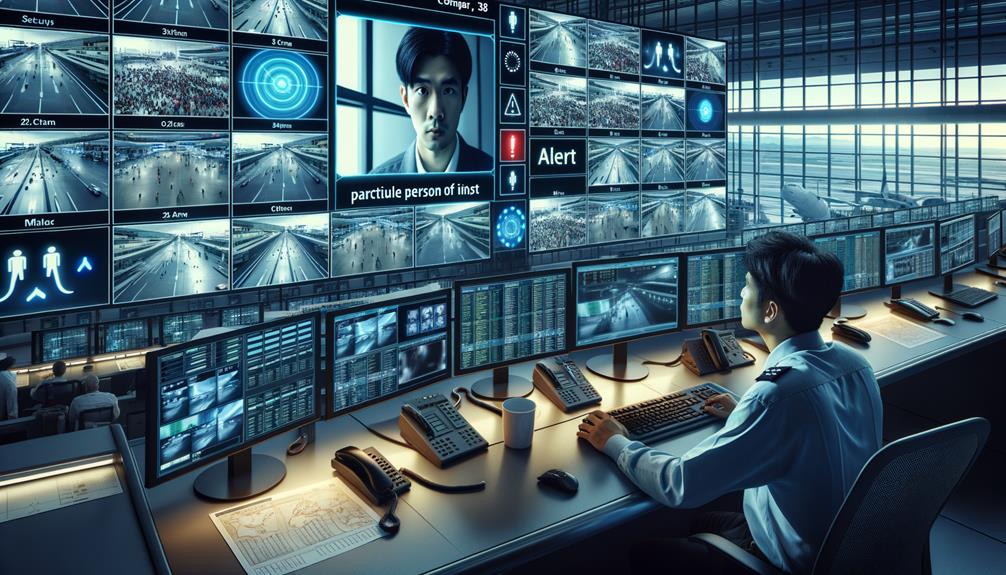
Real-time facial recognition technology greatly enhances surveillance operations across various sectors. For public safety, it aids in rapid response and intervention. It streamlines border control, expediting the immigration process. At airports, it fast-tracks security checks, improving efficiency and passenger experience. In law enforcement, it helps track suspects and enhances situational awareness. Healthcare facilities are transformed with facial recognition for secure access and monitoring. Live events become safer with efficient participant monitoring. Lastly, it plays a pivotal role in identifying and deterring shoplifters for enhanced store security. These advanced applications showcase the versatility and potential of real-time facial recognition in surveillance.
Key Takeaways
- In public safety, real-time facial recognition enables rapid response and intervention, identifying individuals of interest in crowded areas.
- Airport security screening leverages the technology to fast-track security checks and verify passenger identities efficiently.
- Law enforcement agencies use real-time facial recognition to track and monitor suspects, enhancing situational awareness and investigations.
- Healthcare facilities integrate the technology for secure access, monitoring, and patient privacy protection.
- Retail loss prevention systems utilize real-time facial recognition to identify and deter shoplifters, reducing successful thefts.
Surveillance for Public Safety
When enhancing public safety through surveillance operations, real-time facial recognition technologies work in conjunction with ongoing monitoring to provide law enforcement with critical time-sensitive information for rapid response and intervention.
One notable advantage of these advanced surveillance systems is their ability to identify individuals of interest in crowded areas. By integrating facial recognition technology with existing monitoring infrastructure, security personnel can quickly track suspects and respond to potential threats in real-time.
Real-time facial recognition notably improves response times, enabling law enforcement to take proactive measures to maintain public safety. This integration allows for immediate alerts in case of security breaches or unauthorized access, thereby preventing criminal activities and potential threats.
For example, during large public events like festivals or sporting events, real-time facial recognition can be deployed to identify known troublemakers or individuals with restricted access, ensuring the safety of attendees.
Enhancing Border Control Efficiency
Real-time facial recognition technology has greatly streamlined border control operations by expediting the immigration process while bolstering security measures. At border checkpoints, facial recognition systems efficiently identify individuals, reducing waiting times and congestion. This heightened precision in identification enhances overall security by accurately detecting potential threats.
The implementation of biometric entry/exit systems in the Schengen Area, for instance, leverages facial recognition technology to regulate the movements of non-EU nationals. The rise in global usage of real-time facial recognition technology in border control operations contributes to smoother and more secure travel experiences. It's through these integrated systems that the immigration process becomes more efficient and reliable.
For someone like me working in surveillance, real-time facial recognition technology has proven invaluable for enhancing the efficiency and security of border control operations, ensuring genuine travelers move swiftly and those who pose a risk are intercepted. This technology is revolutionizing how we manage borders, and I'm excited to see its continuous application in an increasing number of countries worldwide.
Fast Airport Security Screening

As I explore the subtopic of Fast Airport Security Screening, it becomes clear that real-time facial recognition technology can greatly enhance the efficiency of boarding processes, leading to both improved security and a better passenger experience.
By leveraging this technology, airports can streamline their security checkpoints, reducing wait times and allowing for more thorough monitoring.
In addition, integrating facial recognition into airport operations could revolutionize the way we travel, making the entire process more efficient and enjoyable.
Efficient Boarding Processes
In this section, we'll discuss how facial recognition technology can streamline airport security by enhancing boarding processes.
Today, airports are increasingly adopting facial recognition systems to fast-track security checks, reducing the time passengers spend queuing. This technology verifies identities in real-time, ensuring a swift and secure experience. Importantly, Gemalto's facial recognition systems at Paris airports have improved efficiency for over 100 million passengers annually, demonstrating the substantial impact on efficiency.
Real-time biometric verification using facial recognition technology accelerates security screening at airports. By leveraging facial recognition, boarding processes become more efficient, ensuring quicker passage through security checkpoints and less time spent waiting.
This technology is now widely adopted by U.S. airports and European airlines to enhance the overall travel experience. By integrating facial recognition into boarding operations, airports can notably increase passenger throughput without compromising security.
Enhanced Passenger Experience
By integrating facial recognition technology into airport security, I can expect to spend less time in security lines and more time enjoying my travel experience. This technology is designed to streamline passenger experiences, ensuring that security screening is both efficient and secure.
Gemalto's systems, for instance, have improved processing efficiency for over 100 million passengers annually at Paris airports. This real-time facial recognition reduces wait times significantly, allowing me to move through checkpoints quickly and easily.
The implementation of facial recognition technology in airports like Frankfurt and Munich has already demonstrated its effectiveness. For example, Lufthansa Group travelers can access security, gates, and lounges by simply scanning their faces. This technology isn't limited to specific airlines, as airports like Paris-Charles de Gaulle and Paris-Orly have also adopted it.
The European Union is also introducing biometric entry/exit systems to regulate the movements of non-EU nationals using facial recognition by 2022. Therefore, by leveraging facial recognition technology, airports can provide a smoother, faster, and more secure travel experience for passengers like me.
Improved Security
When I approach security checkpoints at airports utilizing facial recognition technology, I can be confident that security screening will be both effective and secure. This technology has greatly improved passenger processing, as seen in Paris airports where Gemalto's facial recognition systems process over 100 million passengers annually.
The use of biometric border checks in the Schengen Area enhances security measures, guaranteeing that airport security screening is a streamlined and reliable process.
Airports such as Frankfurt and those serving European airlines have incorporated this technology to ensure smooth and safe passage. Real-time facial recognition systems guarantee that security can quickly and accurately verify the identities of passengers.
Intelligence Gathering for Law Enforcement
In the world of law enforcement, effective intelligence gathering is essential for mitigating crime. Real-time facial recognition in surveillance operations greatly aids in this process. By leveraging advanced algorithms, technology allows law enforcement agencies to track and monitor suspects more efficiently.
Surveillance cameras are integrated with facial recognition, which enhances situational awareness by providing immediate alerts when individuals of interest are detected in public spaces. This capability facilitates real-time investigations and gathers evidence for criminal cases.
To achieve optimal results, agencies need to fine-tune facial algorithms to handle different environmental conditions and optimize the performance of surveillance systems. Collaboration between law enforcement agencies is also key in making the most of facial recognition technology. Employing trained personnel and standardized protocols for its use is crucial to guarantee due process and fairness.
Monitoring in Healthcare Facilities

Now, let's discuss how real-time facial recognition is transforming healthcare facilities.
By integrating facial authentication solutions and emotional state tracking within surveillance systems, hospitals and clinics can guarantee that authorized staff have seamless access to restricted areas and that patient movements are efficiently monitored.
This synergy of technology and security protocols is vital for maintaining a safe and secure environment within healthcare facilities.
Facial Authentication Solutions
Implementing facial authentication solutions in healthcare facilities greatly enhances security by ensuring only authorized personnel access restricted areas. This advanced technology plays a key role in ensuring the safety and integrity of medical facilities, as well as protecting sensitive patient information. By monitoring individuals entering and exiting critical zones, healthcare facilities can effectively mitigate potential security threats and minimize the risk of unauthorized access to patient records.
| Facial Authentication Objectives | Benefits in Healthcare Facilities |
|---|---|
| Secure Access Control | Only authorized personnel can access restricted areas, reducing the risk of unauthorized access. |
| Real-Time Monitoring | Allows for continuous monitoring of individuals entering and exiting critical zones. |
| Improved Operational Efficiency | Streamlines access control processes, reducing administrative burdens. |
| Patient Privacy Protection | Effectively safeguards sensitive patient information from unauthorized access. |
Real-time facial recognition technology seamlessly integrates with existing security protocols to provide thorough monitoring in healthcare facilities. By adopting these advanced solutions, healthcare organizations can significantly improve their security measures and protect patient privacy effectively.
Emotional State Tracking
Tracking patients' emotional states through real-time facial recognition enhances the overall quality of care by providing healthcare staff with precise cues to respond effectively to individual needs. By leveraging facial expressions, healthcare facilities can accurately assess pain levels, stress, and overall emotional states, allowing healthcare providers to respond promptly to patients' needs based on their emotional cues.
Real-time facial recognition technology allows healthcare staff to monitor patient well-being closely and offer personalized care more effectively. This approach is especially important in settings where timely interventions are essential, such as emergency rooms and mental health clinics. By continuously tracking emotional states, healthcare providers can tailor their treatment plans and interventions to meet individual patient needs effectively.
The use of real-time facial recognition to monitor emotional states greatly improves patient satisfaction and reduces waiting times. It ensures that healthcare professionals proactively address patients' emotional cues, leading to a more patient-centric approach to care. This technology empowers healthcare facilities to provide high-quality care by focusing on the holistic needs of patients, enhancing their overall experience and well-being.
Live Event Organization and Security
Live event organizers are turning to real-time facial recognition in surveillance operations to elevate security measures and guarantee a safe environment for attendees. Leveraging this technology allows them to monitor participants efficiently and identify potential threats in real-time. This proactive approach prevents unauthorized access and enables prompt responses to security incidents.
Integrating facial recognition into their surveillance systems empowers event organizers to detect and respond to issues promptly, guaranteeing optimized situational awareness.
The enhanced precision and speed of real-time facial recognition result in streamlined security processes and better protection for those attending the events.
Retail Loss Prevention Systems

As I continue to explore the role of real-time facial recognition in guaranteeing safety and security, I turn my attention to retail loss prevention systems, where the same technology plays a pivotal role in identifying and deterring shoplifters and enhancing overall store security.
Facial recognition technology has proven to be instrumental in supporting retailers in their fight against shoplifting and organized retail crime. By leveraging real-time facial recognition integrated with existing security cameras, retail stores can instantly identify known shoplifters and alert personnel to take proactive measures. This technology accurately tracks and deters repeat offenders, providing critical data to support law enforcement and court proceedings.
Additionally, the real-time surveillance capability of these systems ensures swift action can be taken the moment a known shoplifter enters the store, markedly reducing the likelihood of successful thefts. This technology provides a robust layer of security, which, when combined with other security measures, offers a thorough approach to combating retail theft and enhancing overall store safety.
Frequently Asked Questions
How Is Facial Recognition Used in Surveillance?
"I utilise facial recognition for security monitoring and law enforcement by integrating it into access control systems, enhancing public safety through real-time alerts and identity verification, ensuring a secure and efficient surveillance process."
What Are the Real Time Applications of Face Recognition System?
I utilize real-time facial recognition for efficient retail security, border control, crowd monitoring, access control, law enforcement, airport security, identity verification, and public safety by leveraging its instant identification capabilities in surveillance operations.
Which Situation Is the Best Example of the Use of Facial Recognition?
When it comes to identifying suspects or tracking individuals, I believe airports and stadiums are the best examples of the effective use of facial recognition, enhancing security and public safety in crowded environments.
What Is the Real World Application of Facial Recognition?
"I see real-time facial recognition being applied globally in retail security to prevent theft, border control to identify impostors, and law enforcement for suspect identification, enhancing public safety and access control through precise crowd monitoring and airport security."




1 comment
Comments are closed.