

We commenced on the security journey with CCTV, first used in Germany in 1942. Initially, analog cameras relied on coaxial cables for low-quality video transmission. The introduction of DVRs in the 1990s improved resolution and storage. IP cameras emerged, transmitting data over the Internet and providing higher-resolution images. The integration of AI-Enhanced PoE security by recognizing objects, analyzing behavior, and detecting threats marks a significant leap in real-time surveillance and proactive alert systems.
Key Takeaways
- AI-enhanced security cameras continuously improve surveillance by detecting and notifying of security threats before they occur.
- IP cameras have far better video quality and advanced capabilities compared to analog CCTV systems.
- Smart features like object recognition, motion detection, and analytics enhance security while minimizing false alarms.
- PoE camera systems have evolved through years, offering better night vision and integration with smart home security systems.
- Integration of technologies like AI, thermal imaging, and edge AI significantly enhance home security efficiency and reliability.
Historical Roots of Surveillance
As we explore the historical roots of surveillance, we find ourselves tracing back to the dawn of modern security, when the first CCTV system was introduced in Germany in 1942, signaling the birth of surveillance technology. This early innovation marked the inception of a technology that would soon transform the way we monitor and secure our spaces.
Analog cameras, which transmitted video signals through coaxial cables, served as the primary method for video surveillance. However, these cameras were limited by their resolution and storage capacity, requiring significant upgrades. The introduction of DVRs in the 1990s replaced VCRs, providing better storage and retrieval capabilities.
Subsequently, the emergence of IP cameras in the internet age allowed for higher resolution video transmission over networks. This rapid evolution has led us to today’s advanced AI-enhanced cameras that utilize real-time analytics for enhanced security features like facial recognition and behavior analysis.
Analog CCTV Systems
We’ll start by exploring the analog CCTV systems that initially relied on coaxial cables for video transmission.
These systems had significant limitations, including low video quality and the need for physical tapes for recording.
Coaxial Cable Limitations
Coaxial cables laid the groundwork for traditional analog CCTV systems, but they also imposed notable constraints on video quality and storage capacity. These cables limited the resolution, which in turn influenced the overall clarity of the footage.
For instance, the Composite Video Baseband Signal (CVBS) used in most analog cameras provided standard definition video, which was far from high definition. This constraint made the footage less clear and less useful for detailed analysis or evidence.
In addition, the storage capacity of analog systems was also restricted by the coaxial cables. Managing physical tapes and ensuring they were regularly maintained was a common challenge for those relying on these systems. The need for frequent tape changes and the potential for data loss during transfers further complicated matters.
These constraints were notable deterrents to effective surveillance and crime investigation. The limitations imposed by coaxial cables ultimately hindered the full potential of analog CCTV systems. They restricted the quality of footage and presented notable maintenance challenges.
It was only with the shift to digital technology that these limitations were significantly overcome, providing a clearer and more reliable means of surveillance…
Low Video Quality
Analog CCTV systems in the early days had low video quality due to limited resolution capabilities, which was exacerbated by the coaxial cables that transmitted the video signals. These cables, often cited as a limitation of early systems, had a significant impact on video clarity.
To illustrate the challenges we faced, consider the following:
- Grainy Footage: Analog cameras produced grainy, low-resolution images that made it difficult to identify details.
- Image Distortion: Coaxial cables were prone to signal degradation, leading to distorted images that added confusion.
- Tape Management Challenges: Analog systems required the use of physical tapes for recording, which became a pain to manage and maintain.
These limitations hindered the effectiveness of early security systems, making it difficult to achieve reliable surveillance. The combination of low-resolution imaging and coaxial cable limitations made analog CCTV systems a struggle to use for effective security monitoring.
Despite these challenges, the evolution of security cameras has made significant strides, ultimately leading to the sophisticated AI-enhanced PoE security cameras we use today.
IP Cameras Emerge
Slipping neatly into networks, IP cameras revolutionized surveillance by transmitting data over the internet rather than through coaxial cables. This notable shift allowed for higher-resolution images, remote access, and advanced monitoring capabilities. The integration of artificial intelligence (AI) in IP cameras further enhanced the security landscape.
As technology evolved, IP cameras became more scalable, making them ideal for larger installations and advanced security systems. These cameras have truly transformed surveillance by providing higher image quality, more efficient data storage, and enhanced system efficiency.
We, too, can appreciate the superior video signals offered by IP cameras, which have replaced traditional analog cameras. The innovative features of IP cameras have transformed surveillance, and AI integration took it to the next level. We can now enjoy advanced object detection, facial recognition, and real-time analytics.
This progress revolutionized the security industry, making it more proactive and efficient. IP cameras have become a cornerstone of robust security systems, and their continued evolution will unquestionably bring even more sophisticated features to protect our lives and properties.
AI-Enhanced Capabilities
As we delve into the cutting-edge world of artificial intelligence in PoE security cameras, we’ve entered an era where advanced analytics and AI-enhanced capabilities are redefining what surveillance means.
AI algorithms embedded in these cameras tune in on specific objects, behaviors, and anomalies to provide precise threat detection, ensuring enhanced security measures.
We’re just beginning to reveal the potential of AI’s transformative power in this space….
AI for Surveillance
AI for Surveillance
Advanced AI algorithms in security cameras empower real-time surveillance by recognizing objects, analyzing behavior, and detecting anomalies, greatly enhancing safety and security measures. Through advanced object recognition and facial detection, these cameras can effectively identify potential security risks and alert personnel quickly.
Additionally, AI algorithms can analyze behavior patterns, identifying anomalies that could indicate suspicious activities.
Enhanced Surveillance
Here are some key features of AI-enhanced surveillance:
- Object Detection: AI algorithms can detect and identify specific objects, such as weapons or prohibited items.
- Real-Time Analytics: These cameras can analyze video feeds in real-time, allowing immediate responses to security breaches.
- Proactive Alert System: Detected anomalies trigger alerts, enabling proactive security measures before incidents escalate.
Advanced Threat Detection
With advanced threat detection algorithms integrated into PoE security cameras, we enhance real-time monitoring capabilities to identify and respond rapidly to potential security breaches. This means AI-enhanced security cameras can accurately identify potential security risks and anomalies, automatically alerting security personnel to take prompt action. The evolution of AI capabilities in PoE cameras enhances threat detection to a great extent, allowing for more proactive responses. By analyzing patterns and behaviors, these cameras enhance surveillance effectiveness and provide an unmatched level of protection for properties.
Enabled by audio and video analytics, advanced threat detection alerts security officials to occurrences such as gunshots, screams, or unusual activities. These cutting-edge cameras analyze scenes, differentiating between normal events and potential security threats. For instance, they can detect if an individual is carrying a weapon or if there’s unauthorized access to a restricted area.
With AI-enhanced security cameras, we trustlessly migrate from reactive to proactive security strategies, responding before incidents escalate. Real-time monitoring empowers real-time response, significantly improving security efforts and making our properties safer.
Advanced Object Recognition
Advanced object recognition in AI-enhanced PoE security cameras fundamentally alters surveillance by identifying and categorizing objects in real-time. This capability significantly enhances the effectiveness of our security efforts by detecting and identifying potential security threats in a highly accurate and efficient manner.
The real-time object recognition allows these cameras to go beyond mere visual recording, detecting anomalies and suspicious items such as unattended bags or weapons in public areas. This advanced detection vastly improves the response to potential security breaches, ensuring that we can react quickly and effectively to mitigate any threats.
- Swift Identification: AI-enhanced cameras rapidly identify objects, alerting us to potential security risks.
- Accurate Classification: These cameras categorize objects accurately, ensuring that we can prioritize our responses based on the severity of the threat.
- Enhanced Surveillance: Real-time object recognition enhances the overall efficiency and accuracy of our surveillance systems, allowing us to protect our communities more effectively.
Thermal Imaging and Night Vision
While advanced object recognition has greatly enhanced our surveillance capabilities, we now need to explore the role of thermal imaging and night vision technologies in low-light surveillance, maintaining we can effectively monitor and respond to potential security threats in dark conditions.
AI-powered cameras equipped with thermal imaging and night vision capabilities enhance our ability to detect heat signatures and track objects even when there’s little or no visible light. These technologies not only provide accurate surveillance capabilities but also allow for real-time response to security breaches such as fires and chemical spills.
Importantly, the integration of artificial intelligence and machine learning algorithms in these cameras ensures that the accuracy of the surveillance is markedly improved by identifying patterns and anomalies in real-time.
In utilizing thermal imaging and night vision, security cameras can accurately monitor public areas, even in the most challenging environments, and respond effectively to potential threats. This advanced capability maintains that we can protect our communities more reliably and provide a safer environment for all.
Edge AI for Real-Time Surveillance
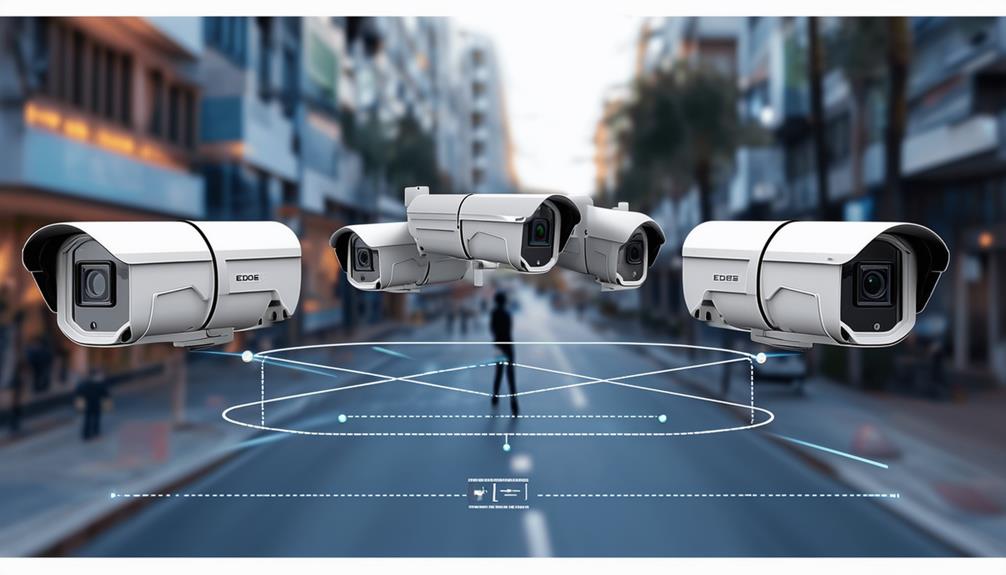
Enhancing our surveillance capabilities further, we turn to Edge AI, which processes data locally on PoE security cameras to provide efficient real-time surveillance. This ability to analyze information directly on the device greatly reduces latency and guarantees timely responses to detected threats.
Instant Threat Detection: Edge AI in PoE cameras quickly identifies potential threats, enabling swift action to prevent security breaches.
Accurate Alerts: Local processing guarantees that alerts are accurate and not influenced by cloud-based delays or interference.
Enhanced Image Analysis: Edge AI processors in PoE cameras enhance image analysis, further supporting the reliability of threat detection.
Revolutionizing Home Security
Edge AI-enabled security cameras are revolutionizing the home security space by providing real-time threat detection and response capabilities, transforming the way we protect our properties. By integrating AI directly into cameras, we can eliminate false alarms and optimize image quality, making surveillance more effective, even in low-light conditions.
As the home security market is projected to grow by nearly 20% annually through 2030, advancements in Edge AI technology are vital for homeowners seeking robust and reliable security solutions.
Cloud-based AI solutions, while prevalent, have limitations in providing real-time security. Edge AI addresses these issues by processing data locally, guaranteeing swift response times and reducing reliance on external servers. This streamlined approach creates a more dependable security infrastructure.
With tailored Edge AI solutions, homeowners can enjoy enhanced threat detection, reduced false positives, and optimized image quality. By embracing Edge AI in home security systems, we can make sure safer and more secure living environments.
Frequently Asked Questions
What Is the Best Security Camera for AI Detection?
“We recommend cameras like those from CamCamptech, offering advanced AI capabilities, night vision, facial recognition, remote monitoring, and intrusion detection, ensuring enhanced security while addressing privacy concerns.”
Are AI Security Cameras Worth It?
“We find AI security cameras worth the investment, as they offer real-time monitoring, accurate threat detection, and customization options, while balancing privacy concerns. The added cost efficiency and versatility make them a valuable choice.”
What Is the Disadvantage of a Poe Camera?
We dislike how PoE cameras operate with high maintenance, limited flexibility due to power limitations, and installation challenges that make them network-dependent—creating vulnerabilities in our security systems that constrain our freedom.
What Is the Best Camera for AI Vision?
The best camera for AI vision is the Nest Cam Indoor, which excels with enhanced video quality, facial recognition, and smart monitoring. It offers real-time alerts and automated tracking.