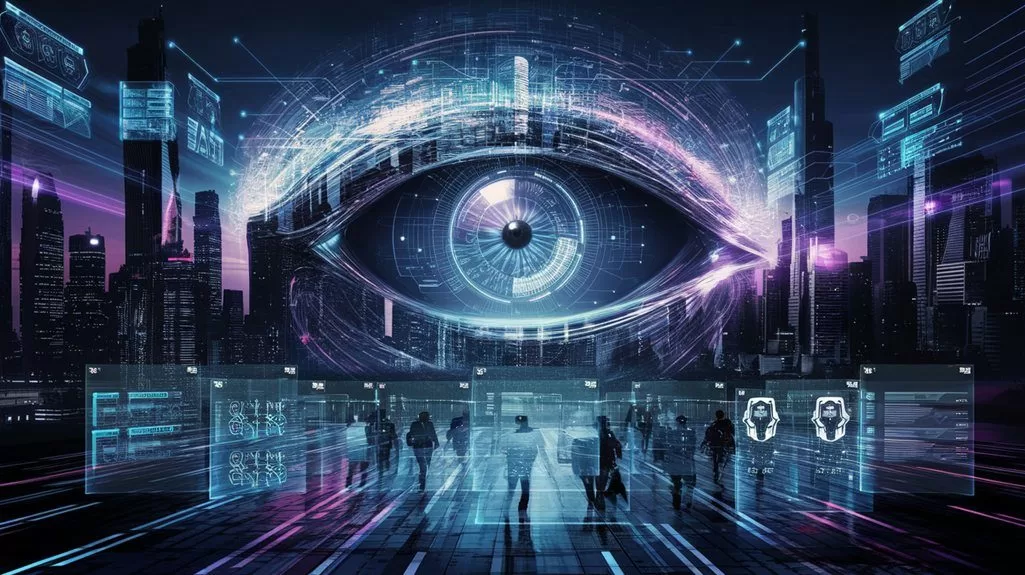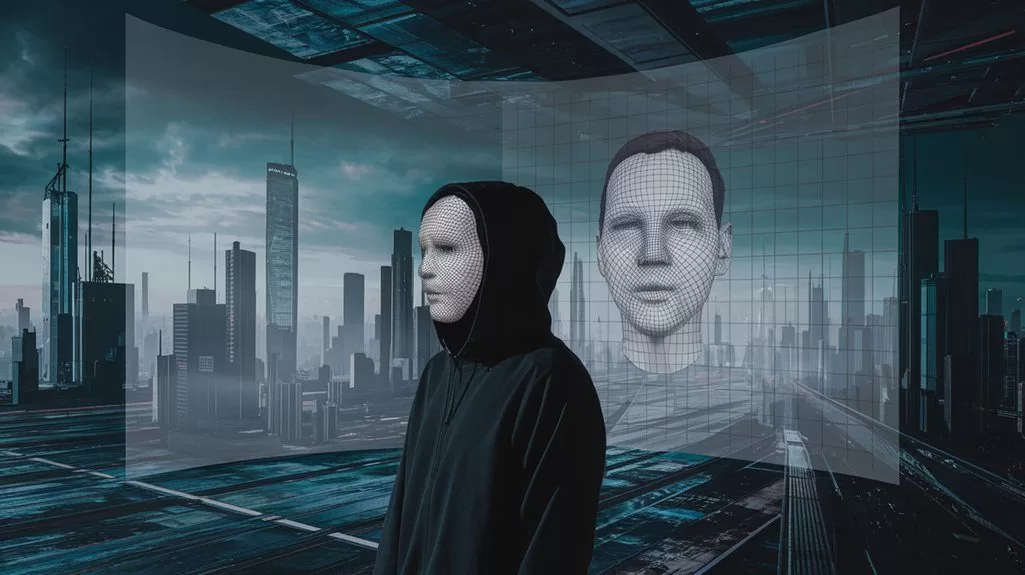
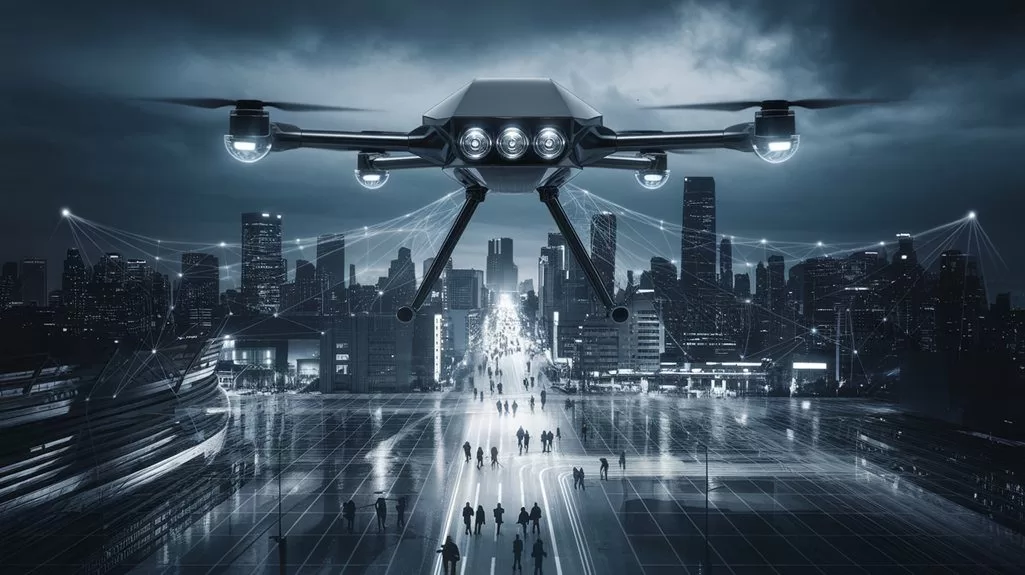

Is AI redefining censorship? Unequivocally, as machine learning improves, surveillance tools tighten their grip on online content. The First Amendment stands resilient, defending free speech in the U.S., yet Europe prioritizes safety, embracing regulatory constriction. Ethical concerns abound, with biases lurking, forming echo chambers. Government-laden censorship raises eyebrows—some might wield AI like a supervillain with a dictatorial agenda. Balancing harm prevention with expression rights? Tricky and heated. Curious about the darker shades of this issue?
Key Takeaways
- AI surveillance tools enable governments to efficiently monitor and censor online content.
- Bias in AI can lead to unfair censorship and creation of digital echo chambers.
- The EU's AI Act prioritizes safety, potentially limiting freedom of expression.
- AI censorship could conflict with free speech rights protected by the U.S. First Amendment.
- Global AI regulations vary, influencing how censorship is approached and enforced.

While the promise of artificial intelligence dazzles many, its role in government censorship raises eyebrows—and not just a few. AI surveillance tools, now a staple in various government arsenals, are used to monitor and regulate online content. Sure, the U.S. prides itself on the First Amendment, where AI-generated content enjoys the same free speech protections as traditional media. But, globally, the picture isn't so rosy. The European Union has taken a different route, introducing regulations that some might say are more about safety than liberty. Machine learning enables proactive risk identification and mitigation, which can play a significant role in how governments apply censorship.
The ethical maze is tricky. Censorship ethics come into play as AI systems can inadvertently serve bias. Train an AI on biased data, and voilà—you've got a digital echo chamber. Bias mitigation is no small feat. It demands diverse teams and ethicists to step in, ensuring that AI decisions don't further entrench societal prejudices. Yet, the irony is hard to miss. AI, a tool designed to enhance human capabilities, might just be limiting access to information, stoking public concern. Guardrails in GenAI shape the ecosystem of information and ideas, raising questions about the balance between harm prevention and freedom of expression.
AI's role in censorship is a dance on a tightrope. On one side, there's the allure of efficient monitoring, promising to filter harmful content. On the other, there's free speech, that pesky yet fundamental right. Government monitoring of speech using AI raises First Amendment concerns, as it parallels the ongoing debate over editorial decisions made by private entities. Governments, particularly those with less democratic zeal, might see AI as the ideal censor. Silent, efficient, and devoid of a pesky conscience.
But it doesn't stop there. Government regulations are a patchwork quilt, with some countries sporting more holes than fabric, especially when compared to the U.S. framework.
Ah, the global perspective. While the EU's AI Act bans high-risk applications, America holds fast to its constitutional roots, albeit with exceptions for incitement and the like. The regulations need to be surgically precise to avoid trampling on free speech. The risk? Stifling innovation. Section 230 hangs like a sword over AI innovation, threatening to slice through the very fabric of online expression if altered.
It's a regulatory challenge of epic proportions. Ensuring ethical AI use while maintaining freedom of expression? Easier said than done. Some argue AI shouldn't make critical decisions alone, lest biases turn into policy. The stakes are high. AI could revolutionize public services, yes. But with great power comes great responsibility—or so they say.
Dark horizons or bright futures? That's for debate. Meanwhile, AI marches on, its role in government censorship casting long shadows. The irony? As AI seeks to illuminate, it may also obscure.
Final Thoughts
AI's role in government censorship is a double-edged sword. On one hand, it can streamline content moderation, making it swift and efficient. On the other, it risks overreach and stifles free speech. Yes, AI can keep the internet safe, but at what cost? It's like handing scissors to a toddler—things can get messy. Governments must tread carefully. Balance is essential, or freedom may become just another casualty of technological progress. Choose wisely, or chaos awaits.
References
- https://www.thefire.org/research-learn/artificial-intelligence-free-speech-and-first-amendment
- https://ash.harvard.edu/wp-content/uploads/2024/02/artificial_intelligence_for_citizen_services.pdf
- https://time.com/6835213/the-future-of-censorship-is-ai-generated/
- https://crsreports.congress.gov/product/pdf/R/R46795
- https://freedomhouse.org/report/freedom-net/2023/repressive-power-artificial-intelligence