


To combat the ever-evolving threat landscape effectively, I leverage advanced technologies for real-time threat detection in cybersecurity. This includes a range of technologies that aggregate data from the entire network, monitor traffic for suspicious activities, and analyze user behavior. Behavioral analytics and machine learning algorithms enhance threat detection accuracy by identifying anomalies and patterns. Real-time monitoring, automated response mechanisms, and predictive threat analytics ensure rapid detection and response to incidents. Integrating external threat intelligence feeds and applying AI-driven defense strategies also play an essential role. By adopting these proactive strategies, I can anticipate and mitigate threats, staying ahead of cybercriminals. The intricacies of these strategies are vital to understanding their full potential.
Key Takeaways
- Real-time monitoring helps identify suspicious activity immediately, allowing for swift incident response and enhanced cybersecurity posture.
- AI-powered threat detection leverages machine learning algorithms to detect anomalies and real-time behavioral insights.
- Endpoint and cloud protection includes implementing security monitoring capabilities to detect malicious activities and advanced threats.
- Selecting a suitable cybersecurity framework helps address unique vulnerabilities and implement specific controls and policies.
- Combining human expertise with automated analysis enhances incident response, enabling rapid threat identification and mitigation.
Threat Detection Technologies
As a cybersecurity professional, I firmly believe that threat detection technologies encompass a range of advanced solutions, including Security Event Detection, Network Threat Detection, Endpoint Threat Detection, and Security Data Lake implementations. These proactive measures enhance security infrastructure by efficiently detecting and responding to threats in real-time.
Security Event Detection aggregates data from the entire network, providing a thorough view of all endpoints.
Network Threat Detection technology, on the other hand, constantly monitors traffic to identify suspicious activities, markedly reducing response time.
Endpoint Threat Detection continuously collects user data, offering real-time behavioral insights for investigators.
Security Data Lake implementations offer flexibility for storing and analyzing both structured and unstructured data, allowing for streamlined historical data analysis.
Behavioral Analytics
In the fight against cyber threats, behavioral analytics emerges as an essential component in our cybersecurity toolkit. It relies on real-time monitoring and machine learning algorithms to detect anomalies and deviant activities that may indicate potential security breaches. By continuously studying and analyzing user behavior and network activities, behavioral analytics can quickly identify suspicious activities that deviate from the norm.
This proactive approach empowers security teams to respond swiftly to potential security incidents, significantly minimizing the impact of cyber threats.
Machine learning algorithms play a critical role in enhancing the accuracy of threat detection by recognizing patterns and abnormalities in user behavior. Behavioral analytics helps identify insider threats, unauthorized access attempts, and other malicious activities that traditional security measures might miss. Its real-time analysis of user behavior and network activities pinpoints anomalies, allowing for immediate response and remediation.
In today's threat landscape, where cybercriminals continually adapt and evolve, behavioral analytics provides a powerful tool for staying ahead of the game. By leveraging machine learning algorithms and real-time monitoring, we can ensure robust protection against the ever-changing spectrum of cyber threats.
This technologically advanced approach helps safeguard our digital spaces, enabling freedom and security in the face of persistent cybersecurity threats.
Real-Time Monitoring

In the world of real-time threat detection, I emphasize the pivotal role of network traffic monitoring and anomaly detection systems in enhancing incident response.
These technologies enable organizations to track and analyze network traffic immediately, identifying unexpected patterns and potential security incidents before they escalate.
With immediate threat detection, the window for response is dramatically minimized, making it essential for mitigating the impact of cyber attacks effectively.
Network Traffic Monitoring
Real-time network traffic monitoring is a proactive security measure that continuously analyzes data packets as they move across the network, enabling immediate detection of suspicious activities, anomalies, and potential security threats. This approach empowers organizations to quickly respond to incidents and thwart data breaches. By capturing and analyzing data in real-time, network traffic monitoring tools can identify unauthorized access, malware, or unusual behavior, allowing for swift incident response.
Here are three key benefits of real-time network traffic monitoring:
- Immediate Detection of Threats: Continuous analysis of data packets enables the detection of security threats as they arise, ensuring prompt action to prevent data breaches.
- Improved Anomaly Identification: Real-time monitoring helps to pinpoint anomalies and suspicious activity, allowing organizations to fine-tune their security posture.
- Enhanced Incident Response: With real-time monitoring, organizations can respond swiftly to incidents, minimizing the impact of potential security breaches.
This proactive approach is essential for maintaining a robust cybersecurity posture, safeguarding digital assets, and ensuring freedom from threats.
Anomaly Detection Systems
By analyzing network traffic and user behavior in real-time, anomaly detection systems can quickly identify unusual patterns or deviations that may signal potential cyber threats. These systems leverage machine learning algorithms to establish baselines of normal behavior and flag anomalies that fall outside these defined norms. This real-time monitoring enables organizations to swiftly respond to security incidents, minimizing the impact of cyber threats.
Continuous analysis of data and network activity allows anomaly detection systems to proactively identify emerging threats before they escalate. This proactive approach enhances the overall cybersecurity posture by enabling rapid detection and response to malicious activities.
Automated Response Mechanisms
In cybersecurity, swift action is crucial. That's why we use AI and ML algorithms to automate incident response, enabling our systems to promptly identify, analyze, and respond to security incidents in real-time, guaranteeing efficient threat containment and minimizing the potential damage.
By automating response mechanisms, we achieve several key benefits:
- Reduced Response Times: Automated processes notably decrease the time it takes to respond to security incidents, thereby mitigating potential damage.
- Enhanced Security Posture: By eliminating the need for manual intervention, our security stance becomes more robust and proactive.
- Improved Efficiency: Automation frees up valuable resources, allowing teams to focus on more strategic tasks that further strengthen our cyber defense strategies.
With real-time threat detection and automated response, organizations can effectively stay ahead of evolving threats.
Predictive Threat Analytics
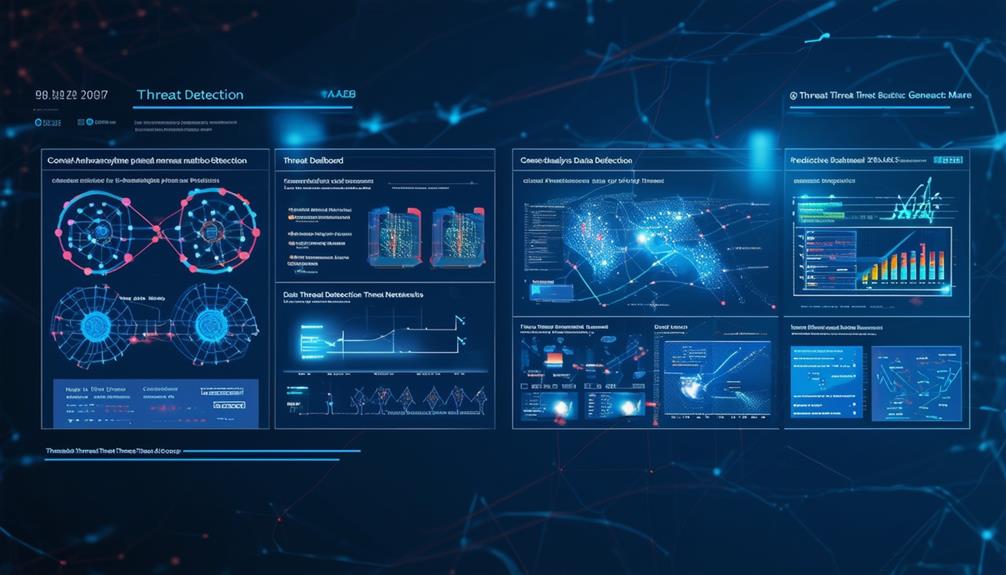
In the domain of real-time threat detection, I rely on predictive modeling and threat forecasting to anticipate potential security threats before they occur.
By leveraging AI and ML to analyze historical data, patterns, and behaviors, these analytics enable me to proactively strengthen my cybersecurity defenses.
This proactive approach allows me to respond rapidly to evolving cyber threats, enhancing my overall security posture.
Predictive Modelling
Predictive modeling in cybersecurity functions like my own highly-trained IT team, constantly studying the latest cyber threats and using historical data and AI algorithms to forecast potential security threats before they even materialize.
Predictive modeling enhances threat detection accuracy and response times by identifying patterns and trends in data.
Here are some key benefits of this approach:
- Predictive Threat Analytics: By leveraging historical data and AI algorithms, we can forecast potential security threats based on patterns and trends. This allows us to prepare and respond before a breach occurs.
- Proactive Measures: Predictive modeling identifies vulnerabilities in real-time, enabling organizations to implement proactive measures to prevent cyber incidents before they happen.
Threat Forecasting
Real-time threat detection is a critical component of modern cybersecurity efforts. Organizations must employ effective strategies to identify and respond to threats promptly. One key strategy is leveraging advanced security tools such as intrusion detection systems and security information and event management (SIEM) solutions. These tools can help organizations monitor and analyze their network traffic in real-time, allowing them to detect any suspicious activities or potential threats.
Another effective strategy is implementing a robust incident response plan. This plan should outline clear procedures for how to respond to various types of security incidents, including real-time threats. By having a well-defined incident response plan in place, organizations can quickly contain and mitigate the impact of any security incidents that occur.
Regular security awareness training for employees is also crucial in the fight against real-time threats. Employees are often the weakest link in an organization's cybersecurity defenses, so educating them about common threats such as phishing attacks and malware can help prevent security incidents from occurring. By creating a culture of security awareness within the organization, employees can become more vigilant and better equipped to identify and report potential threats in real-time.
In addition to these strategies, organizations should also regularly conduct security assessments and penetration testing to identify any vulnerabilities in their systems. By proactively testing their defenses, organizations can uncover weaknesses before they can be exploited by malicious actors. Overall, a multi-layered approach that combines advanced security tools, incident response planning, employee training, and regular security assessments is key to effectively defending against real-time threats in today's digital landscape.
Threat Intelligence Integration
Utilizing threat data from diversified sources, threat intelligence integration greatly enhances threat detection by providing real-time information on emerging threats and vulnerabilities. Integrating external threat intelligence feeds into my system allows me to stay informed about potential security hazards. This fusion of internal data with external intelligence empowers my organization to proactively address potential threats before they materialize.
To maximize the benefits of threat intelligence integration, I focus on the following key areas:
- Entity Behavior Analytics (UEBA) and Artificial Intelligence (AI): These technologies help analyze user behavior and identify anomalies indicative of potential threats.
- Machine Learning (ML): By applying ML algorithms, I can automate the detection and response process, guaranteeing swift action against emerging threats.
- Continuous Monitoring: Regularly updating and reassessing my threat intelligence data guarantees that I remain prepared for new and evolving risks.
Integrating threat intelligence supports a proactive approach to threat detection by leveraging advanced technologies like Security Information and Event Management (SIEM) and predictive analytics. This strengthens defenders against threats by detecting and responding to them in a more targeted and informed manner.
AI-Driven Cyber Defense

To take threat detection to the next level, AI-driven cybersecurity systems aid me in staying ahead of sophisticated threats by harnessing the speed and accuracy of AI-powered threat analysis. This enhanced ability enables effective anomaly detection, automated incident response, and proactive threat detection. Continuous monitoring of network traffic is crucial, as it allows for swift detection and response to potential threats.
AI-Driven Cyber Defense Capabilities
| Technology | Explanation |
|---|---|
| Artificial Intelligence and Machine Learning | Enhance threat detection and response accuracy through AI-powered threat analysis |
| Real-time Threat Analysis | Enables timely mitigation through continuous monitoring of network traffic |
| AI-driven Cybersecurity | Revolutionizes defense mechanisms to stay ahead of evolving threats |
| AI-driven Incident Response | Automates response to threats, ensuring swift action |
| Predictive Analytics | Utilizes historical and real-time data to predict potential threats |
Proactive Threat Hunting
By putting myself in the attacker's shoes, I proactively hunt for potential threats in my network before they cause any harm. Proactive threat hunting is essential to counter the increasing sophistication of cybercriminals.
Understanding normal network behaviors and leveraging industry-specific threat intelligence are key aspects of proactive threat hunting. This approach helps me anticipate and prepare for potential cyber incidents.
To enhance my threat anticipation, I leverage advanced techniques to monitor and analyze employee activities, data, and critical assets for potential threats.
Automation of threat hunting processes greatly improves the efficiency of identifying and mitigating threats before they materialize.
Effective threat hunting tools, such as SIEM systems and threat intelligence feeds, enable me to detect suspicious behaviors and act promptly.
Proactive threat hunting complements real-time threat detection strategies by providing a proactive and intelligent defense. Through continuous monitoring and analysis, I can enhance threat anticipation and prevent potential cyber incidents.
Frequently Asked Questions
What Are the Three 3 Pillars of Effective Threat Detection?
'To guarantee effective threat detection, I rely on the three pillars: people skilled in behavioral analytics, processes outlining incident response plans, and technology harnessing data analysis, machine learning, and network monitoring for real-time risk assessment.'
What Are the Four Methods to Detect Prevent Cybersecurity Threats?
I employ four key methods to detect and prevent cybersecurity threats: behavioral analytics to monitor user tendancies, network monitoring for real-time threat tracking, endpoint security for device-level protection, and machine learning to identify anomalies.
What Is Real Time Detection in Cyber Security?
Real-time detection in cybersecurity is leveraged through integrated processes, including network monitoring, endpoint protection, and behavior analysis to identify anomalies. This helps guarantee prompt incident response and swift mitigation, leveraging machine learning and threat intelligence for enhanced security operations.
What Are the Advanced Threat Detection Techniques?
To identify advanced threats, I use behavioral analytics, machine learning, and network monitoring to detect anomalies. Endpoint security, intrusion prevention, threat intelligence, and predictive modeling are also employed for thorough data analysis, ensuring effective real-time threat detection and incident response.