

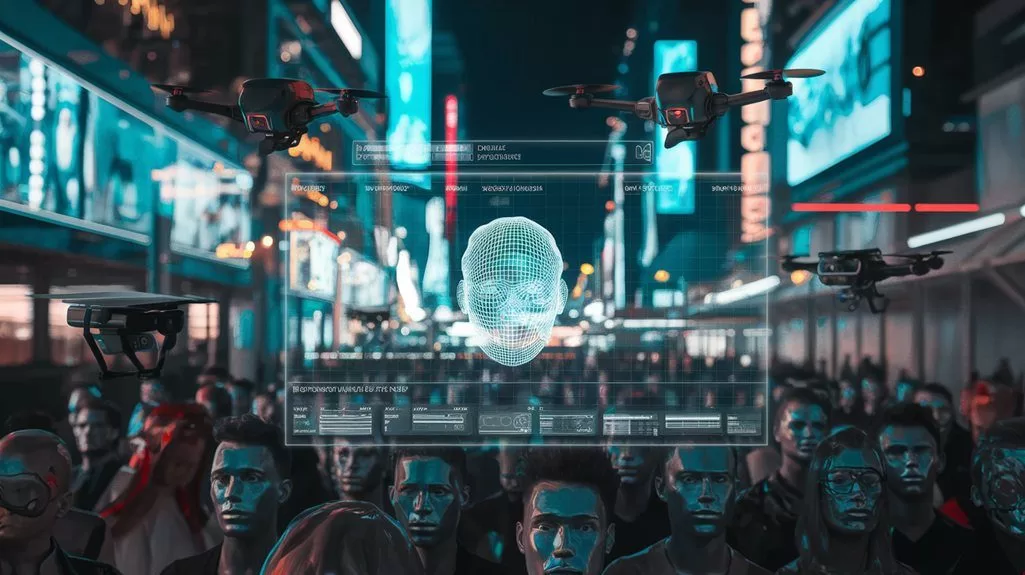
In Georgia, AI policing tools like ShotSpotter and Flock Safety Cameras dropped Macon's homicide rates. Applauded for enhancing safety, but is it Big Brother's dream? Almost Orwellian, some say. Youth homicides? Down, with AI predicting crime hotspots. Yet, constant surveillance feels eerie—a "panopticon" of observation. Privacy? Practically gone, some argue. Bias in facial recognition? A real issue. Balancing tech with ethics remains tricky. Intrigued by the implications? Explore this complex narrative.
Key Takeaways
- AI tools in Georgia are credited with reducing homicide rates, notably a 44% decrease in Macon-Bibb County.
- Ethical concerns include potential privacy erosion and racial bias in AI-driven facial recognition systems.
- Public safety initiatives complement AI, integrating mental health support and education to enhance community well-being.
- Algorithm-based crime predictions guide strategic camera placements, but effectiveness depends on unbiased data inputs.
- Oversight and regulation are essential to balance AI policing benefits with privacy and ethical responsibilities.

Could it be that AI policing is the magic bullet behind Georgia's plummeting homicide rates, or is it just the latest Orwellian nightmare? In the heart of Georgia, innovative AI policing tools have sparked both praise and concern. In Macon-Bibb County, a 44% drop in homicides from 2022 to 2023 has been attributed to AI interventions. The use of ShotSpotter, Flock Safety Cameras, and Verkada Cameras is hailed as a leap forward in crime prevention.
Yet, the ethical quagmire of AI Ethics and Surveillance Accountability looms large. ShotSpotter, an AI marvel, detects gunfire, helping locate shell casings like a high-tech bloodhound. Flock Safety Cameras take on a role akin to a digital detective, tracking suspects' license plates and alerting authorities. These tools, part of an AI-driven crime prevention arsenal, have indeed bolstered Community Safety.
The ethical quagmire of AI-policing raises concerns about privacy and constant surveillance despite enhanced community safety.
But at what cost? Their deployment raises eyebrows about constant surveillance and privacy erosion. Are these tools ensuring safety or creating a panopticon of digital eyes? In Macon-Bibb County, the dramatic drop in youth homicides—from 15 in 2022 to just 2 in 2024—paints a hopeful picture. Macon ranked as the sixth best U.S. city for reducing gun violence in 2023, showcasing the potential impact of these AI tools.
Yet, the specter of AI-driven bias still looms. Facial recognition, for instance, is under scrutiny for potential racial bias. It's akin to a double-edged sword, offering both crime-solving prowess and the risk of false arrests. AI Ethics demand rigorous oversight to balance the scales of justice and maintain public trust.
Algorithm-based Crime Prediction is another tool in the AI toolkit. By predicting crime locations based on historical data, it guides strategic camera placements. But remember, AI outputs can only be as unbiased as their input data. Garbage in, garbage out. The need for Surveillance Accountability is undeniable. Without it, AI tools may perpetuate existing biases, undermining their crime prevention potential. The Georgia Tech and Warner Robins collaboration is a prime example of using AI to predict and adapt to shifting crime patterns.
Public Safety Initiatives in Georgia include programs like Macon Violence Prevention, which integrates mental health support with education. These initiatives complement AI efforts, suggesting a multifaceted approach to reducing crime. Facial recognition technology has the potential to enhance public safety by accurately identifying individuals and detecting suspicious behavior. But the question remains: Are we relying too heavily on technology at the expense of human intervention?
AI has undeniably increased murder and violent crime solution rates in places like Miami. Yet, the debate over privacy, regulatory needs, and the role of AI in policing persists. As Georgia explores AI integration into public safety, the challenge lies in ensuring these tools support, not replace, human decision-making. The balance between technological innovation and ethical responsibility remains as precarious as ever.
References
- https://www.govtech.com/public-safety/how-ai-policing-helped-reduce-homicides-in-macon-ga
- https://news.gatech.edu/news/2023/12/11/finding-better-way-use-cameras-reduce-crime
- https://hypegig.com/ai-blog-post/
- https://www.route-fifty.com/emerging-tech/2024/01/ai-helping-police-solve-more-crimes-some-are-still-worried/393670/
- https://thecurrentga.org/2024/11/15/a-new-take-on-robocop-georgia-lawmakers-look-into-ways-ai-can-improve-public-safety/