

To utilize advanced AI-driven security drones, I integrate AI algorithms that analyze video feeds in real-time for object detection and situational awareness. This enhances surveillance capabilities by directing real-time threat detection and alerts for swift responses. Autonomous navigation guarantees continuous monitoring, adapting to dynamic environments and guaranteeing perimeter security. Swarm intelligence allows drones to cover larger areas while data analysis enables predictive maintenance, reducing downtime. However, implementing these upgrades requires addressing challenges like ethical surveillance and data privacy concerns.
Key Takeaways
- Utilize AI-driven drones for enhanced surveillance, real-time threat detection, and continuous monitoring of sensitive areas.
- Implement smart navigation by leveraging AI algorithms to adapt to environmental changes and avoid obstacles dynamically.
- Combine predictive analytics and machine learning to proactively prevent security risks and boost incident response capabilities.
- Integrate AI with drone technology to enable autonomous decision-making, reducing the need for human intervention and improving overall safety.
- Ensure ethical deployment and address data privacy concerns by adhering to legal and regulatory frameworks and developing unbiased AI algorithms.
AI Integration for Surveillance
AI Integration for Surveillance
By integrating AI into security drones, I can vastly enhance the surveillance capability by detecting potential security threats in real-time, allowing for proactive and autonomous surveillance.
Advanced AI algorithms analyze video feeds from drone cameras to identify and track objects of interest, providing enhanced object detection and situational awareness. This integration enables real-time threat detection and automatic alerts, allowing for swift and effective responses to security breaches.
Through AI-driven video analytics, security drones can continuously monitor sensitive areas and provide actionable insights for better threat assessment.
AI-powered drones can detect and track unauthorized drones, people, or objects in restricted airspace, ensuring the safety of critical infrastructure and public events.
AI integration in security drones is pivotal for enhancing perimeter security, preventing unauthorized access, and ensuring public safety. By leveraging these capabilities, I can greatly improve incident response and proactive security measures.
Real-Time Threat Detection Techniques
Implementing real-time threat detection methods into advanced AI-powered security drones greatly boosts their ability to swiftly identify and respond to potential security risks. By using AI algorithms to analyze video feeds in real-time, these drones can spot anomalies and alert security personnel immediately, ensuring prompt response to security incidents.
This real-time feature significantly boosts situational awareness, allowing for quick and decisive action in response to detected threats.
Utilizing predictive analytics and machine learning, security drones can proactively identify and prevent security risks. This incorporation of AI in security drones allows for continuous monitoring and immediate action in response to detected threats, ensuring strong security measures.
The real-time threat detection methods used in these drones greatly enhance their effectiveness in safeguarding assets and facilities.
These advanced drones are designed to provide thorough surveillance solutions, ensuring that security personnel are informed and prepared to respond to potential security breaches. By combining real-time threat detection with predictive analytics, AI-powered security drones offer unparalleled security and monitoring capabilities.
Autonomous Navigation and Control
As security risks are rapidly detected and addressed in real-time, the advanced capabilities of AI-driven drones shift towards autonomous navigation and control to safeguard vast areas continuously. These drones leverage advanced algorithms to navigate independently, guaranteeing efficient and accurate decision-making.
With the ability to analyze real-time data, they adjust their flight paths dynamically, avoiding obstacles and tracking targets with precision. This autonomous navigation allows them to cover extensive areas effectively, maintaining continuous surveillance.
Incorporating sophisticated AI technology enhances control capabilities, facilitating swift and precise responses to potential threats. By intelligently processing data, these drones can make informed decisions swiftly, optimizing operational efficiency.
Moreover, their capacity to operate consistently without human intervention reduces the risk of fatigue and maintains 24/7 monitoring. With AI-driven security drones, ensuring the safety of expansive areas becomes more manageable and reliable.
Swarm Intelligence in Drones
In utilizing advanced AI-driven security drones, we must leverage the powerful capabilities of swarm intelligence to enhance surveillance and response times.
Continuous collaboration and distributed coordination of drones through swarm intelligence greatly boost surveillance capabilities. This decentralized approach allows multiple drones to work together seamlessly, distributing tasks and communicating effectively to achieve common goals.
This collaborative strategy also enables the drones to adapt to dynamic environments, ensuring they can respond swiftly to changing situations.
Here are some key benefits of swarm intelligence in drones:
- Enhances surveillance capabilities by covering larger areas
- Improves response times through efficient task distribution
- Allows drones to adapt to dynamic environments and respond swiftly to changing situations
- Enables effective communication among drones for smooth coordination
Data Analysis for Predictive Maintenance
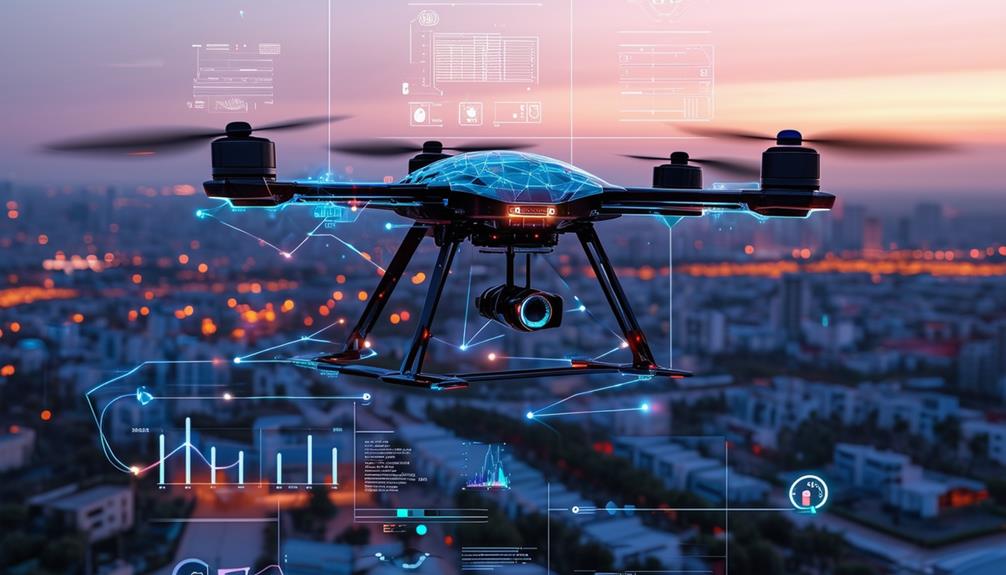
When operational continuity is crucial, AI-driven security drones can greatly benefit from data analysis that enables predictive maintenance to prevent costly downtime and guarantee consistent performance. By leveraging advanced AI-driven algorithms, security drones can proactively identify maintenance needs, and schedule timely repairs to avoid operational disruptions. This approach involves real-time monitoring of critical performance metrics to detect anomalies and issues before they escalate into more substantial problems.
Predictive maintenance through data analysis in security drones leads to numerous benefits. It ensures increased operational efficiency by reducing downtime and the need for urgent repairs. Maintenance costs are also notably reduced as issues are addressed before they become major problems. Consequently, improved security capabilities are guaranteed, as the drones remain operational and effective in their surveillance and monitoring duties.
Ultimately, integrating data analysis for predictive maintenance into AI-driven security drones is an important aspect of ensuring seamless, continuous operations. By staying ahead of potential issues, these drones can maintain peak performance, protecting people and assets with utmost reliability.
Enhanced Autonomy and Situational Awareness
As I explore the capabilities of AI-driven security drones, I'm struck by their ability to greatly enhance autonomy and situational awareness.
These advanced drones leverage AI algorithms for real-time data analysis and smart path planning to optimize their operations and avoid obstacles.
With these autonomous surveillance drones, we can achieve improved object detection and environmental monitoring.
Autonomous Surveillance Drones
Autonomous surveillance drones unveil unmatched levels of independence and situational awareness by leveraging the power of advanced AI algorithms to operate autonomously without human intervention. This integration guarantees seamless and continuous monitoring of vast areas, greatly enhancing security measures by providing rapid threat response and efficient surveillance operations.
Enhanced Independence: AI-driven surveillance drones can process real-time data to detect and respond to security threats effectively, ensuring self-sufficient operation without human fatigue or error.
Improved Anomaly Detection: These drones utilize advanced algorithms to identify anomalies, track objects, and adapt to changing environments, ensuring more precise threat assessment and response.
Real-Time Threat Response: Autonomous surveillance drones can rapidly react to threats, providing critical real-time video feeds to security personnel, allowing for swift and informed decision-making.
Scalable Efficiency: By deploying these drones, security teams can cover extensive areas efficiently, reducing the need for manual patrols and ensuring thorough security coverage.
Improved Environmental Monitoring
Autonomy and Situational Awareness in Environmental Monitoring
By leveraging advanced AI algorithms, modern security drones greatly enhance environmental monitoring through independent data collection and real-time analysis. This advanced self-governance guarantees consistent and precise data gathering, which provides a crucial foundation for enhanced awareness of the situation. In shifting environmental conditions, AI-driven security drones can swiftly adjust their navigation and data processing to provide more detailed and responsive insights.
| Enhanced Self-Governance | Real-Time Insights | Adaptive Navigation |
|---|---|---|
| Automated data collection | Real-time processing | Complex environment adaptation |
| Uniform data quality | Situational awareness | Environmental factor adaptation |
| Reduced human error | Timely threat response | Efficient data collection |
| Improved data inclusiveness | Increased efficiency | Enhanced adaptability |
These advanced features deliver thorough and accurate environmental monitoring, making it easier for decision-makers to analyze and act upon time-critical data. AI-driven security drones thereby provide a powerful tool for ensuring timely responses to changing conditions, ultimately safeguarding our environment.
Enhanced Object Detection
To significantly boost surveillance efficiency and incident response times, advanced AI-driven security drones come equipped with sophisticated object detection capabilities that allow for improved autonomy and situational awareness.
These advanced object detection features empower security drones to accurately identify and track objects in real-time, notably enhancing their ability to detect potential threats. AI algorithms enable these drones to differentiate between normal and abnormal objects or activities, leading to more informed decision-making. This integration of AI technology leads to more precise and reliable object detection, resulting in quicker response times to security incidents and improved overall surveillance efficiency.
- Enhanced Autonomy: AI algorithms enable security drones to operate independently, detecting and responding to threats without constant human oversight.
- Improved Situational Awareness: Advanced object detection capabilities provide security drones with detailed data of their surroundings, enabling informed decisions.
- Real-Time Tracking: AI-driven security drones can track targets in real-time, ensuring timely responses to potential threats.
- Efficient Surveillance: Enhanced object detection enables security drones to provide more precise and reliable surveillance, reducing the risk of human error.
Implementation Challenges and Solutions
As I explore the implementation of advanced AI-driven security drones, I face a multitude of challenges. Effective regulation of drone use is essential to guarantee safety and privacy given the powerful capabilities of AI in surveillance.
Incorporating robust cybersecurity measures and addressing technical issues also present significant obstacles that require careful consideration to unleash the full potential of AI-driven security drones.
1 Regulating Drone Use
Regulation of drone use poses significant implementation challenges, particularly in addressing privacy concerns, ensuring safety standards, and maintaining compliance with evolving regulations. The integration of AI algorithms is key to overcoming these hurdles.
To effectively regulate drone use, we must:
- Implement AI-driven compliance monitoring to stay updated on changing regulatory requirements.
- Enhance safety standards using AI to simulate various scenarios and anticipate potential risks.
- Optimize energy efficiency through AI-driven route optimization and power management.
- Ensure ethical and responsible deployment by leveraging machine learning strategies to anticipate and navigate regulatory hurdles.
2 Cybersecurity Measures
Securing AI-driven security drones requires robust cybersecurity measures to protect sensitive data and communication channels from cyber threats. As these advanced drones continue to play an important role in modern security applications, it's essential to address the implementation challenges associated with their cybersecurity.
Implementing cybersecurity measures for AI-driven security drones involves safeguarding against potential cyber threats and ensuring data protection. Challenges in cybersecurity implementation for these drones include securing communication channels, protecting sensitive data, and preventing unauthorized access.
Solutions for these challenges involve encryption protocols, secure communication channels, regular software updates, and intrusion detection systems.
Cyber attacks on security drones can compromise data integrity, disrupt operations, and pose serious security risks to facilities and assets. Effective cybersecurity measures are essential to maintain the integrity, confidentiality, and availability of data collected and processed by AI-driven security drones.
3 Navigating Technical Issues
In managing the complex implementation of AI in security drones, several technical issues must be addressed to guarantee seamless integration and efficient performance. One major hurdle is regulatory compliance, as adhering to strict rules and regulations can be a significant challenge.
Additionally, ensuring the safety of both drone operations and the surrounding environment is crucial. To overcome these technical issues, AI algorithms can be leveraged to simulate scenarios that enhance compliance and mitigate potential risks. These algorithms can also devise strategies to optimize routes and settings, resulting in increased energy efficiency and prolonged operational times.
Furthermore, AI efficiently processes vast amounts of real-time data, extracting valuable insights that inform decision-making and enhance threat detection.
- Regulatory Compliance: Simulate scenarios to ensure compliance with regulations.
- Enhancing Safety: Leverage AI algorithms to predict and mitigate safety risks.
- Energy Efficiency: Optimize routes and settings for prolonged operational times.
- Real-time Data Processing: Utilize AI to extract insights from vast datasets for effective decision-making.
Regulatory Compliance for AI Drones
To guarantee seamless AI drone integration, I must diligently familiarize myself with and adapt to the ever-changing regulatory landscape governing drone operations. Regulatory compliance for AI drones is essential to guarantee adherence to laws and standards set by aviation authorities. This includes obtaining necessary permits, licenses, and certifications for drone operations. Compliance also extends to aspects such as flight restrictions, safety protocols, and data privacy requirements.
The Federal Aviation Administration (FAA) regulates drone use in the United States, and compliance involves adhering to the agency's Part 107 rules for commercial drone operations. For public safety uses, agencies like the Pearland Police Department have received authorization for beyond visual line-of-sight (BVLOS) flights. Ensuring accountability and transparency in AI drone deployment is also crucial for public trust.
Public safety agencies must balance the benefits of drones with privacy concerns by implementing strict data management protocols and protecting sensitive information. Examples of this include Illinois's Drones as First Responders Act, which limits facial recognition and data retention.
Staying compliant with evolving regulations is essential to avoid fines, penalties, or legal actions.
Privacy and Security Concerns
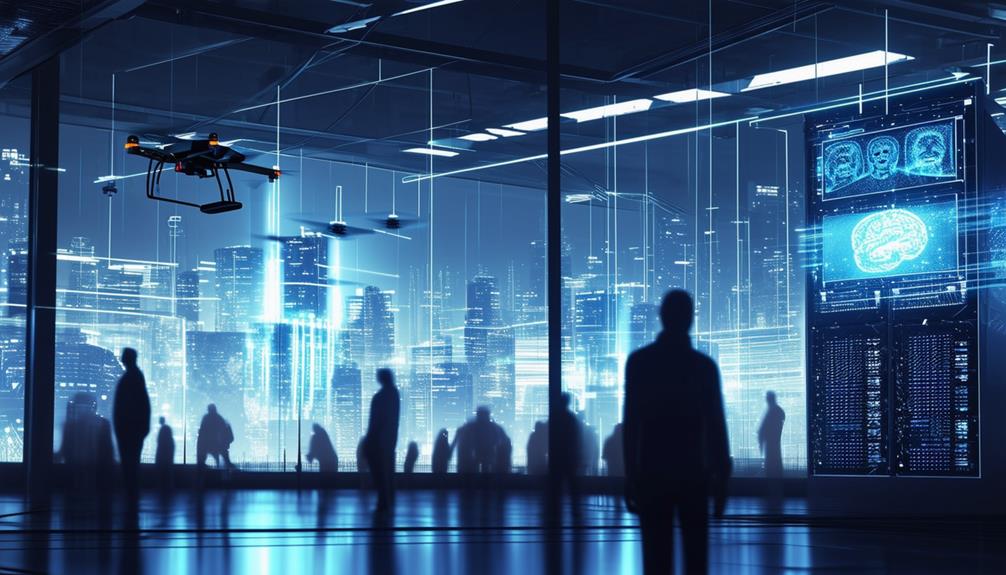
As I explore the increasingly sophisticated world of AI-driven security drones, concerns about data privacy risks, cybersecurity threats, and biased surveillance become more urgent than ever.
I must now confront the dark side of these advanced tools, grudgingly acknowledging the potential dangers that lurk within their capabilities.
Examining these criticisms is essential to guarantee that the benefits of AI-driven security drones don't come at the expense of our personal privacy and safety.
Data Privacy Risks
Security drones powered by AI technology amplify privacy risks due to the constant surveillance and data collection capabilities they provide, which can potentially intrude on individual privacy rights. This influx of sensitive data collection brings significant data security risks, exposing it to cyber attacks that could compromise the integrity of the information gathered.
Additionally, ethical dilemmas arise regarding the use of AI in drones, highlighting conflicts between individual privacy and security needs.
- Privacy Invasion: AI-driven drones could lead to constant monitoring, blurring the boundaries of private spaces.
- Data Security Risks: Collected data can be vulnerable to cyber attacks, compromising sensitive information.
- Ethical Dilemmas: The use of AI in drones must balance individual rights with security requirements.
- Legal and Regulatory Frameworks: Ensuring accountability and transparency is essential to mitigating privacy and security concerns.
Elevating privacy and security measures in AI-driven security drones is paramount. This can't be achieved without thorough legal and regulatory frameworks that prioritize accountability and transparency while addressing ethical dilemmas and data security risks.
Cybersecurity Threats
Drones equipped with AI technology amplify cybersecurity threats, creating vulnerabilities in communication systems that potentially expose sensitive data to hacking and interception, thereby necessitating robust privacy measures and the implementation of advanced encryption protocols.
As AI-driven security drones increasingly become integral to surveillance operations, concerns about privacy and security take center stage. Importantly, cybersecurity threats in these drones include the risk of data breaches, unauthorized access, and manipulation of sensitive information.
Privacy concerns arise from drones collecting and storing personal data during surveillance operations, which, if compromised, could lead to severe consequences. Key measures to mitigate these threats include implementing strong authentication mechanisms and conducting regular security audits to ensure that vulnerabilities are identified and addressed proactively.
Additionally, encryption and secure protocols are essential to safeguard data transmission and prevent cyber attacks on AI-powered security drones. By focusing on these measures, we can guarantee that AI-driven security drones operate safely and responsibly to maintain the trust of those they're intended to protect.
Biased Surveillance
In the midst of enhanced surveillance capabilities, I grapple with the unsettling reality that AI-driven security drones risk perpetuating biased surveillance, thereby exacerbating privacy and security concerns.
This biased surveillance can emerge from the inherently biased training data used in these AI systems, which can lead to privacy violations and discrimination against specific individuals or groups.
Biased algorithms can result in discriminatory actions, marginalizing certain sectors of society.
Unauthorized surveillance by AI-driven drones can collect, analyze, and store sensitive personal data without consent, heightening privacy risks.
Misuse of AI in drones can lead to wider unauthorized surveillance, further eroding privacy and security.
The perpetuation of biased surveillance demands that we address these ethical concerns, prioritize transparency in data usage, and work towards developing unbiased algorithms to promote fair and secure application of AI-driven security drones.
Edge AI for Real-Time Processing
Edge AI powers real-time data processing within security drones by bringing computation closer to remote sensors, efficiently leveraging local device capabilities to enhance monitoring and response.
This approach enables drones to analyze and interpret live video feeds on the device itself, reducing latency and improving response times.
With edge AI, drones can make critical decisions autonomously without relying on continuous connectivity to a central server, ensuring continuous surveillance capabilities even in areas with poor network coverage.
Frequently Asked Questions
How Do You Use AI in Drones?
I integrate AI algorithms into my drones for surveillance, enabling real-time threat detection, autonomous flights, and intruder identification. The drones' advanced capabilities improve safety and efficiency while enhancing situational awareness.
How Can Drones Be Used for Security Services?
As a security expert, I utilize drones for surveillance monitoring, enhancing perimeter protection, and detecting intruders. They swiftly respond to emergencies, manage crowds, track assets, and guarantee access control, all while providing remote monitoring and investigating incidents effectively.
What Is the Use of AI Driven Drones in Transport Sector?
In the transport sector, I leverage AI-driven drones to enhance safety, efficiency, and security. Deploying AI algorithms for real-time traffic monitoring and smart decision-making, I enable efficient perimeter surveillance, cargo tracking, incident response, safety inspections, and swift emergency response.
What Is the Intelligent Drone Solution for the Security Industry?
I use AI-driven surveillance drones for autonomous patrols, detecting intruders, and monitoring perimeters. Real-time alerts notify me of threats, aided by facial recognition and night vision. Efficient threat assessment and emergency response guarantee secure operations.