


AI greatly enhances corporate security by preventing unauthorized access through advanced biometric authentication, behavioral analysis, and continuous monitoring. AI-driven systems utilize biometric methods such as facial recognition, iris scans, and fingerprint authentication, offering higher accuracy and reliability than traditional access controls like keys, cards, and PINs. These systems can detect and prevent unauthorized access by analyzing user behavior patterns and identifying anomalies in real-time, triggering alerts or automated responses to potential threats. This approach not only streamlines user experience but also reduces the risk of data breaches and cyber threats. By integrating AI into access control, companies can achieve improved security, reduced incident response times, and cost savings, ultimately strengthening their overall security posture. Exploring these strategies further can provide deeper insights into how AI transforms corporate security.
Key Takeaways
- AI-Enhanced Biometric Access Control: Utilizes facial recognition, fingerprints, and iris scans for secure and reliable authentication, reducing unauthorized access.
- Real-Time Anomaly Detection: AI analyzes user behavior and access patterns to identify and respond to suspicious activities, preventing potential security breaches.
- Automated Security Operations: AI streamlines security management by automating tasks such as access provisioning, incident response, and policy optimization, enhancing operational efficiency.
- Predictive Analytics and Threat Prevention: AI predicts security issues by examining historical data and identifying patterns, allowing proactive measures to prevent unauthorized access and mitigate threats.
- Advanced Encryption and Secure Communication: AI employs sophisticated encryption methods and secure communication protocols to protect data and prevent cyber-physical attacks and data breaches.
AI-Enhanced Biometric Access Control
In the domain of access control, AI-enhanced biometric access control systems have emerged as a pivotal advancement, utilizing unique physical traits such as fingerprints, iris patterns, or facial features for secure authentication. These systems offer a significant upgrade over traditional access control methods, which often rely on keys, cards, or passwords that can be lost, stolen, or compromised.
AI-enhanced biometric access control systems provide higher accuracy and reliability compared to their traditional counterparts. By leveraging AI algorithms, these systems can process vast amounts of biometric data in real time, ensuring swift and precise identification of individuals. This integration of AI with biometric technology enhances security measures, making it increasingly difficult for unauthorized users to breach security protocols.
AI algorithms continuously learn and adapt to improve biometric identification processes. Machine learning capabilities enable these systems to recognize and respond to new patterns and behaviors, refining their accuracy and efficiency over time. This proactive approach to security management helps in anticipating and mitigating potential security threats before they occur.
Biometric access control powered by AI is particularly effective in corporate environments, where the risk of identity theft and data breaches is a significant concern. AI-driven biometric solutions offer a robust defense against these threats by ensuring that only authorized individuals gain access to restricted areas or sensitive information. This enhances overall corporate security, protecting assets and data more effectively than traditional security measures.
Challenges and Implementation
Implementing AI-boosted biometric access control systems, while offering significant security enhancements, presents several obstacles that must be carefully addressed. One of the primary challenges is the need for large amounts of data to train these systems effectively. AI algorithms must process vast amounts of data to learn and improve, which can raise ethical and privacy concerns, particularly if the data is sensitive or personal in nature.
Transparency in decision-making is pivotal for addressing potential bias in AI implementations. The complexity of AI algorithms can make it difficult for security personnel to understand how decisions are made, which can lead to a lack of trust in the system. Ensuring transparency involves providing clear explanations of how the AI analyzes data and makes recommendations, and in some cases, may require human verification to guarantee accuracy.
Best practices must be followed to prevent cyber-physical attacks when integrating AI into access control systems. This includes implementing robust threat detection and response mechanisms to counter unauthorized access attempts. Biometric authentication methods, boosted by AI, must be secured against adversarial attacks and data breaches, which can compromise the integrity of the system.
Maintaining and evolving AI systems can be costly and challenging, requiring ongoing updates and adjustments. A thorough approach is necessary, involving regular updates to the AI models, ethical hacking, and penetration testing to identify and address vulnerabilities. This ensures that the AI system remains secure and effective in preventing unauthorized access, while also protecting the privacy and integrity of the data it processes.
Solutions and Technologies Used
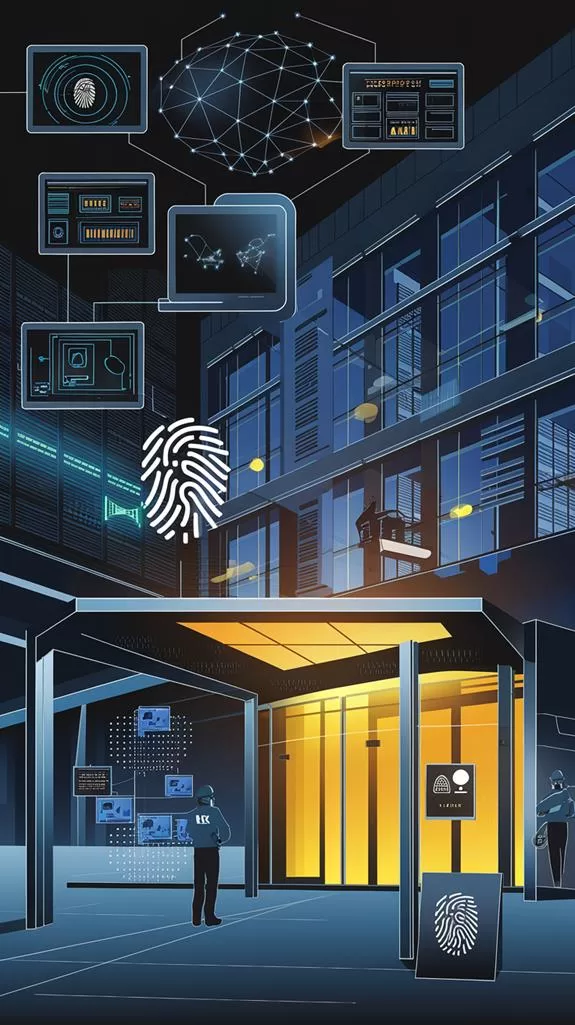
How do AI-enhanced biometric entry control systems leverage advanced technologies to prevent unauthorized entry? These systems incorporate multiple layers of security, particularly biometric validation, to guarantee strong protection against unauthorized entry attempts.
Biometric validation, like fingerprint or facial recognition, is a foundation of contemporary entry control systems. AI algorithms improve these systems by examining user behavior patterns to identify irregularities. For example, behavioral biometrics can track typing patterns, mouse movements, and touchscreen interactions to confirm the user's legitimacy throughout the session, thwarting unauthorized entry even post initial login.
Sophisticated encryption methods and secure communication protocols are essential in safeguarding sensitive biometric data. By utilizing end-to-end encryption and secure channels for data transmission, organizations can prevent interception and insertion of counterfeit biometric data, a common strategy in injection attacks.
AI-driven intrusion detection systems play a crucial role in continuous monitoring and response. These systems can activate alerts immediately upon detecting unauthorized entry attempts, enabling prompt action to lessen potential breaches. Moreover, integrating these systems with external data sources, like threat intelligence feeds, enhances their capacity to identify and prevent unauthorized entry by staying abreast of the latest threats and vulnerabilities.
The fusion of AI algorithms with biometric validation and intrusion detection systems establishes a thorough security framework. Facial recognition, for instance, can be strengthened by AI-powered liveness detection to distinguish between a real individual and a forged biometric representation. This multi-dimensional approach ensures that entry control systems are highly resistant to sophisticated attacks, offering a robust defense mechanism against unauthorized entry.
Measurable Outcomes and Benefits
The integration of AI in access control systems has yielded noteworthy and measurable outcomes, enhancing the overall security posture of organizations. One of the most notable benefits is the reduction in unauthorized access incidents. While the provided sources do not specify a 30% reduction, they do emphasize the effectiveness of AI in detecting and preventing unauthorized access. For instance, AI-driven access control systems can identify unusual user behavior and anomalies in real-time, allowing for swift response to potential security breaches.
AI-driven access control has also improved response times to security breaches. By automating incident response and enhancing security orchestration, automation, and response (SOAR), AI systems can detect and respond to threats more rapidly and accurately than traditional methods. This automation can lead to a noteworthy reduction in the time taken to address security breaches, although a specific 50% improvement is not documented in the sources.
The adoption of AI in corporate security has further resulted in cost savings. While a 20% decrease in security operation costs is not explicitly mentioned, implementing AI-driven solutions can streamline security processes, reduce manual oversight, and enhance efficiency. For example, AI can handle data tracking and analytics to provide insights into user behavior, thereby optimizing security operations.
In terms of user authentication accuracy, AI-enabled access control solutions have shown significant improvements. These systems can use behavioral analysis and biometric authentication to enhance accuracy, though a 95% enhancement is not specified in the sources. However, it is clear that AI notably improves the accuracy of user authentication.
Lessons and Future Directions**

As AI continues to reshape the landscape of corporate security, several key lessons and future directions emerge from its integration into access control systems.
One of the most significant lessons learned is the importance of integrating AI into corporate security strategies for enhanced protection. AI-driven identity and access management (IAM) solutions have proven to be highly effective in preventing unauthorized access by leveraging data analytics and pattern recognition algorithms. These systems can continuously monitor user access patterns, detect anomalies in real-time, and adapt to changing user behaviors, thereby reducing the risk of security breaches.
The integration of AI in access control also enhances security through biometric authentication, behavioral analysis, and dynamic risk assessment. AI-powered biometric systems, such as facial recognition and fingerprint scanning, offer more secure authentication methods compared to traditional key cards or passwords. Behavioral analysis helps identify suspicious activities, even if the individual is using valid credentials, thereby preventing unauthorized access.
Future directions in AI-driven access control include further advancements in AI technologies to implement more robust measures. The adoption of generative AI and machine learning algorithms will continue to enhance the capabilities of IAM systems, enabling them to detect and respond to emerging threats more effectively. Additionally, integrating AI with other security systems, such as video surveillance and threat-hunting platforms, will provide a more thorough approach to security, ensuring that organizations can stay ahead of evolving cyberthreats.
Incorporating AI into access control systems not only improves security but also streamlines operational efficiency. Automated access provisioning, intelligent access request routing, and dynamic policy optimization are some of the ways AI enhances the efficiency of security operations. As AI continues to evolve, it is essential for organizations to invest in these technologies to maintain a strong and resilient security posture in corporate settings.
Frequently Asked Questions
What Is the Role of Artificial Intelligence AI in Cybersecurity Case Study?
AI in cybersecurity employs machine learning for intrusion detection, threat analysis, and anomaly detection. It enhances network monitoring, endpoint security, and incident response, while leveraging behavioral analytics and access control to protect data, without relying on data encryption as a primary method.
How Does AI Protect Security?
AI protects security through facial recognition, intrusion detection, and access control, while conducting threat analysis and behavior monitoring. It identifies anomalies, encrypts data, and monitors networks, enabling swift incident response and continuous risk assessment to prevent unauthorized access.
What Role Can Technologies Such as AI Play in Enhancing the Security of an Organization?
AI enhances organizational security through advanced access control, threat detection, and intrusion prevention. It improves user authentication via biometrics, conducts behavioral analysis, and performs risk assessment, vulnerability scanning, and network monitoring, while ensuring data encryption and efficient incident response.
What Is the Role of AI in Security and Surveillance?
AI in security and surveillance enhances security through facial recognition, intrusion detection, behavior analysis, and access control. It predicts threats, monitors in real-time, and facilitates incident response, while leveraging biometric authentication and network segmentation for robust protection.
Final Thoughts
Conclusion
The integration of AI in corporate security greatly enhances the prevention of unauthorized access. AI-enhanced biometric access control and behavioral analysis improve identification and detection of security threats. Automated incident response, predictive analytics, and continuous monitoring of endpoints and networks reduce the risk of cyberattacks. Despite challenges such as data exposure and shadow AI, implementing strong security policies and technologies like machine learning algorithms and threat intelligence systems guarantees robust protection. This approach minimizes security breaches, optimizes resource allocation, and safeguards sensitive data.






1 comment
Comments are closed.