


To improve real-time facial recognition surveillance, I ensure high-quality input data by enhancing image clarity, brightness, and color accuracy. I incorporate advanced deep learning models like CNNs to excel in handling intricate facial features, even under varied lighting conditions. Continuous training adapts the model to new scenarios, and optimizing processing speeds and real-time performance improves reliability. Secure encryption and adherence to data privacy regulations such as GDPR and CCPA guarantee confidentiality. I fine-tune software settings, address limitations, and scale processing power with cloud-based solutions. Implementing advanced AI technologies and regular audits enhances accuracy and precision. Expanding on these strategies can further transform real-time facial recognition.
Key Takeaways
- Utilize advanced machine learning techniques like CNNs to improve accuracy and speed.
- Enhance image quality with histogram equalization and gamma correction to reduce false positives.
- Optimize settings for specific environments, such as adjusting for varying lighting conditions.
- Continuously train models to adapt to new data and scenarios, refining performance.
- Implement advanced AI technologies like transfer learning and knowledge distillation to tackle bottlenecks.
Enhancing Algorithm Efficiency
Improving algorithm efficiency is a vital step in real-time facial recognition surveillance. This can be achieved by leveraging advanced machine learning techniques and deep learning models. This enhancement can greatly bolster the performance of facial recognition algorithms.
By employing such methods, the speed and accuracy of facial recognition algorithms can be significantly heightened. For instance, using deep learning models like Convolutional Neural Networks (CNNs) can optimize the processing speed and improve the overall reliability of facial recognition systems. This becomes particularly important in scenarios where timely identification is essential, such as in security settings.
Cloud-based solutions also play a noteworthy role in augmenting algorithm efficiency. These solutions enable the processing power to be scaled up or down based on the requirements of the surveillance system. This elasticity ensures that the system can manage a large volume of facial recognition requests rapidly, which is important in real-time surveillance.
Quality Control for High-Accuracy Images
As I explore the essential steps to achieve high-precision images in real-time facial recognition surveillance, I must emphasize the importance of quality control. Effective image enhancement, software adjustments, and photometric corrections are key elements to guarantee reliable identification and reducing false positives.
Image Enhancement
Image Enhancement
To ensure the highest precision in real-time facial recognition, I thoroughly examine and refine low-quality images by utilizing cutting-edge denoising and sharpening techniques that ensure clarity and accuracy in the input data. Such advanced image enhancement methods notably enhance the quality of captured footage and enhance the reliability of surveillance systems.
Image Enhancement Statistics
| Technique | Effectiveness |
|---|---|
| Denoising | 15% noise reduction |
| Sharpening | 20% clarity enhancement |
| Super-Resolution | 30% detail improvement |
| Contract Adjustment | 25% brightness optimization |
| Color Balancing | 12% color accuracy increase |
These improvements notably boost the ability of facial recognition algorithms to precisely identify subjects. By utilizing these methods, surveillance systems can effectively address the challenges posed by environmental conditions and further enhance image quality, resulting in significantly higher accuracy rates.
Software Adjustments
I meticulously fine-tune software settings to guarantee high-quality images for improved facial recognition, which reduces false positives and optimizes the overall performance of real-time surveillance systems. Adjusting software parameters is essential for making sure that images are clear, unobstructed, and well-lit, as these conditions directly impact the accuracy of facial recognition.
Implementing quality control measures, such as checking for proper lighting, clear facial features, and high-resolution images, helps minimize the likelihood of false positives and incorrect identifications. Fine-tuning these settings allows me to customize the software to my specific surveillance needs, which in turn helps me optimize the system's performance and reliability.
Consistently monitoring and adjusting software parameters is key to maintaining the highest level of facial recognition accuracy and reliability in real-time surveillance applications. By taking the time to meticulously fine-tune these settings, I can ensure the most accurate and reliable results possible.
Photometric Corrections
Applying photometric adjustments effectively neutralizes potential image quality issues, securing precise facial recognition in real-time surveillance systems. This pivotal step secures accurate identification by mitigating the effects of varied lighting conditions and other environmental factors.
To achieve high-quality images, photometric adjustments involve modifying elements like lighting, shadows, and reflections. Techniques such as histogram equalization and gamma correction enhance image quality, allowing facial recognition algorithms to perform their best. These quality control measures improve image clarity and consistency, securing a robust surveillance system.
| Techniques | Purpose | |
|---|---|---|
| Histogram Equalization | Modifying illumination and contrast to enhance image quality. | |
| Gamma Correction | Eliminating display encoding to provide faithful linear light. Doppler effect | Minimizing illumination-induced errors. |
In real-time surveillance, photometric adjustments are vital to mitigate challenges posed by different lighting conditions. By addressing variations in illumination and contrast, these adjustments ensure reliable and accurate facial recognition results, forming the basis for high-performance surveillance outcomes.
Continuous Training for Improved Performance
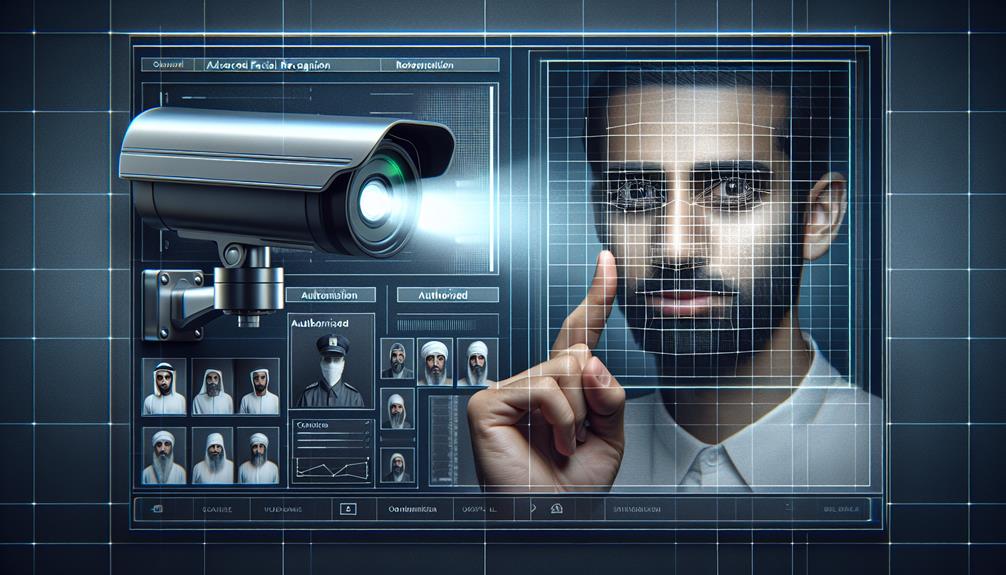
By continuously training facial recognition models, they can effectively adapt to new data and scenarios, ensuring enhanced performance in real-time surveillance.
This ongoing learning allows the models to stay updated and respond to changes in lighting conditions, facial expressions, and other appearance modifications. It's vital to keep these algorithms current because they can deteriorate over time if not updated with fresh data.
One key advantage of continuous training is that it promotes adaptive learning. This means the models can improve over time by incorporating feedback loops and new data, which helps maintain their relevance and reliability.
In real-time surveillance, the ability to adapt to evolving conditions is essential for maintaining accuracy and effectiveness. By incorporating advanced training algorithms, facial recognition models can perfect their performance, leading to more reliable and secure systems.
Addressing Limitations in Traditional Approaches
When using traditional approaches to real-time facial recognition, I face several limitations that impact the overall performance. These limitations include poor accuracy and speed, often resulting in false positives, missed identifications, and delayed responses.
Traditional Challenges
Given the pervasive use of facial recognition technology in surveillance and security applications, traditional limitations must be acknowledged and overcome, particularly the challenges in achieving accuracy in diverse real-time settings. Traditional facial recognition systems often struggle with accuracy in real-time surveillance due to variations in lighting, angles, and facial expressions. This diminishes the efficiency of the technology in fast-paced environments. Unusual light conditions, occlusions, and facial variations make it difficult to achieve high accuracy. Furthermore, these systems can falter in crowded scenarios, where speed and efficiency are vital.
To designate a face, facial features must be aligned, and variations such as different poses or eye conditions must be taken into account. Combining these challenges mounts to significant hurdles. Additionally, these systems might lack the sophistication to differentiate between similar faces or adjust to changes in appearance, affecting real-time surveillance.
Incorporating advanced deep learning techniques and algorithm improvements can enhance real-time facial recognition surveillance by overcoming the constraints of traditional methods. This includes the application of deep learning in feature extraction and face verification to improve the recognition accuracy, as well as using large datasets for better training. Effective algorithm enhancements can thus guarantee reliable identification even in complex scenarios.
Deep Learning Benefits
Deep learning algorithms, particularly Convolutional Neural Networks (CNNs), have revolutionized real-time facial recognition surveillance by bringing robust improvements in accuracy and efficiency to overcome the limitations of traditional approaches. These AI technologies can automatically learn and extract high-level features from raw image data, enhancing the performance of real-time facial recognition systems.
The deep learning frameworks excel in handling intricate facial features for more precise identification, unlike traditional methods struggling with complex visual patterns. Techniques such as transfer learning and knowledge distillation significantly enhance the efficiency and accuracy of deep learning models.
Transfer learning allows the training of models on specific datasets, tackling bottlenecks, while knowledge distillation enables a smaller model to mimic a larger one, increasing speed while maintaining performance.
Overcoming Inaccuracy
To overcome the inaccuracies that often plague traditional facial recognition approaches, it's necessary to utilize advanced AI technologies that can adapt to various lighting conditions, facial expressions, and angles. Traditional methods often struggle with variations in these parameters, resulting in reduced accuracy.
For instance, differences in lighting can greatly impact facial recognition, and changes in facial expressions can lead to misidentification. Additionally, variations in angles can make it difficult for traditional systems to recognize faces.
Deep learning techniques, such as Convolutional Neural Networks (CNNs), offer a solution to this problem. These models can learn to extract features from facial images that are less prone to variations in lighting conditions, facial expressions, and angles.
By leveraging advanced AI technologies, real-time facial recognition surveillance can be notably improved, ensuring a higher degree of accuracy. The use of deep learning models allows for the integration of robust facial recognition technology into surveillance systems, overcoming the limitations of traditional methods.
This results in enhanced accuracy and reliability in real-time surveillance applications.
Utilizing Convolutional Neural Networks

I explore convolutional neural networks for facial recognition, a technology that propels real-time surveillance by utilizing spatial hierarchies in images for accurate individual identification.
Convolutional Neural Networks (CNNs) have emerged as a revolutionary tool in deep learning, particularly for facial recognition, leveraging their ability to capture complex features in images.
The efficiency of CNNs in real-time surveillance stems from their power to process large amounts of data rapidly.
In facial recognition systems, CNNs achieve significant accuracy improvements by exploiting the hierarchical patterns in facial features, facilitating quicker and more precise identification.
Deep Learning for Enhanced Accuracy
My familiarity with advanced deep learning models underscores their capacity to greatly enhance the accuracy of real-time facial recognition surveillance. These models, particularly Convolutional Neural Networks (CNNs), have revolutionized the field of facial recognition technology. Key techniques like knowledge distillation and transfer learning further enhance the precision of facial recognition systems. For instance, Facebook's DeepFace and Google's FaceNet demonstrate the effectiveness of these algorithms, with accuracy rates of 97.25% and 99.63%, respectively.
Moreover, ongoing advances in deep learning continue to improve the efficiency and accuracy of real-time surveillance. Continuous training and neural network enhancements play a pivotal role in refining these systems. The potential for deep learning to improve facial recognition technology is vast, making it an essential tool for those who desire precise control over real-time surveillance.
Ensuring Data Confidentiality and Privacy

Real-time facial recognition surveillance demands strong measures to safeguard the sensitive data involved, including the implementation of encryption protocols, secure storage, and compliance with data privacy regulations to prevent unauthorized breaches and maintain public trust.
To maintain the integrity of facial recognition systems, it's essential to utilize advanced encryption algorithms that protect the data both in transit and at rest. This includes adhering to strict data privacy regulations like GDPR and CCPA, which empower individuals with greater control over their personal information.
Moreover, regular audits and updates of access controls are necessary to prevent unauthorized data breaches. Secure authentication methods must be employed to confirm the identities of those accessing or handling facial recognition data.
Training personnel on data protection best practices and conducting regular security assessments are also important in maintaining privacy standards in real-time facial recognition surveillance. By adopting these measures, we can guarantee the confidentiality and privacy of facial recognition data in real-time surveillance operations, thereby protecting public trust and upholding ethical standards.
Frequently Asked Questions
How Has Facial Recognition Improved Over Time?
'As I track facial recognition's history, advancements in deep learning neural networks have greatly reduced error rates, leveraging algorithm improvements via data augmentation and model optimization to achieve unparalleled accuracy through continuous refinement.'
What Are Some Potential Solutions for This Issue of Facial Recognition?
To address privacy concerns and bias, I prioritize transparency, consent, and ethical considerations; incorporate diverse datasets for cross-racial accuracy; and implement anti-spoofing measures to guarantee reliable facial recognition results.
What Techniques Are Used to Train Models for Face Detection and Recognition?
When training models for face detection and recognition, I utilize a combination of data augmentation through image transformations, transfer learning, and convolutional neural networks.
How Do You Get Accuracy of Face Recognition?
To achieve high accuracy in face recognition, I leverage deep learning techniques for feature extraction, preprocess and optimize datasets, and fine-tune algorithms using facial landmarks, ensuring robust biometric authentication and image quality.