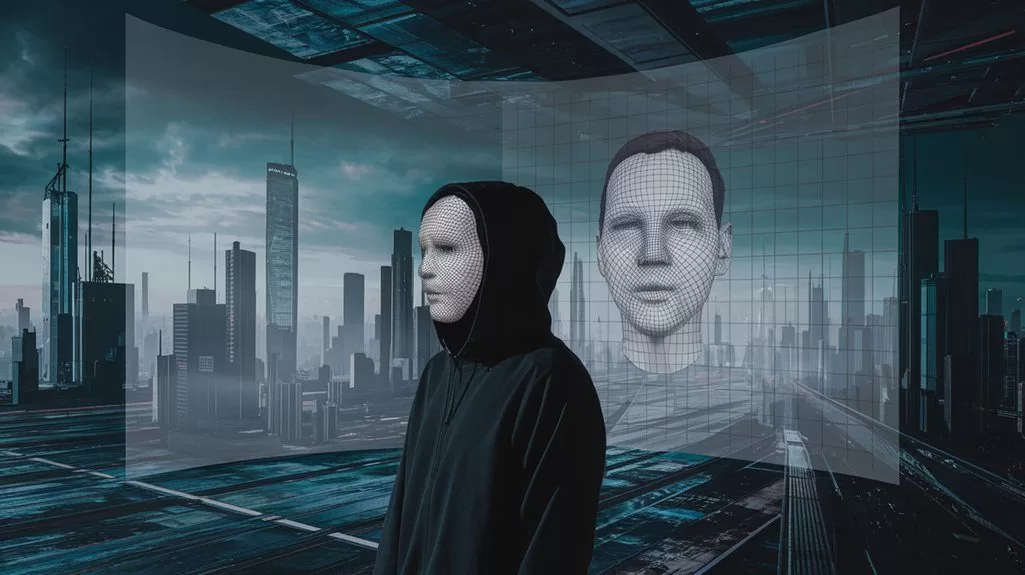


I leverage facial recognition technology to greatly enhance surveillance precision by using advanced AI techniques, high-quality datasets, and rigorous testing protocols. This guarantees error-free identifications and elevates public safety standards. New tools help detect faces with masks, provide effective image quality enhancements, and decrease error rates for accurate identification. What I find particularly thrilling is the ongoing research and testing to enhance demographic diversity and mitigate bias – an essential step towards responsible and regulated use cases. Furthermore, federal governance and clear guidelines will help protect individual privacy.
Key Takeaways
- Facial recognition technology improves accuracy by weeding out low-quality images.
- Higher precision rates exceed 99% across demographic groups.
- NIST evaluations promote accurate image quality.
- Diverse training datasets reduce bias and errors.
- Efficient recognition of faces with masks enhances accuracy.
Improving Surveillance Accuracy
Notable improvements in facial recognition technology have raised its accuracy across various demographic groups, showcasing a marked enhancement in surveillance capabilities. As a biometric identification specialist, I witness firsthand the rigorous testing and validation process these algorithms undergo. NIST evaluations assure that the technology is free from discriminatory biases and can accurately identify individuals of different races, ages, and sexes. Leading facial recognition algorithms now boast over 99% accuracy, with some surpassing 99.5%. Importantly, these outcomes aren't limited to specific groups; instead, they hold true across diverse populations.
False positive rates are also decreasing dramatically, further bolstering security and privacy. This remarkable enhancement allows for greatly improved surveillance outcomes. For instance, law enforcement can now swiftly and accurately identify suspects, ensuring swift and efficient crime resolution. Additionally, enhanced accuracy translates to better protection of privacy, as fewer false matches diminish the risk of mistaken identities.
Advancements in Facial Recognition
As a biometric identification specialist, I've witnessed major breaks in facial recognition, particularly the ability to accurately recognize faces despite variations like masks. This technology has developed considerably over the years, demonstrating notable advancement in its features.
Here are the key improvements:
- Efficient Recognition: Facial recognition algorithms now efficiently recognize faces even when people are wearing masks, which was previously a substantial challenge.
- Innovations in Image Quality: Innovations in facial recognition technology have improved accuracy with low-quality and wild images, enhancing overall performance.
- Precise Identification: Advances in facial recognition have notably decreased error rates, allowing for precise identification in high-quality visa pictures.
These advancements highlight the remarkable progress made in the field of facial recognition. The ability of the technology to handle diverse scenarios and accurately identify individuals has markedly enhanced biometric recognition, offering an improved and reliable means of identification.
Identity Verification and Security

Facial identification technology has transformed identity verification and security by providing a dependable and efficient method for confirming identities. Its impressive precision rates of over 99% overall and 97.5% across demographic groups have positioned it on par with fingerprint and iris recognition.
The top algorithms showcase an outstanding precision of over 99.5% across major demographic groups, guaranteeing strong security. In NIST evaluations, the top algorithms have exhibited precision ranging from 99.7% to 99.85%, highlighting the accuracy of facial identification technology. These remarkably high precision rates emphasize the effectiveness of the technology in identity verification and security applications.
Interestingly, even the lowest-performing subcategory and algorithm in NIST evaluations maintain high precision rates. For example, facial identification technology has been identified as less precise for white males, indicating the need for ongoing research to address such precision concerns.
To further bolster security, researchers continue to enhance this technology to ensure its usage is dependable and impartial across diverse demographic groups.
Enhanced Public Safety Measures
France technology has greatly advanced public safety measures by providing rapid and accurate identification. This technology helps law enforcement agencies make error-free decisions, ensuring informed surveillance and data-driven safety strategies.
Error-Free Decisions
When it comes to ensuring error-free decisions in facial recognition, I look for technologies that demonstrate virtually perfect accuracy. The latest top-tier algorithms deliver this level of accuracy across all demographic groups, with testing data often drawn from law enforcement records like mugshots.
To guarantee error-free decisions, the following key aspects of facial recognition technology are critical:
- Consistency Across Demographics: The accuracy of facial recognition systems must be rigorously tested and validated across diverse demographic characteristics to prevent biased outcomes.
- Algorithm Enhanced Precision: The latest facial recognition algorithms have been fine-tuned to achieve impressive accuracy levels, even in challenging scenarios.
- Regular System Updates: Regular evaluation and refinement of facial recognition technologies are essential to maintain high levels of accuracy in operational contexts.
Informed Surveillance
Implementing informed surveillance with facial recognition enhances public safety measures by enabling rapid and precise identification of individuals, fostering a proactive and efficient response to potential security threats. As a biometric identification specialist, I prioritize the accurate and unbiased use of facial recognition algorithms to guarantee that law enforcement agencies are empowered to react quickly and effectively against potential dangers.
Unreliable technology jeopardizes this objective. Inaccurate facial recognition software can result in a false match rate, which can lead to misidentification and compromised public safety. This underscores the vital importance of rigorous testing and evaluation of facial recognition technology to ensure high accuracy rates, particularly across diverse demographic groups.
Preventing inaccuracies in surveillance operations is essential for ensuring that the focus remains on legitimate security threats, rather than inequality-driven mistakes. By harnessing the power of facial recognition technology, authorities can effectively monitor and address safety concerns, further safeguarding the well-being of communities.
Data-Driven Safety
To guarantee swift and targeted public safety responses, law enforcement must integrate accurate facial recognition technology into their data-driven safety initiatives, leveraging enhanced surveillance capabilities to counter emerging security threats.
Facial recognition technology plays a pivotal role in ensuring effective public safety measures. When local law enforcement agencies utilize facial recognition technology in critical situations, they significantly enhance the responsiveness and proactiveness of their safety protocols. This technology enables them to swiftly identify individuals and pinpoint their locations, ensuring accurate data is collected and utilized efficiently. Notably, the National Institute of Standards emphasizes the importance of facial data quality and false accept rate reduction to guarantee high accuracy levels.
Key Benefits of Data-Driven Safety
- Enhanced Surveillance Efficiency: Facial recognition technology helps local law enforcement agencies to monitor and respond to emergencies more effectively.
- Accurate Identification: This technology ensures high accuracy levels, reducing wrongful arrests and enhancing trust in law enforcement.
- Protections for Marginalized Communities: Data-driven safety initiatives can be designed to minimize biases and guarantee that facial recognition data is collected and used responsibly.
Mitigating Bias Concerns

Facial recognition technologies have greatly advanced in recent years, with top-tier algorithms demonstrating high accuracy across demographic groups, disproving claims of inherent bias. As a biometric identification specialist, I can attest that thorough scientific research is essential to validating and maintaining the accuracy gains of facial recognition algorithms.
However, mitigating bias concerns is an important aspect of guaranteeing appropriate use in the criminal justice system. Misclassification rates vary across demographic categories, particularly when the training datasets aren't diverse enough.
For instance, the NIST published a report highlighting that false positive rates for Black, Asian, and Native American individuals are higher compared to white individuals in many facial recognition algorithms. This underscores the significant flaws that can arise from underrepresentation in training data.
Nevertheless, ongoing tests like the FRVT continue to push vendors to improve the accuracy and speed of their algorithms. Furthermore, research instituted protocols like the Facial Recognition Algorithm Independent Evaluation (CHEXIA-FACE) and the Face Recognition Prize Challenge (FRPC) demonstrate concerted efforts to tackle demographic bias.
It's essential to recognize that responsible use of facial recognition technology requires not only rigorous testing but also consideration of data privacy to guarantee its use doesn't exacerbate existing inequities.
Future Developments and Regulation
The ongoing evolution of facial recognition technology in the future is contingent on the relentless pursuit of precision and fairness in identity verification, necessitating carefulness in regulating its use across sectors.
As a specialist in biometric identification, I firmly believe that future developments in facial recognition technology should prioritize the following critical areas:
- Enhanced Testing and Standardization: The National Institute of Standards and Technology (NIST) must continue to lead efforts in thorough testing and evaluation of facial recognition algorithms across diverse demographic data sets to secure accuracy.
- Federal Privacy Law and Governance: Strong federal legislation and governance frameworks are necessary to prevent misuse of facial recognition technology and safeguard individual privacy.
- Transparency in Use Cases: Clear guidelines and standards for the responsible use of facial recognition technology must be established across law enforcement, border control, and other applications to lessen accuracy concerns and false non-match rates.
These measures are critical to securing the responsible and effective utilization of facial recognition technology.
Frequently Asked Questions
How to Make Face Recognition More Accurate?
To enhance facial recognition accuracy, I focus on optimizing high-quality image data, refining machine learning algorithms, improving lighting conditions, and enhancing facial features detection. By training robust models and minimizing errors, I guarantee reliable verification processes, addressing privacy concerns and enhancing overall performance.
Does Facial Recognition Increase Security?
As a biometric specialist, I believe facial recognition increases security through accurate criminal identification but acknowledges privacy concerns, false positives, and ethical implications due to algorithm bias and data storage issues.
What Is the Highest Accuracy of Face Recognition?
The highest accuracy of face recognition has reached 99.88% in recent NIST testing, thanks to advancements in deep learning and machine learning algorithms, highlighting the promise of biometric data and technology advancements, while also balancing ethical concerns and minimizing false positives.
How Accurate Are Facial Recognition Cameras?
I, as a specialist, guarantee facial recognition cameras are accurate and unbiased. With advancements in machine learning and stringent evaluations, these devices offer high levels of biometric verification while addressing data privacy and ethical concerns.