


Advanced AI drone monitoring systems greatly enhance navigation, data capture, autonomy, and analytics. These drones use sensors like LiDAR and ultrasonic, in addition to computer vision, to guarantee real-time obstacle detection, high-resolution data collection, and secure flight paths. Autonomous collision avoidance, GPS-denied navigation, and advanced sensor integration make these drones dependable in complex environments. Applications include surveillance, environmental monitoring, and drone-based delivery systems, all of which depend on AI-powered data analysis tools for improved insights.
Key Takeaways
- Advanced AI drone monitoring systems combine LiDAR and ultrasonic sensors for real-time obstacle detection.
- They use enhanced image quality and specialized sensors for accurate spatial data capture.
- AI algorithms merge data for detailed environmental understanding and ensure real-time obstacle avoidance.
- Warping obstacles detected, advanced autonomy features like GPS-denied navigation ensure safe flight paths.
- These systems can track wildlife, monitor climate conditions, and detect pollution using multispectral imaging.
Enhanced Navigation Capabilities
Advanced AI algorithms enable drones to accurately navigate even the most dynamic urban settings, thanks to improved navigation capabilities that incorporate sensors like LiDAR and ultrasonic sensors for real-time obstacle detection. These sensors offer a wealth of information about the surroundings, empowering the drone to create a detailed and constantly updated spatial awareness.
This enhanced spatial awareness is essential in urban areas, where obstacles can be varied and dynamic. It allows the drone to detect and respond to unexpected obstacles, ensuring safe operations.
Furthermore, advanced AI algorithms can merge data from various sensors to generate a detailed understanding of the environment. This fusion of sensor data enables the drone to adjust its navigation in real-time, selecting the most efficient and secure routes for tasks like mapping, surveying, and delivery.
Real-time obstacle avoidance features are crucial in this situation, as they ensure the drone can modify its flight path promptly to avoid collisions. By utilizing state-of-the-art sensors and AI algorithms, drones can navigate intricate urban environments with accuracy and confidence, guaranteeing smooth and dependable operations.
Precision in Data Capture
As I explore the potential of AI-powered drones in data capture, it's clear that their enhanced image quality and advanced sensor integration are essential for precision.
One significant factor contributing to this precision is the capture of high-resolution data.
This advanced data capture capability is particularly beneficial for detailed crop analysis and environmental monitoring.
Enhanced Image Quality
Through the integration of state-of-the-art AI and sensor technologies, drones capture data with enhanced precision, yielding high-resolution images and real-time insights that revolutionize environmental monitoring and conservation. These advanced drones are equipped with sensors and cameras that provide detailed crop analysis and environmental monitoring capabilities, precisely extracting valuable data for various applications.
Here are four key benefits of these advanced AI drone monitoring systems:
- Enhanced Data Accuracy: Specialized sensors like thermal and multi-spectral imaging enhance data precision and enable detection of heat leaks and pollution levels.
- Real-Time Insights: Real-time image processing on drones provides immediate data for applications like wildlife monitoring and climate studies.
- High-Resolution Imaging: High-resolution images and videos enable precise data collection for informed decision-making.
- Environmental Conservation: Enhanced image quality and data accuracy support effective environmental monitoring and conservation efforts.
Advanced Sensor Integration
The precision in data capture achieved by these advanced monitoring systems relies heavily on the integration of specialized sensors and high-resolution cameras that enable drones to collect detailed spatial data accurately.
Advanced sensors like LiDAR and thermal cameras elevate environmental monitoring and analysis capabilities, providing high-quality data for various applications. Through real-time processing, AI algorithms assure that images and data are analyzed promptly and precisely, facilitating detailed information collection.
Multi-spectral imaging is another key feature of these advanced sensors, allowing drones to detect subtle environmental changes and monitor wildlife patterns effectively. By combining these sensor capabilities with AI algorithms, the drones can process and analyze the data in real-time, empowering users to make informed decisions rapidly.
The integration of advanced sensors and AI algorithms creates a robust data capture framework, enhancing the overall efficiency and accuracy of surveillance, surveying, and environmental monitoring operations.
High-Resolution Data Capture
High-resolution data capture is achieved through the advanced AI drone monitoring systems that leverage specialized sensors and high-resolution cameras to accurately collect detailed spatial data. These systems process images in real-time to extract valuable information for applications like crop analysis and environmental monitoring. Here's how I achieve this precision:
- Multispectral Imaging: By capturing light across several particular wavelengths, these systems offer a thorough view of environmental and plant conditions.
- Thermal Imaging: Specialized thermal sensors detect temperature differences, ensuring systems operate efficiently and detecting potential issues early.
- High-Resolution Cameras: With the ability to capture detailed images, these cameras enhance crop health monitoring and yield optimization.
- Integrated AI Algorithms: These specialized algorithms enable precise flight path following, efficient data collection, and autonomous planning.
These advanced AI drone monitoring systems are designed to meet the demands of various industries, ensuring that the collected data is accurate and actionable.
Advanced Autonomy Features
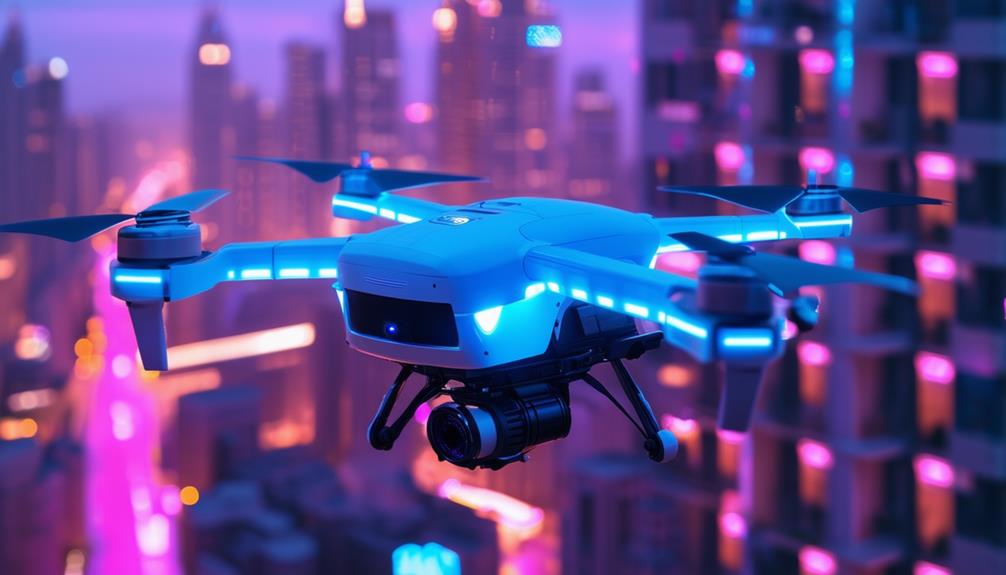
As I examine the advanced autonomy features in AI drone monitoring systems, I'm impressed by their ability to navigate with precision even in the most complex environments.
Technologies like GPS-denied navigation guarantee that drones can continue to operate reliably without relying on satellite signals.
Additionally, advanced collision avoidance and real-time obstacle detection capabilities guarantee they maintain safety in dynamic settings.
Precise GPS-Denied Navigation
Considering the complexities of urban or indoor environments where GPS signals are weak or absent, precision navigation for drones necessitates advanced AI capabilities to guarantee safe and efficient operations. GPS-denied navigation enhances the versatility and reliability of drones across various applications.
To achieve this, drones employ onboard sensors and AI algorithms to maintain accurate positioning and navigation even in GPS-denied environments.
Here are some key features:
- Indoor Adaptability: Drones can navigate through obstacles and obstacles detecting and avoidance capabilities ensure safe flight.
- Advanced Sensor Fusion: Combining data from various sensors guarantees precise positioning without relying on GPS.
- AI-Guided Mapping: Real-time 3D maps enable drones to adjust their flight paths quickly and securely.
- Algorithmic Agility: The continuous refinement of AI algorithms ensures consistent improvement in GPS-denied navigation.
These features make GPS-denied navigation an essential aspect of advanced AI drone monitoring systems, empowering efficient and safe operations across diverse sectors such as infrastructure monitoring and disaster response.
Enhanced Collision Avoidance
As I navigate my drone through densely populated urban areas or perform complex tasks like surveillance and mapping, I rely on robust collision avoidance systems to guarantee seamless operations. Advanced AI drone monitoring systems are equipped with sophisticated autonomous navigation capabilities that allow them to avoid obstacles with precision. This is made possible by AI algorithms that analyze the surroundings and dynamically choose ideal flight paths.
Real-time obstacle detection is enabled by cutting-edge sensors such as LiDAR and ultrasonic sensors, guaranteeing that drones maintain detailed spatial awareness, even in the most challenging environments. This spatial awareness is crucial for drones to avoid collisions and operate safely in complex terrains and environments.
Moreover, AI-powered autonomous navigation enables drones to react swiftly to unforeseen obstacles, ensuring that operations remain smooth and efficient. By leveraging these advanced collision avoidance features, drones can optimize their flight paths and ensure dependable performance in the most demanding tasks.
This technology truly brings drone operations to the next level, providing unparalleled safety and reliability.
Real-Time Obstacle Detection
Utilizing state-of-the-art sensors like LiDAR and ultrasonic sensors, advanced AI drone monitoring systems empower real-time obstacle detection capabilities, guaranteeing drones maintain precise spatial awareness in even in the most complex and challenging environments. This real-time obstacle detection feature is vital for ensuring safe and efficient drone operations in various environments, particularly in urban areas where obstacles are diverse and dynamic.
Here are the key benefits of real-time obstacle detection:
- Autonomous Navigation: Advanced AI algorithms analyze real-time sensor data to navigate intricate flight paths efficiently.
- Enhanced Collision Avoidance: Drones can instantly detect obstacles and adjust their course to avoid crashes, making operations safer.
- Optimized Mapping: Real-time obstacle detection allows drones to create accurate and detailed maps by being spatially aware of their surroundings.
- Efficient Routing: AI algorithms dynamically adjust flight routes based on detected obstacles, ensuring the most efficient paths are chosen.
Surveillance and Security Enhancements
By integrating advanced AI algorithms, drone monitoring systems can automatically detect, track, and analyze behaviors in real-time, greatly enhancing surveillance capabilities across diverse environments. These systems deploy facial recognition technology to identify and track individuals for security purposes. Law enforcement and crowd management benefit significantly from these autonomous tracking capabilities in various settings.
| Coverage Area | Real-Time Capabilities |
|---|---|
| Large open spaces | Identification of unauthorized intrusions |
| Crowded events | Detection of dangerous objects and behavior |
| Remote infrastructure | Monitoring of critical infrastructure for anomalies |
| Public gatherings | Enhanced facial recognition for law enforcement |
| Weather Conditions | Autonomous tracking in diverse weather conditions |
AI drone monitoring systems eliminate the need for manual surveillance, ensuring that critical events are not overlooked. Equipped with advanced sensors and cameras, they provide high-quality real-time data for situational awareness and incident response. Enhanced by AI capabilities, these systems minimize false alarms and optimize operational efficiency. With robust data privacy measures in place, AI drone monitoring solutions offer unparalleled surveillance and security enhancements.
Environmental Monitoring Insights
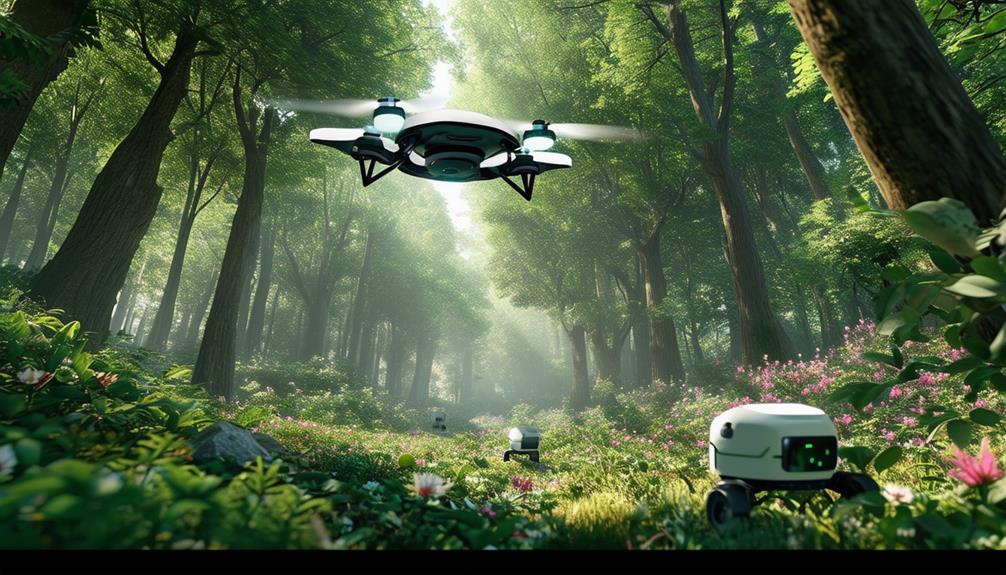
While enhancing surveillance capabilities, advanced AI drone monitoring systems have greatly expanded into environmental monitoring, offering real-time insights into our planet's ecological status. These AI-equipped drones are equipped with environmental sensors that track wildlife movements and behavior, providing essential data for conservation efforts.
By capturing thermal and multi-spectral images, these drones provide detailed information on environmental conditions, enabling researchers to understand the complex relationships between ecosystems, wildlife, and climate change.
Advanced AI drone monitoring systems deliver real-time data on climate conditions and pollution levels, helping researchers and policymakers make informed decisions about environmental policy and management.
Here are some key ways these systems contribute to ecological research:
- Tracking Wildlife: AI drones monitor wildlife movements and behavior in their natural habitats, aiding conservation efforts.
- Climate Conditions: Real-time data on temperature, humidity, and air quality support ecological research and conservation initiatives.
- Pollution Levels: Advanced drones detect pollution levels, enabling researchers to assess and mitigate its impact on ecosystems.
- Multispectral Imaging: AI-equipped drones capture detailed images that reveal hidden patterns and characteristics of ecosystems, enhancing our understanding of the natural world.
These advanced drone monitoring systems play a pivotal role in understanding and protecting our planet's delicate ecosystems, providing essential insights for a more sustainable future.
Drone-Based Delivery Systems
Spearheading the future of logistics, I harness the power of AI drone monitoring systems to propel drone-based delivery systems forward, ensuring unmatched efficiency and precision. Drone-based delivery systems have transformed the logistics landscape by leveraging AI algorithms for efficient route planning and package delivery.
| Feature | Description |
|---|---|
| AI Algorithms | Guarantee the most efficient routes for delivery |
| Real-time Tracking | Provide exact location information for enhanced logistics |
| Autonomous Navigation | Enable drones to navigate urban areas effortlessly |
AI-powered drones optimize delivery routes, reduce delivery times, and enhance customer satisfaction. These systems utilize AI for obstacle avoidance, secure delivery, and streamlined logistics operations. Additionally, drones equipped with AI can autonomously navigate urban areas and deliver packages to precise locations, revolutionizing the way goods are transported. By integrating advanced AI technologies into drone-based delivery systems, the future of logistics has never looked brighter.
Real-Time Data Analysis Tools
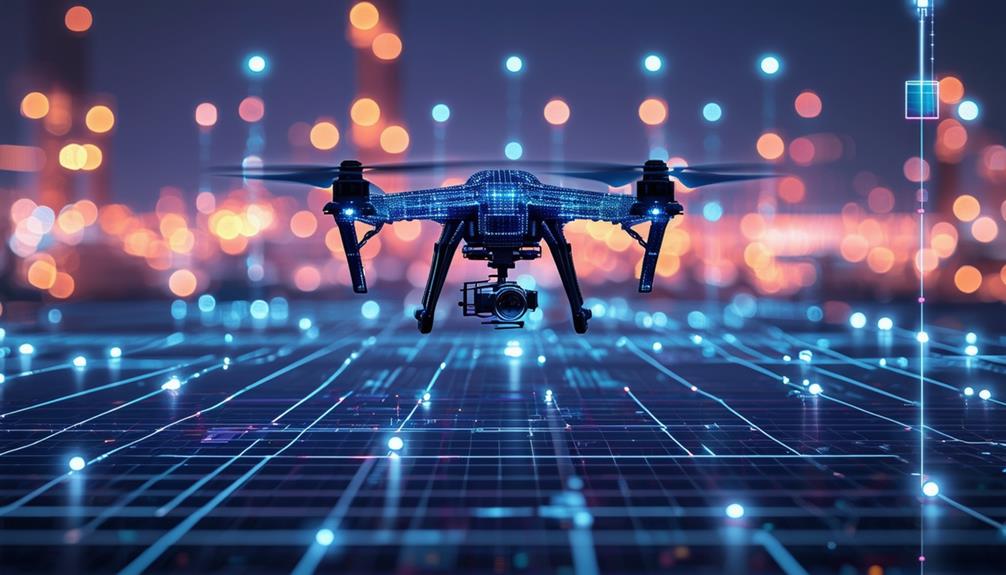
As I explore the field of advanced AI drone monitoring systems, I'm excited to investigate the current subtopic of real-time data analysis tools. These tools are revolutionizing the way we utilize drones by enabling them to process data on the fly.
Utilizing advanced AI algorithms, real-time data analysis tools within drone monitoring systems instantly process the data captured by drones, providing actionable insights for diverse applications.
Here are four key aspects of real-time data analysis tools:
- Enhanced Situational Awareness: Real-time analysis enhances situational awareness by providing immediate insights, enabling better decision-making during drone operations.
- AI-Powered Data Extraction: AI algorithms process data from sensors and cameras, extracting valuable information for monitoring and surveillance.
- Adaptation to Changing Environments: With real-time data analysis, drones can adapt to changing environments, ensuring efficient monitoring tasks.
- Increased Efficiency: By automating data processing, real-time data analysis tools notably reduce the time required for manual analysis, making drone operations more efficient.
These features empower drone monitoring systems to adapt seamlessly to various applications, making them invaluable tools for numerous industries.
Frequently Asked Questions
What Is the AI Technology in Drones?
"I work with drones powered by advanced AI algorithms. They execute autonomous flights for drone surveillance, leveraging machine learning for precise data analysis, real-time image recognition, and efficient sensor integration to save time on flight planning."
What Are Advanced Drones?
'As I dig into drone technology, advanced drones equipped with AI algorithms offer enhanced surveillance, autonomous flights, and precise data collection. These capabilities boost military and commercial applications, streamlining emergency response, while raising pivotal discussions about regulations, privacy, and future trends.'
Can Drones Be Controlled by Ai?
Yes, drones can be controlled by AI, which allows autonomous navigation and surveillance, leveraging machine learning for efficient decision-making, and enhancing overall drone intelligence, enabling diverse applications and fostering freedom.
What Are the Advancements of Drone Technology?
Advanced drone technology includes autonomous flight with real-time tracking, enhanced sensors for improved accuracy, long range capabilities, precision navigation, and smart surveillance for seamless data analysis and remote monitoring via intelligent algorithms.