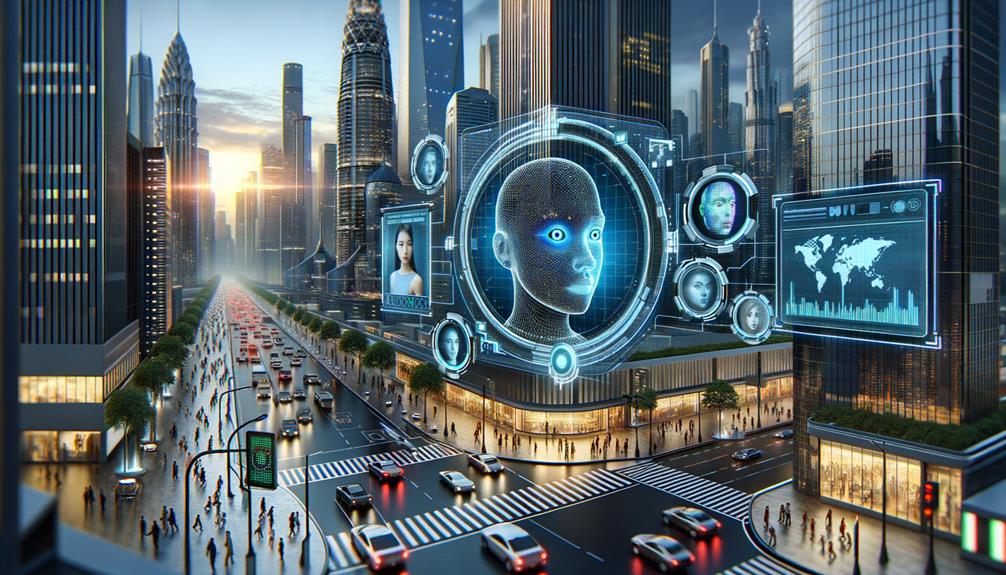

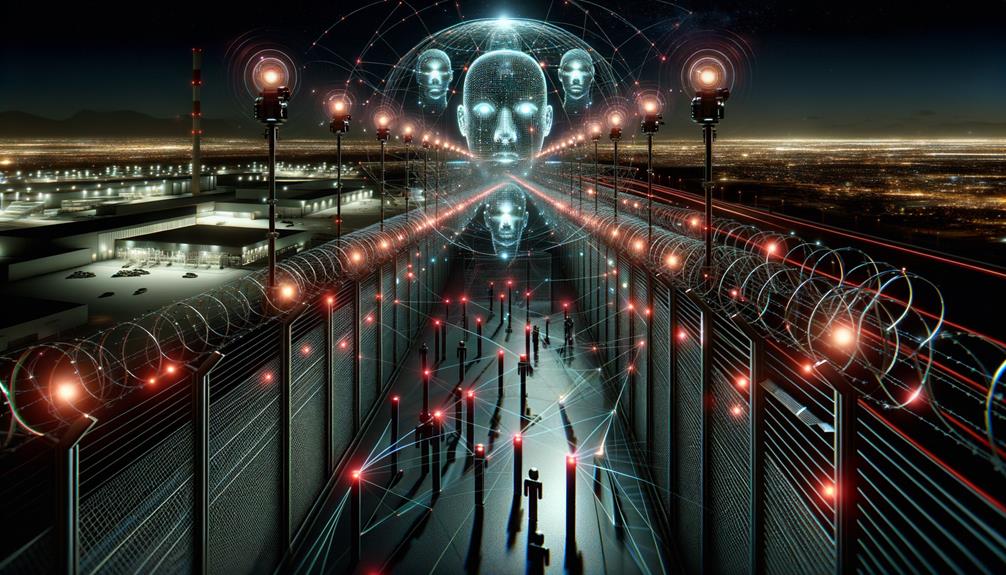
By leveraging advanced surveillance capabilities and precise identification through facial features, facial recognition greatly enhances perimeter security by guaranteeing only authorized personnel access restricted zones and providing real-time alerts for unauthorized individuals. This cutting-edge technology improves security operations' efficiency and response times. Facial recognition guarantees that only those who should be inside actually enter, preventing unauthorized breaches. Dive deeper to learn more about how this game-changing technology revolutionizes perimeter security.
Key Takeaways
- Facial recognition technology enhances perimeter security by identifying individuals and generating alerts for unauthorized access.
- Integration with access control systems ensures advanced surveillance and authentication protocols.
- The technology enables real-time monitoring and alerts for potential threats, significantly improving security operations.
- Unique facial features are used for precise identification, reducing the risk of unauthorized breaches.
- Facial recognition enhances security efficiency and response times, making it a crucial tool for perimeter security.
Purpose of Facial Recognition
Facial recognition in perimeter security plays a crucial role in identifying and tracking individuals entering or exiting a secured area, providing an advanced layer of surveillance to enhance overall security measures. By leveraging facial recognition, we can effectively compare facial features with a database of authorized personnel or potential threats. This allows us to make sure that only authorized individuals gain access to restricted zones, significantly reducing the risk of unauthorized breaches.
The integration of facial recognition technology with access control systems takes perimeter security to the next level. Real-time alerts are generated for any unauthorized individuals attempting to enter the secured area, enabling swift responses to potential threats. This heightened level of accuracy and efficiency in monitoring and controlling access greatly enhances the overall security posture of any facility.
Essentially, facial recognition serves as a robust sentry, ensuring that our premises remain safe and secure by identifying individuals and regulating access appropriately.
Facial Recognition Basics
To effectively integrate facial recognition technology into perimeter security, it's vital to understand the basics of how facial recognition works and its capabilities in real-time monitoring and access control.
Facial recognition technology uses an individual's unique facial features to verify or identify them. This biometric approach ensures precise identification of personnel entering or exiting a secured area, enhancing overall security.
When integrated with access control systems, facial recognition enables real-time monitoring and alerts for unauthorized individuals attempting to breach the perimeter. This technology provides an additional layer of authentication and access control, which is pivotal in perimeter security.
I can attest that facial recognition is more than just a fancy gadget; it's a powerful tool that can significantly enhance the security posture of any facility. The accuracy and speed it offers help improve the efficiency of security operations, allowing for more effective response times to potential threats.
Public Perceptions and Debates

In the domain of facial recognition in perimeter security, plenty of nuts and bolts fall into place regarding government surveillance. As I step into the discussion, it's clear that public concerns about this tech center on privacy and misuse, which are more than valid reasons to take a closer look.
These apprehensions must be acknowledged and tackled to make certain that the power of facial recognition doesn't swallow the very freedoms we seek to protect.
Government Surveillance
Given how rapidly facial recognition technology is evolving and spreading into our daily lives, many of us can't help but wonder where the line should be drawn between security and privacy. This concern is ubiquitous, with both privacy advocates and concerned citizens raising questions about the balance between public safety and individual privacy rights.
- Government Use: The use of facial recognition technology by government agencies has sparked intense debates and raised privacy concerns.
- Public Perceptions: Studies show that a majority of the public is wary of widespread government surveillance through facial recognition due to privacy implications.
- Data Security: Public concerns about government surveillance include fears of mass data collection, lack of transparency, and potential misuse of facial recognition technology.
- Legal Compliance: Discussions on government surveillance often center on the need for regulations, oversight, and accountability to address the ethical and legal implications of facial recognition in public spaces.
Public Concerns
As I navigate the complexities of facial identification in perimeter security, the public's apprehension about this technology's impact on privacy and ethics becomes increasingly apparent.
One of the primary concerns is privacy, with people worried about the potential for broad surveillance and the lack of informed consent. Concerns about bias risks also loom large, as inaccurate data collection and analysis could unfairly target certain demographics.
Transparency is also a major issue, as citizens demand clear policies and regulations on how facial identification data is used and stored.
The public perception of facial identification technology is heavily influenced by media reports of privacy breaches and potential biases in the algorithms used. Addressing these concerns will require ethical and transparent methods for implementing facial identification systems in public spaces.
Continuous monitoring and evaluation are necessary to ensure accountability and mitigate risks. By acknowledging and addressing these public concerns, governments and organizations can build trust and work towards a more secure and responsible use of facial identification in perimeter security.
Regulations and Compliance
Securing regulatory compliance is crucial when deploying facial recognition technology in perimeter security. Regulations in Canada under PIPEDA set stringent standards for data protection and privacy, mandating that organizations take specific measures to protect sensitive information.
Key compliance requirements include:
- Data access restrictions to guarantee only authorized personnel can retrieve personal information.
- Obtaining explicit consent from individuals before collecting and using their facial recognition data.
- Posting clear notices informing individuals about facial recognition use.
- Implementing secure systems and proper disposal of data after the required time frame to prevent unauthorized access.
Following these guidelines helps maintain trust among stakeholders and minimizes the risks associated with facial recognition technology in perimeter security.
Camera Technology and Alternatives

In pursuit of an intelligent perimeter security setup, we broaden our horizon to evaluate camera technology and its alternatives. High-quality WDR cameras stand out for their balanced image processing, making them the preferred choice for robust facial recognition.
Beyond this, alternatives like motion detection for perimeter protection, behavior AI, and the AXIS Face Detector offer unique solutions to enhance the overall security landscape.
Motion Detection
Instead of focusing on individual identities, I choose motion sensing cameras that can safeguard my perimeter by detecting even the slightest movements. These advanced cameras are intelligent, immediately alerting me to any suspicious activity before it poses a significant threat. This approach not only enhances my security setup but also streamlines the monitoring process.
Here are the key ways motion sensing cameras excel in protecting my perimeter:
- Enhanced Surveillance: Motion sensing cameras seamlessly integrate with security cameras to bolster my surveillance capabilities, allowing me to quickly respond to any detected movement.
- Outdoor Security Mastery: Motion sensing technology excels in outdoor security applications, efficiently monitoring and securing perimeters where traditional facial recognition might struggle.
- Ease of Monitoring: By only recording and alerting me to actual events, motion sensing conserves resources and reduces the need for continuous monitoring.
- Inclusive Surveillance: Unlike facial recognition, which focuses on specific individuals, motion sensing ensures a broader scope of surveillance, making it an attractive alternative for my perch.
Behavior Analysis
By leveraging advanced camera technologies and integrative solutions, I tap into behavior analysis to transform my approach to perimeter security and proactively detect potential threats.
This powerful tool focuses on predicting consumer behavior through AI algorithms, tracking and analyzing patterns of behavior in real-time to enhance security and improve customer experiences.
By monitoring movements and interactions, behavior analysis helps in identifying suspicious activities and preventing potential threats. It seamlessly integrates with security cameras to detect anomalies and trigger alerts for security personnel, ensuring early threat detection and proactive monitoring.
This capability is pivotal for perimeter security as it enhances overall security while providing a seamless experience for guests.
Efficiency Boost
I take my perimeter security to the next level by exploring cutting-edge camera technologies and innovative alternatives to boost efficiency and stay ahead of potential threats. The key to maximizing efficiency lies in harnessing the capabilities of advanced camera technologies and strategically integrating them into my perimeter security strategy.
To illustrate this, here are some key enhancements:
- High-quality WDR cameras: Maintain balanced image processing for facial recognition in perimeter security.
- Motion detection: Provides a substitute for facial recognition for perimeter protection, enhancing responsiveness to security threats.
- Behavior AI: Predicts consumer behavior effectively, offering an additional perimeter security tool to complement facial recognition.
- AXIS Face Detector technology: Creates a safer environment by identifying individuals without relying solely on facial recognition, improving overall efficiency.
Business Applications and Benefits
Facial recognition technology holds a critical position in modern perimeter security, greatly increasing the accuracy and efficiency of access control and employee management systems within businesses. The integration of these systems enhances security protocols by automating processes such as verifying identities in real-time.
This technology is especially useful in retail settings where it can help prevent theft and guarantee personalized services to customers. Additionally, facial recognition technology offers numerous perks such as streamlined operations and precise tracking of staff, further strengthening perimeter security.
In business settings, facial recognition provides significant convenience by automating tasks, such as attendance tracking and authentication processes, which previously required manual intervention. Its ability to create unique profiles based on past behavior, demographics, and other data allows for targeted marketing strategies.
Enhanced security measures like automated alerts for known offenders can also make certain that unwanted individuals don't breach perimeter security. Overall, facial recognition technology gives businesses the ability to balance security and customer experience.
Implementation and Challenges

When incorporating facial recognition technology into perimeter security systems, several challenges must be thoughtfully considered to guarantee effective and accurate performance. There are several hurdles that arise during the implementation process that must be addressed.
- Lighting Conditions: Varying light conditions can greatly impact the accuracy of facial recognition. Both high-contrast and low-light scenarios can lead to errors as they affect the quality of the captured images.
- Facial Angle Variations: Facial recognition algorithms are inherently biased towards standardized positions, leading to reduced accuracy when faces are misaligned or not directly facing the camera.
- Privacy Concerns: One of the primary concerns is the storage and management of facial data. More concrete regulations are still developing, and businesses must ensure they maintain ethical practices while implementing the technology.
- Algorithmic Bias: Commercially available algorithms exhibit biases based on race, ethnicity, and age, impacting the overall reliability of the system.
Addressing these issues is important to guarantee seamless and secure perimeter security. By acknowledging these challenges, developers can refine their systems and integrate advanced algorithms, enhancing both accuracy and privacy.
Frequently Asked Questions
How Does Facial Recognition Help With Security?
"I integrate facial recognition to boost security by ensuring identification accuracy, real-time monitoring, and seamless access control. It enables swift threat detection, data encryption, intrusion prevention, and flexible integration capabilities to keep my perimeter secure."
What Is the Role of Facial Recognition System in Surveillance Systems?
In surveillance systems, facial recognition systems greatly enhance security measures by improving identification accuracy, enabling real-time monitoring, and bolstering access control, allowing for rapid threat detection and advanced behavioral analysis while integrating seamlessly and ensuring robust data protection.
What Is the Function of Facial Recognition?
"I use facial recognition to securely verify identities, enhance access control, and provide real-time threat detection, ensuring robust security enhancement through advanced biometric technology."
How Does Facial Recognition Violate Privacy?
"I feel uneasy about facial recognition in perimeter security because it quietly captures my biometric data, threatening my privacy concerns and data protection. It has serious ethical implications, undermining civil liberties and potentially fostering a surveillance state where facial data can be misused and government overreach prevails."