


AI-powered drones are dramatically changing the face of warfare. With enhanced accuracy and increased lethality, autonomous targeting has become a game-changer. Both Russia and Ukraine are ramping up drone production for strategic advantage, but the ethical and legal questions are glaringly evident. Misuse by non-state actors adds fuel to the fire. Human oversight remains essential, but at what cost? As AI advances, regulatory frameworks race to keep up. There's more to this high-stakes game. Curious?
Key Takeaways
- AI-powered drones enhance target engagement success rates from 10-20% to 70-80%, significantly increasing their combat effectiveness.
- Autonomous targeting and real-time processing allow drones to adapt quickly to dynamic battlefield conditions.
- Increased drone production by Russia and Ukraine demonstrates their strategic value in modern warfare.
- Ethical and legal concerns arise due to the increased lethality and autonomous decision-making capabilities of AI drones.
- International governance and regulation are crucial to prevent misuse and address unintended consequences of AI in military operations.
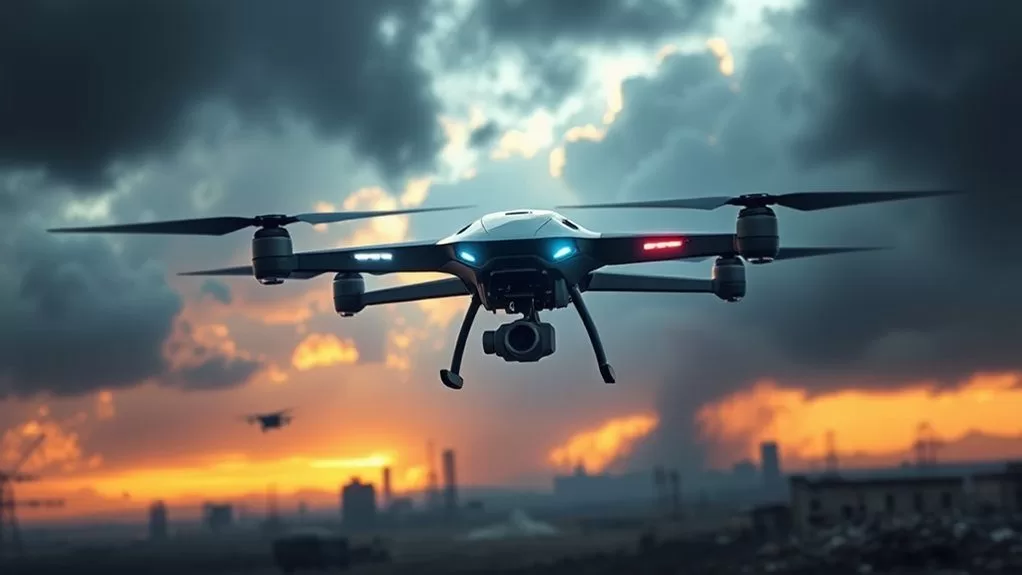
While the world grapples with the implications of AI across various sectors, the battlefield is no exception. AI-powered drones are transforming warfare, offering increased accuracy and efficiency. By automating navigation and reducing human error, these drones raise target engagement success rates from a meager 10-20% to an impressive 70-80%. Autonomous targeting is no longer just a sci-fi concept; it's the new reality. But, of course, not without ethical implications.
AI-powered drones revolutionize warfare, boosting accuracy to 70-80% while raising ethical concerns.
Retrained on real-world combat data, AI models adapt to specific battlefield conditions, enhancing precision and local strategies. It's like giving the drones a crash course in military tactics. The use of open-source models further saves time and reduces costs, as there's no need to reinvent the wheel. Why construct a brand-new AI when you can just download one? These AI models have increased target hit rates three- to four-fold, underscoring the effectiveness of real-world combat data integration.
These technological marvels extend target recognition ranges up to 1 km in combat and 2 km in ideal conditions, greatly improving mission effectiveness. They even boast counter-electronic warfare measures, maintaining targeting focus despite communication disruptions. It's as if these drones have a sixth sense, a knack for staying on target no matter what. AI edge computing, which allows for real-time processing and analysis, is a key enabler of these advanced capabilities, ensuring that drones can operate autonomously and respond rapidly to changing conditions. AI-driven threat detection capabilities enhance the drones' ability to identify and neutralize potential dangers swiftly and efficiently.
Both Russia and Ukraine are riding this AI wave, ramping up production to gain combat advantages. Russia plans to increase drone production tenfold, while Ukraine aims for AI-assisted drones to comprise half of its fleet by 2025. Strategic utilization of these drones spans reconnaissance, artillery guidance, evacuations, and direct attacks. Who knew drones could be such multitaskers?
Yet, despite the benefits, there are ethical and legal concerns. Lethality in warfare is heightened, while the question of autonomous decision-making looms large. Human oversight, thankfully, is still a requirement for engagement decisions, though AI handles the final approach. It's a relief to know that humans have the last word, for now.
Regulatory frameworks are slowly emerging to standardize AI use in military operations. But the potential for misuse, especially by non-state actors, is a ticking time bomb. International governance efforts are essential to establish norms and prevent unintended consequences. However, the pace of technological advancement often outstrips the speed of regulation. A classic case of the cart before the horse.
References
- http://breakingdefense.com/2025/03/trained-on-classified-battlefield-data-ai-multiplies-effectiveness-of-ukraines-drones-report/
- https://www.maris-tech.com/blog/the-role-of-ai-edge-computing-in-the-moral-dilemmas-of-drone-warfare/
- https://www.lawfaremedia.org/article/the-rush-for-ai-enabled-drones-on-ukrainian-battlefields
- https://www.youtube.com/watch?v=XgIrvCACI6c
- https://www.csis.org/analysis/ukraines-future-vision-and-current-capabilities-waging-ai-enabled-autonomous-warfare