
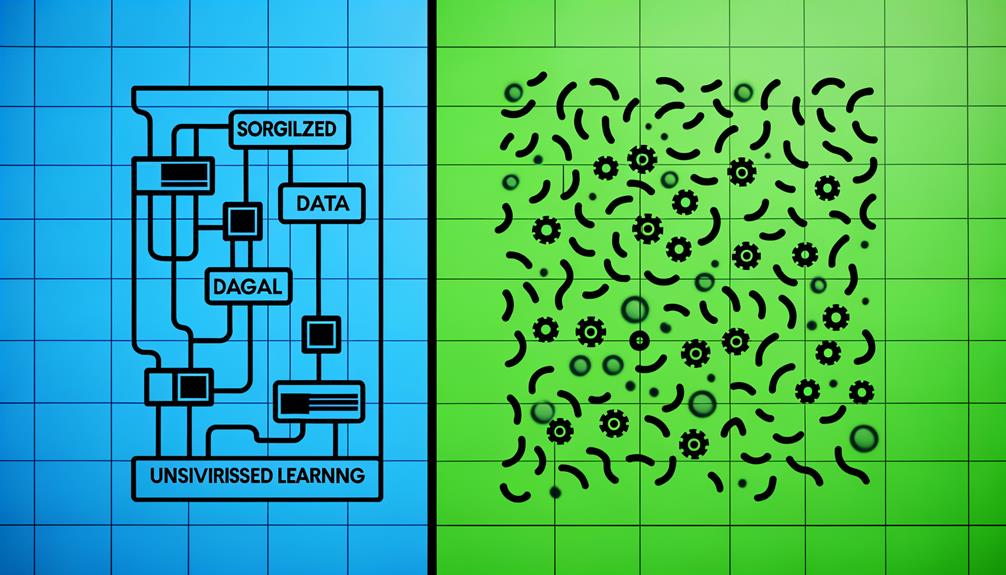

Supervised and unsupervised learning algorithms have different purposes and applications in machine learning. Supervised algorithms, like Linear Regression and Random Forest, are trained on labeled datasets to achieve high accuracy in regression and classification tasks. In contrast, unsupervised algorithms, such as K-Means Clustering and Principal Component Analysis, operate on unlabeled data, discovering hidden patterns and reducing dimensionality. Each type has its strengths: supervised algorithms excel in classification and regression tasks, while unsupervised methods are ideal for uncovering complex patterns. For a deeper understanding and exploration of the best algorithms in each category, further examination is advisable.
Key Takeaways
- Supervised Learning: Linear Regression and Random Forest are popular algorithms in supervised learning, offering high accuracy due to labeled training data.
- Unsupervised Learning: K-Means Clustering, Hierarchical Clustering, and Principal Component Analysis (PCA) are notable algorithms in unsupervised learning, suitable for pattern discovery and dimensionality reduction.
- Linear Regression is ideal for regression tasks, while Random Forest excels in classification, as well as regression problems.
- Key Performance Metrics: Mean Squared Error (MSE) is important in supervised regression models, whereas Accuracy is often used for classification tasks.
- Supervised and unsupervised methods complement each other effectively, each addressing different aspects of machine learning tasks.
Understanding Supervised Learning
Supervised learning is an important machine learning approach in which algorithms are trained on labeled data sets, enabling them to accurately predict outcomes and classify data. This approach involves the use of regression models for predicting continuous values and classification algorithms for predicting categories.
Regression models, such as Linear Regression and Random Forest, are commonly used in supervised learning to accurately model relationships between variables. Classification algorithms, on the other hand, are used to divide data into different categories based on input features.
Evaluation metrics are pivotal in supervised learning, as they help evaluate the performance of these algorithms. For regression models, metrics such as Mean Squared Error (MSE) and Root Mean Squared Error (RMSE) are used to measure accuracy. For classification algorithms, metrics like Accuracy, Precision, Recall, and F1 score are used to determine how well the algorithms are performing.
The advantages of supervised learning include its ability to solve real-world problems efficiently and optimize performance. It has applications in various domains, including data categorical classification and regression tasks. By leveraging labeled data, supervised learning algorithms can yield high accuracy, making them essential in many applications.
Unsupervised Machine Learning
Unsupervised machine learning algorithms operate independently on unlabeled datasets to uncover hidden patterns and structures, unlike their supervised counterparts that rely on labeled data. These algorithms enable machines to learn without explicit direction, revealing valuable insights from large datasets.
Cluster analysis is one type of unsupervised algorithm used to group similar data points together based on their intrinsic properties. This helps discover natural groupings within data, like identifying customer segments.
Another type is association rule learning, which uncovers relationships between variables, as seen in the Apriori algorithm commonly used for market basket analysis.
Dimensionality reduction techniques like PCA (Principal Component Analysis) also fall under unsupervised learning. They efficiently reduce the number of features in datasets while preserving essential information.
Additionally, hierarchical clustering creates a tree-like structure to illustrate data relationships. These algorithms are particularly useful for anomaly detection and understanding complex patterns without human intervention.
Collectively, these algorithms help uncover hidden structures in unlabeled data, ensuring machines can make informed decisions without prior guidance.
Key Differences in Learning Models
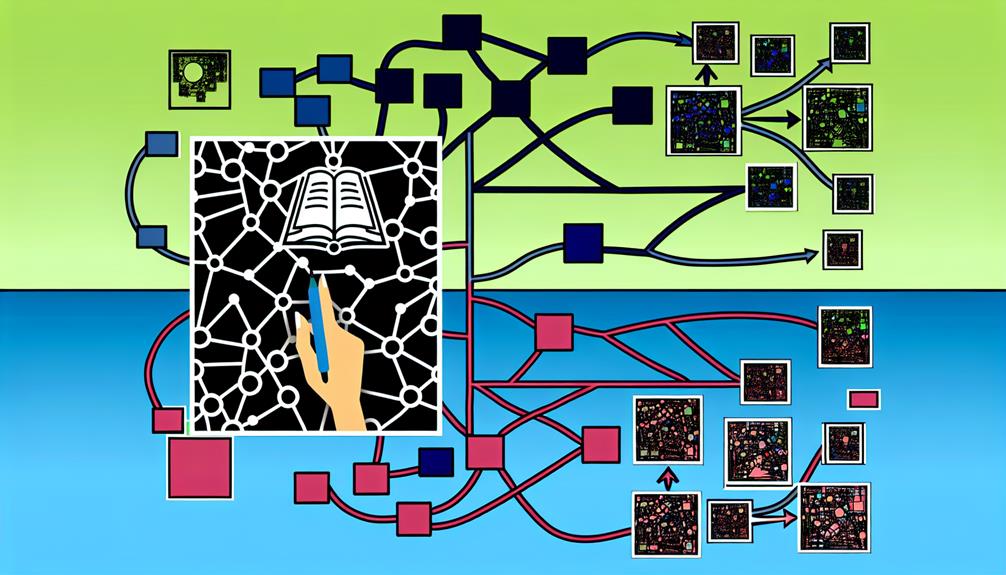
The fundamental distinction between supervised and unsupervised learning lies in the level of human intervention and guidance provided to machine learning algorithms during the learning process. This difference impacts the way algorithms learn from data and the purposes they serve.
Supervised learning, which involves labeled training data, is ideal for tasks like classification and regression where clear outputs are required. On the other hand, unsupervised learning, which operates on unlabeled data, excels at discovering hidden patterns and relationships within datasets, making it suitable for clustering and anomaly detection applications.
The contrast between these learning models is also reflected in their respective strengths. Supervised models are generally more accurate due to the guidance provided by labeled data. However, this accuracy comes at the expense of requiring resource-intensive data labeling.
In contrast, unsupervised models are more flexible and can handle vast, unexplored datasets but may lack explainability in their output, necessitating additional human oversight for validation.
Despite their differences, both supervised and unsupervised machine learning models are essential tools in the arsenal of data analysis and processing. By understanding the distinct strengths and weaknesses of each approach, practitioners can make informed decisions about the most effective methodology to deploy for their specific tasks.
Frequently Asked Questions
Which Is Better, Supervised or Unsupervised Learning?
The choice between supervised and unsupervised learning depends on specific goals and available data. Supervised learning excels in precise predictions, requiring labeled data, while unsupervised learning uncovers hidden patterns from unlabeled data.
Which Algorithm Is Best in Supervised Learning?
The choice between decision trees, neural networks, support vector machines, random forests, logistic regression, gradient boosting, Naive Bayes, k nearest neighbors, and ensemble methods in supervised learning depends on the specific problem complexity and data characteristics.
What Are the Examples of Supervised and Unsupervised Learning Algorithms?
Examples of supervised learning algorithms include Decision Trees, Linear Regression, Support Vector Machines, Random Forest, Naive Bayes, Logistic Regression, Gradient Boosting, Neural Networks, AdaBoost, and K Nearest Neighbors. Unsupervised algorithms include K Means, PCA, Hierarchical Clustering, DBSCAN, Gaussian Mixture, Mean Shift, Spectral Clustering, Self Organizing Maps, and Agglomerative Clustering.
Is CNN Supervised or Unsupervised?
Convolutional Neural Networks (CNNs) are supervised learning algorithms used for image classification and object detection. They require labeled data for training to extract features, leveraging deep learning, convolutional layers, and pattern recognition.