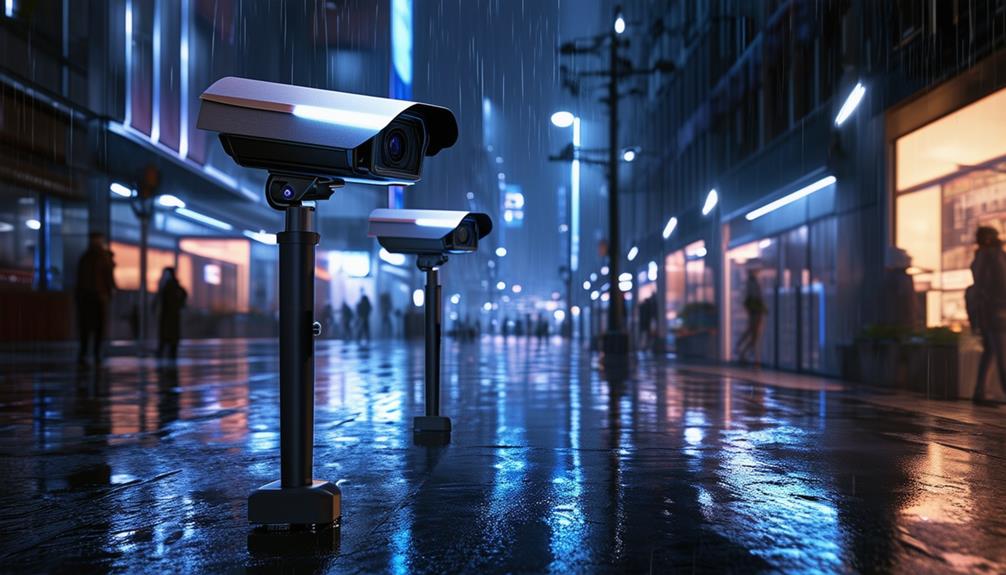


To set up facial recognition for personalized surveillance systems, I focus on strategic camera placement to capture clear facial images across various angles. Positioning cameras at eye level and prioritizing lighting conditions in high-traffic areas enhances image quality. System design should guarantee compatibility, real-time alerts, and scalability. Best camera angles, distance, and environmental factors are balanced for wider coverage and reliable results. Advanced algorithms are utilized for quick and accurate identification, enhancing access control and monitoring.
Key Takeaways
- Position cameras strategically at eye level, focusing on high-traffic areas and balancing lighting conditions and angles for clear facial images.
- Utilize wide-angle lenses with high resolutions (at least 1 MP) to capture detailed footage across various angles.
- Optimize camera tilt angles (up to 30 degrees from horizontal) and heights to ensure proper facial alignment for accurate recognition.
- Implement advanced algorithms and deep learning models to preprocess images, create unique face templates, and ensure accurate identification.
- Integrate facial recognition with mainstream video management systems for seamless surveillance and robust access control.
Key Success Factors
To implement an effective facial recognition system for personalized surveillance, it's essential to define and address key constraints and success factors that include accuracy requirements, system integration needs, data collection, scalability, and deployment considerations.
Accuracy requirements guarantee that the system can identify subjects reliably. For least intrusion:
High accuracy guarantees that only recognized individuals are allowed access, thereby enhancing privacy.
For bank security access: High accuracy is vital to protect financial assets.
System architecture is also crucial. The selection of hardware components must align with system integration needs for seamless communication and processing of facial data.
Effective data collection is another critical factor. It involves ensuring data quality and integrity for reliable facial recognition outcomes.
Scalability is also a significant consideration for expanding or enhancing the system in the future.
Lastly, deployment must be smooth, ensuring compatibility with existing infrastructure to prevent disruptions and maintain data continuity. By prioritizing and integrating these factors, you can establish a robust facial recognition system for personalized surveillance.
Designing Facial Recognition
When designing a facial recognition system for personalized surveillance, I must carefully plan the system architecture to guarantee seamless integration of hardware and software components.
Effective camera placement is also vital to capture high-quality images with ideal lighting conditions, angles, and resolutions.
System Architecture
As I design the architecture of my surveillance system, incorporating facial recognition technology is crucial to achieving personalized security and enhanced surveillance capabilities. This technology offers advanced features that improve the overall performance and reliability of my security setup.
To take into account seamless integration, I need to contemplate various factors when planning the system architecture.
- Camera Placement: Strategically place cameras to capture clear facial images from different angles, ensuring effective recognition.
- Integration: Take into account compatibility with existing hardware and software components to avoid system disruption.
- Scalability: Design the system architecture to easily upgrade to advanced facial recognition systems like FaceMe® Security for improved efficiency.
- Real-time Alerts: Implement the facial recognition technology to enable real-time alerts, increasing monitoring efficiency and security effectiveness.
Camera Placement
Optimizing my facial recognition system requires careful planning for camera placement to capture high-quality facial images from diverse angles. Accurate facial recognition accuracy hinges on strategic camera placement, which involves positioning cameras at eye level to capture facial features effectively. Avoid placing cameras too high or too low, as this can lead to obscured or distorted facial images. Additionally, lighting conditions are essential in facial recognition; as a result, cameras should be positioned to minimize harsh lighting effects and capture the highest-resolution images possible.
| Area Color | Tilt Angle | Recognition Quality |
|---|---|---|
| Red | 50⁰+ | Low |
| Yellow | 15⁰ – 45⁰ | Average |
| Green | 0⁰ – 15⁰ | High |
To maximize the effectiveness of my surveillance system, I must prioritize camera placement, focusing on ground-level entry points and high-traffic zones both inside and outside the home. Adjusting camera angles to minimize the impact of harsh lighting conditions and using wide-angle lenses to capture detailed footage across expansive areas are equally essential. With careful planning and attention to detail, my facial recognition system can provide unparalleled accuracy and control.
Facial Recognition Technology

Facial recognition technology frequently uses biometric data to identify individuals based on unique facial features, analyzing facial patterns and distances between the eyes, nose, and mouth to create a facial template for recognition.
One of the key aspects of this technology is its ability to enhance security measures and personalize surveillance systems.
Here are some ways facial recognition technology can improve security:
- Fast and Accurate Identification: Advanced algorithms in facial recognition systems enable fast and accurate identification of faces, ensuring that potential security threats can be quickly addressed.
- Personalized Surveillance: Facial recognition can be integrated with cameras to create personalized surveillance systems tailored to specific settings and needs.
- Enhanced access control: It's widely used in access control systems to verify individuals, ensuring that only authorized personnel enter secure areas.
- Advanced Monitoring: Facial recognition technology can monitor patterns and behaviors, helping security teams respond to potential threats in real time.
Field of View and Setup
As I set up my facial recognition system, I realized the importance of optimizing camera placement to capture facial details effectively.
The angle and distance of the camera have a substantial impact on the accuracy of facial recognition, so I'd to carefully consider these factors when deciding where to mount each device.
Additionally, I needed to account for environmental factors like lighting, humidity, and temperature that could affect the performance of my surveillance cameras.
Camera Placement Optimization
Can strategic camera placement overcome current limitations in facial recognition technology, guaranteeing more accurate and personalized surveillance systems? The answer lies in understanding how to optimize the field of view and setup for maximum coverage and accuracy.
To get the most out of your facial recognition system, proper placement is vital. Here are a few key considerations to keep in mind:
- Optimize camera angles: Position cameras at a height of 6.5 to 9.8 feet to capture faces clearly within the surveillance area.
- Adjust tilt angles: Guarantee the tilt angle is between 0 to 15 degrees for high-quality facial recognition.
- Select the right lens: Choose cameras with high-quality lenses providing clear, distortion-free images.
- Minimize external noise: Eliminate any objects or displays that can negatively impact the accuracy of facial recognition.
Angel and Distance Impact
Understanding the best field of vision and setup requirements is vital for delivering high-quality facial recognition capabilities, even at various distances from the camera. A facial recognition camera with the correct field of vision greatly enhances the ability to detect faces accurately at different distances. Proper camera setup guarantees optimal coverage and recognition capabilities for personalized surveillance systems.
Recognizing the distance impact is pivotal in positioning cameras effectively. Adjusting the field of vision based on the setup requirements enhances the overall performance of the surveillance system. For instance, if the camera is located at a distance, a wider field of vision might be necessary to capture more detail. This ensures that facial features remain resolvable even at greater distances.
Strategic placement and setup of cameras in the surveillance environment is essential for accurate recognition of faces. By considering these factors, you can fine-tune your facial recognition system to deliver reliable results consistently, even in diverse settings.
Environmental Factors Effect
Environmental factors like the angle and height of camera placement significantly impact facial recognition accuracy. This crucial setup step can't be ignored. The field of view directly influences the range of faces that can be identified. Wider angles capture more faces, but at the expense of detail. Best camera placement, including mounting heights between 2.8 meters (9 feet) and 10 feet, ensures that captured images are of the highest quality, enhancing facial recognition capabilities.
Several key considerations must be taken into account during setup:
- Camera Angle: Tilting the camera up to 30 degrees from horizontal enables better facial recognition results, especially if individuals are facing forward and not looking downward.
- Lighting Conditions: Guarantee the scene is well-lit for optimal facial recognition. Excessively bright lights or too much backlighting can adversely affect imaging.
- Field of View: Balanced camera angles and placement allow for wider surveillance coverage and clearer facial detection.
- Camera Settings: Adjusting settings for facial recognition helps improve system performance and identification accuracy.
Integrating FaceMe Security
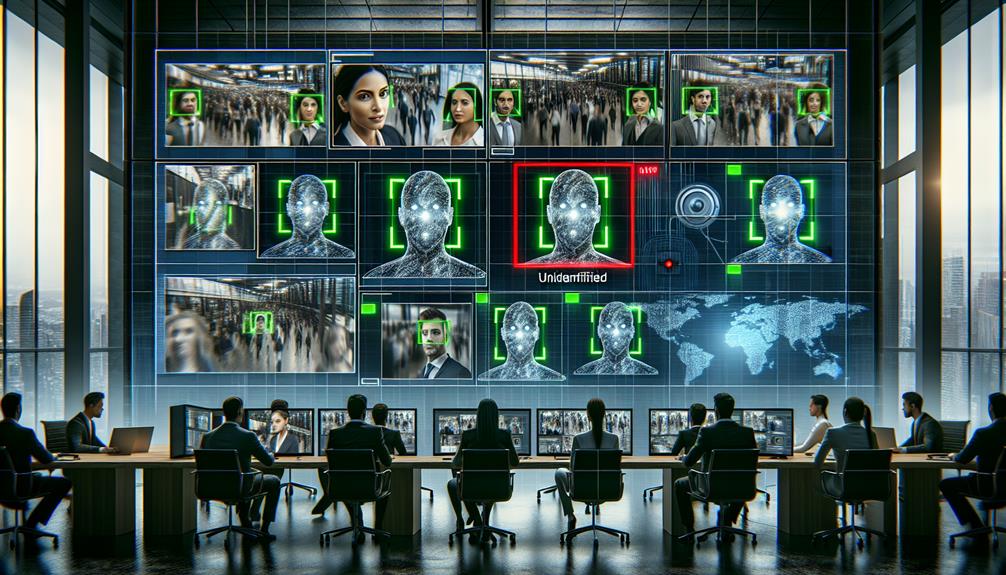
'Integrating FaceMe Security: Efficient Surveillance Defense'
When setting up facial recognition for personalized surveillance systems, integrating FaceMe Security is a pivotal step that not only enhances your surveillance experience but also provides real-time security benefits.
FaceMe Security's advanced integration capabilities provide enhanced surveillance experiences by smoothly linking with mainstream video management systems like Milestone XProtect, Genetec VMS, and Hanwha Wisenet WAVE.
One of the key advantages of FaceMe Security is its seamless integration with IP cameras, enabling robust access control and real-time alerts. This integration guarantees that security devices can automatically detect and identify personnel, ensuring that only authorized individuals can enter restricted areas. Additionally, the system can notify security teams instantly when a blocklisted individual is detected. This proactive approach significantly improves security and reduces the likelihood of breaches.
FaceMe's efficient integration with mainstream surveillance systems makes it an ideal solution for various industries, from airports to retail spaces, where security control is paramount.
Future Implications and
As facial recognition technology progresses and expands into diverse sectors including home security and health care, key ethical and privacy concerns are starting to emerge. The integration of facial recognition systems into our daily lives has the potential to greatly enhance security measures and patient diagnoses, but these benefits must be weighed against the risks associated with data handling and storage.
- Privacy Anticipations:
Amazon's Ring patents, such as those using facial recognition to identify 'suspicious' individuals and alert law enforcement, have raised concerns about potential misuse and privacy violations.
- Ethical Considerations:
The collection and use of biometric data in health care, like 3D facial recognition, require strict informed consent and transparency to maintain patient trust.
- Policy Pressure:
Lack of transparency in data handling by companies using facial recognition technology fosters skepticism among users and prompts calls for policy changes to regulate surveillance systems.
- Future Implications:
Advancements in facial recognition capabilities could lead to improved security measures but also raise ethical dilemmas; it's essential to establish guidelines that balance security benefits with individual privacy rights.
Face Recognition Workflow

I begin by capturing an image or video frame containing a face, which becomes the primary input for the facial recognition workflow. This initial step sets the ground for subsequent processes that guarantee accurate recognition.
The captured image then undergoes preprocessing, which enhances facial features to improve detection and analysis. Haar cascades and deep learning algorithms are utilized to detect the face, extracting facial features to create a unique face template for comparison.
Accurate templates enhance recognition precision, ensuring exact identification. The extracted face data is then matched against existing databases to recognize and identify individuals. This comparison step is essential in guaranteeing that the methodology delivers accurate results.
Face recognition systems rely heavily on high recognition precision, making the entire workflow vital. By leveraging advanced techniques and deep learning models, the facial recognition workflow can allow quick and accurate identification, facilitating personalized surveillance and various other applications.
As technology continues to advance, so too does the precision and capability of these systems, leading to heightened control and efficiency in various fields.
Frequently Asked Questions
How Is Facial Recognition Used in Surveillance?
Here is a 35-word answer to the question, focusing on the use of facial recognition in surveillance:
"I use facial recognition in surveillance to accurately identify individuals in real-time, balancing security features with privacy concerns. This involves careful data storage and consideration of ethical implications."
5 keywords:
- Privacy concerns – Ensuring that personal data is handled appropriately.
- Accuracy rates – Ensuring that face recognition is reliable and minimizes false positives.
- Security features – Enhancing security through personalized monitoring and access control.
- Ethical implications – Addressing the potential consequences of widespread surveillance.
- Data storage – Managing and protecting the extensive data required for facial recognition systems….
How to Implement a Face Recognition System?
To implement a face recognition system, I guarantee data storage is secure, adhere to privacy laws, optimize accuracy rates through robust algorithms, integrate with existing security measures, and confirm transparency in facial recognition technology usage.
How Do You Set up Facial Recognition?
To set up facial recognition, I start by selecting compatible cameras, configuring the software, ensuring proper lighting, and training it with accurate data. Then, I test for accuracy, address privacy concerns, and optimize for real-time detection.
How to Make a Biometric Facial Recognition System?
To create a biometric facial recognition system, I gather diverse facial images, apply machine learning algorithms like CNNs for feature extraction, guarantee image processing handles varied lighting, and implement robust security measures to protect biometric data, addressing privacy concerns.