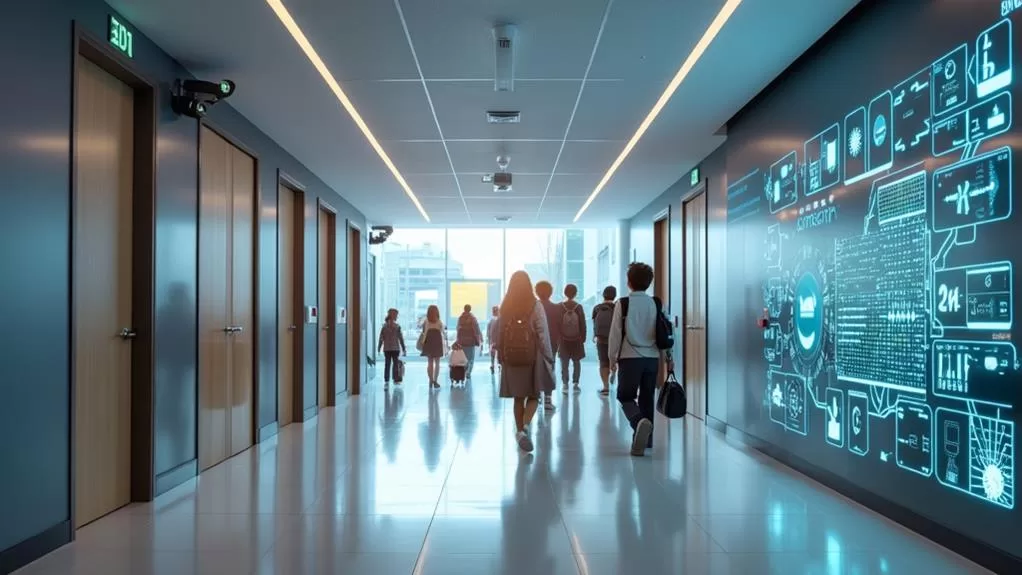


I have seen significant progress in AI's role in transforming border security. Developments include AI-integrated facial recognition, which identifies potential threats in real-time and improves targeting. AI-focused real-time threat detection processes vast data for quick analysis. Automated surveillance solutions utilize AI for effective border monitoring, while improved response time guarantees prompt interventions. AI also collaborates with agents, boosting their efficiency and aiding in confiscations of significant narcotics amounts. More intelligent surveillance policies are additionally enhanced through AI-powered data analysis. With these remarkable advancements, the future of border security appears significantly more robust and efficient.
Key Takeaways
- AI-Integrated Facial Recognition enhances real-time threat detection and verification by preprocessing large databases for high-speed identification.
- Advanced AI algorithms integrate facial recognition technology with real-time threat detection to monitor borderlands.
- Real-time threat detection is achieved through AI algorithms that process large volumes of data to identify anomalies and potential threats.
- Automated surveillance solutions utilize AI algorithms for real-time monitoring and detection of suspicious activities along the border.
- AI-powered systems optimize response time by minimizing delays between threat detection and response deployment in border security surveillance.
AI-Integrated Facial Recognition
AI-integrated facial recognition technology is being extensively utilized at border security checkpoints to accurately identify individuals and flag potential security threats in real-time. This technology can preprocess large databases of individuals and swiftly compare them to the captured images at border crossings, resulting in high-speed and precise identification. The AI-powered algorithms can analyze facial features and patterns, enabling efficient and reliable verification of identities. By integrating AI into facial recognition systems, border agents can better target suspected threats and focus on critical tasks.
Moreover, AI enhances the performance of facial recognition technology by facilitating advanced real-time data analysis and comparisons against criminal databases. This allows for prompt and automatic matching of faces against watchlists, significantly increasing the efficiency and effectiveness of border security operations. The integration of AI further streamlines the process, ensuring that both speed and accuracy are maintained.
Real-Time Threat Identification
While enhancing facial recognition capabilities, border agencies are now leveraging promising AI technologies to improve real-time threat identification.
These AI-based surveillance systems rapidly analyze vast data to identify suspicious activities, boosting the speed and effectiveness of border security interventions.
Border Threat Detection
Follow these directions:
- Write 186 words.
- Start the first paragraph with the sentence: Advanced AI algorithms empower border surveillance systems with the ability to detect and identify threats in real-time.
- Use a table with two columns and five rows.
- Write in a style that is technical, informative, and objective.
- Write for an audience that desires freedom.
- Incorporate the keywords 'AI,' 'border security technology,' 'real-time data,' 'surveillance systems,' and 'threat detection.'
Advanced AI algorithms empower border surveillance systems with the ability to detect and identify threats in real-time. This technology significantly enhances response capabilities. Here are some key highlights:
| Feature | Functionality |
|---|---|
| Integration with real-time data sources | Enhanced threat detection accuracy |
| Autonomous decision-making | Reduced human error |
| Advanced sensor and camera input analysis | Increased accuracy in detecting borderline breaches |
| Continuous monitoring | Minimal risk of undetected threats |
| Rapid alert systems | Prompt response to unauthorized crossings |
Enhanced Real-Time Analysis
The True Potential of Real-Time Analysis: Immediately Identifying Threats Across Borders.
Advanced AI systems empowered border surveillance by swiftly analyzing vast amounts of real-time data to identify potential threats within seconds. This process enhances situational awareness, enabling proactive security measures to respond effectively to identified risks. The accuracy and speed of AI-driven real-time threat identification greatly enhance the effectiveness of border surveillance operations by detecting anomalies and suspicious activities that would likely go unnoticed by human analysts alone.
AI algorithms excel in detecting anomalies and suspicious activities, providing vital insights for border security operations. Their ability to handle such massive data loads quickly and accurately ensures that border agents can respond promptly to potential security hazards. This heightened situational awareness allows border security agencies to take proactive measures, significantly improving overall security effectiveness.
Automated Surveillance Solutions

lance technologies to create a comprehensive border monitoring network. Utilizing advanced algorithms and machine learning, these AI solutions can analyze vast amounts of data in real-time to detect suspicious activities or individuals. By automating certain surveillance tasks, border patrol agents can focus their efforts on responding to potential threats more efficiently. This technology also enables quicker decision-making and improved situational awareness along the border.
U.S. Customs and Border Protection is actively testing and deploying these AI-powered surveillance solutions along the U.S.-Mexico border and other critical points of entry. The goal is to leverage technology to secure the border more effectively while streamlining operations. As these systems continue to evolve, they are expected to play a crucial role in enhancing national security and border protection efforts.
Enhancing Border Agent Efficiency
By leveraging advanced AI capabilities, border agents can dedicate more time to high-priority tasks, such as threat assessment and rapid response, as automation assumes routine monitoring and detection responsibilities. This shift allows agents to focus on imminent threats and important activities while AI technologies handle the heavy lifting of identifying illicit contraband like narcotics and undeclared currency.
Advanced AI tools have greatly enhanced border security efforts, particularly in the interception of narcotics. In FY 2022, AI-assisted operations led to the seizure of over 100,000 pounds of narcotics, showcasing AI's effectiveness in supporting border agents.
AI serves as a valuable support system, empowering agents to work efficiently and effectively. While AI can't replace human agents entirely, it complements their efforts by automating routine tasks, freeing them to tackle more complex and pressing issues.
As AI continues to develop, its role in enhancing border security will become even more important for combating threats posed by cartels and ensuring the safety of border agents and the public.
AI-Centric Borderlands Monitoring

As I discuss the advancements in AI for border security surveillance, AI-centric borderlands monitoring stands out as a pivotal component.
Here, advanced AI algorithms and facial recognition technology come together to enhance real-time threat detection and monitoring capabilities.
AI Enhanced Alert Systems
Advanced AI technologies play a crucial role in enhancing border surveillance capabilities by systematically integrating real-time data from various sensors, cameras, and drones to reliably detect and respond to unauthorized border crossings. AI-enhanced alert systems are designed to analyze this data and flag potential security threats and activities.
I've seen firsthand how AI-powered surveillance tools can dynamically differentiate between legitimate and suspicious border activities, greatly improving threat detection accuracy. Integrated with autonomous surveillance towers, these AI-driven systems can simultaneously point, identify, and track objects, thereby streamlining the response time to border security breaches.
Moreover, AI-based risk assessments and data classification guarantee that classified information is correctly handled and secured. Additionally, advanced analytics within these systems aid in understanding the threat landscape, making it easier for security teams to proactively mitigate emerging risks.
Autonomous Surveillance Monitoring
Autonomous surveillance monitoring systems, powered by sophisticated AI algorithms, have transformed border surveillance by integrating data from diverse sensors to guarantee precise detection and swift response to security threats. These cutting-edge technologies analyze vast amounts of video footage and sensor data in real-time, significantly reducing the workload of human operators and enhancing the overall efficiency of border security operations.
Advanced AI algorithms enable such systems to adapt to evolving threats by automatically detecting and flagging suspicious activities, unauthorized border crossings, and contraband. This real-time analysis ensures that security personnel can respond quickly and accurately to potential threats, thereby strengthening the safety and integrity of border regions.
The integration of advanced technologies, such as computer vision, into autonomous surveillance monitoring systems further enhances their capabilities, allowing them to detect patterns and anomalies that might go unnoticed by human operators.
Real-time Threat Detection
AI-powered borderlands monitoring systems analyze vast amounts of data in real-time to immediately identify potential security risks. This rapid threat detection is critical in border surveillance, enabling a swift response to unauthorized crossings and suspicious activities.
Advanced AI algorithms are capable of differentiating between normal border activities and suspicious behavior in real-time.
- Real-time Insights: AI-centric monitoring provides actionable intelligence to border agents, allowing them to prevent security breaches more effectively.
- Data Analysis Efficiency: AI algorithms process large volumes of data to identify anomalies and potential threats along the border.
- Enhanced Accuracy: AI-powered threat detection reduces the risk of human error, ensuring a higher degree of consistency in security operations.
- Proactive Security: AI-driven surveillance enables real-time threat detection, facilitating proactive measures to safeguard borders.
Efficient Response Time Optimization
Optimizing response times in border security surveillance involves leveraging cutting-edge algorithms to minimize delays between threat detection and response deployment, ensuring swift action against potential security breaches.
Advanced AI-powered systems now allow for real-time monitoring and immediate detection of suspicious activities at the border. These enhanced algorithms reduce response times by automating decision-making processes that optimize the deployment of resources for swift response actions.
Moreover, AI technology enhances situational awareness, leading to quicker and more efficient border security operations. This integration of AI in surveillance systems minimizes delays in identifying and addressing potential security breaches. The result is a more robust and proactive approach to border security, enabling enforcement agencies to respond to threats with unprecedented speed and precision.
Smarter Surveillance Policy Design

When crafting policy for border security surveillance, we must utilize cutting-edge AI algorithms that support real-time threat detection and well-informed decision-making. To optimize border security operations, it's essential to integrate AI-driven surveillance policies to guarantee we stay ahead of potential risks.
- Real-time Threat Detection:
Advanced AI surveillance systems enable the rapid identification of threats, allowing for swift and targeted responses.
- Enhanced Data Analysis:
Machine learning algorithms analyze vast amounts of data, optimizing surveillance resources for efficient monitoring.
- Improved Situational Awareness:
AI technologies enhance situational awareness by synthesizing data and intelligence, ensuring a proactive rather than reactive approach.
- Informed Decision Making:
Frequently Asked Questions
How Can AI Help Border Security?
As AI integrates into border security, I leverage real-time monitoring, facial recognition, and predictive analytics to detect threats effectively. AI's anomaly detection capabilities guarantee that border agents respond swiftly, safeguarding national safety and security.
What Is the Future of AI in Security and Surveillance?
As I look at the future of AI in security and surveillance, I see advancements in threat detection and response efficiency, but also vital ethical concerns, privacy implications, regulatory challenges, integration possibilities, and a significant global impact.
What Are the Technological Advancements in Border Security?
As I explore border security advancements, I see that facial recognition integrated with drones and predictive analytics enhances surveillance. Autonomous vehicles and virtual fences further secure borders, ensuring freedom and national safety.
How Can AI Be Used in Surveillance?
As I deploy AI for border surveillance, I leverage real-time monitoring to detect threats, utilize facial recognition for identification, and apply anomaly detection with predictive analytics to enhance security and protect individual freedom.