

I've seen facial recognition technology make significant strides in recent years, driven by advancements in machine learning and imaging techniques that have transformed the security landscape. While its accuracy and efficiency have improved dramatically, concerns around privacy and surveillance practices persist.
Key Takeaways
- Facial recognition technology has advanced significantly in recent years through machine learning and 3D imaging techniques.
- Integration of deep convolutional neural networks enhances securing facial recognition systems against presentation attacks and spoofing.
- Thermal IR imagery in 3D face modeling improves accuracy by mapping unique facial patterns.
- High precision rates achieved through advancements like ArcFace and Face ID technologies.
- Accuracy gains stem from the replacing or integrating prior approaches with deep neural networks.
2D Technology Advances
In recent years, facial recognition technology has witnessed notable advancements, particularly in the field of 2D and 3D imaging. These progressions have transformed the security market, providing improved authentication and identification capabilities. The integration of machine learning algorithms, mimicking the human brain with artificial neurons, has greatly enhanced the accuracy of facial recognition systems.
One notable innovation is Apple's Face ID technology, which employs advanced 3D camera capabilities to guarantee secure authentication. This technology has set a new standard for facial recognition, and its adoption has accelerated the evolution of facial recognition in the surveillance technology sector.
Another vital aspect of facial recognition is liveness detection. This involves confirming interaction with a real human and not just a printed image or digital representation. Deep convolutional neural networks play a crucial role in detecting liveness, further enhancing the security of facial recognition systems.
The ongoing advancements in facial recognition technology will continue to shape the future of surveillance and authentication, providing improved security and efficiency for users.
Enhancing Security With Liveness Detection
By incorporating vitality detection into facial recognition systems, we can greatly enhance their security by verifying the presence of a living individual, thereby thwarting spoofing attacks with photographs or masks. This advanced technology effectively detects non-live image indicators, making sure that only genuine interactions occur. Users may be prompted to perform specific actions like blinking or moving to confirm their live presence.
Deep convolutional neural networks play a pivotal role in vitality detection, enabling accurate verification and substantially reducing the risk of spoofing attempts.
Through this technology, facial recognition systems become even more reliable, with an added layer of security that helps protect valuable information and assets. In applications where security is paramount, such as finance and healthcare, vitality detection is particularly valuable. It ensures that only authorized individuals can access sensitive resources and data, eliminating potential threats from deep fakes or 3D masks.
The Role of Machine Learning
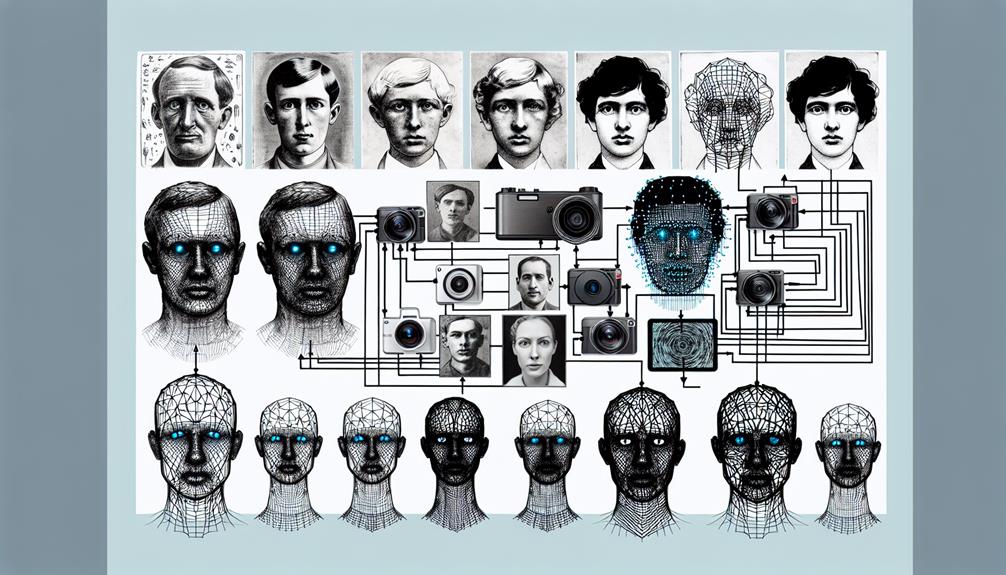
Machine learning algorithms, which learn from image data, are the driving force behind facial recognition technology's ability to identify individuals accurately. By mimicking the human brain with artificial neurons, these algorithms process and match facial features for secure authentication.
Advanced machine learning systems adapt over time to produce the desired outputs, leading to significant improvements in accuracy. Deep convolutional neural networks (CNNs) are commonly used in modern facial recognition technology, enabling the extraction of complex facial features with enhanced precision.
As the technology continues to evolve, these advancements have become critical components of advanced surveillance systems. Effective facial recognition in surveillance relies on the ability of these algorithms to identify individuals accurately, even in diverse scenarios. Additionally, the integration of artificial intelligence has significantly enhanced the efficiency and accuracy of these systems. With the ability to process vast amounts of data in real-time, facial recognition technology in surveillance is now able to adapt to various lighting conditions and angles, improving its overall reliability. As a result, law enforcement agencies are increasingly adopting these solutions to bolster their crime prevention and investigation efforts.
Increasing Accuracy With 3D Technology
In the latest episode of surveillance technology, facial recognition technology has been significantly enhanced through the employment of 3D facial recognition methods. These 3D methods greatly enhance accuracy by leveraging advanced imaging techniques that map and analyze the unique geometry of facial features, ensuring robust security and authentication enhanced by the difficulty to replicate through traditional spoofing methods.
The utilisation of thermal IR imagery to map facial patterns based on blood vessels enhances security by making it difficult for unauthorised access through the use of photographs or masks.
The inclusion of 3D technology represents a more advanced form of facial recognition, providing enhanced accuracy and security compared to traditional 2D systems. This advancement in facial recognition technology offers a significant improvement in accuracy and security, making it a preferred choice for applications requiring high levels of verification and authentication.
Measuring Surveillance Success
I'm going to focus on measuring the success of surveillance systems, particularly those utilizing facial recognition technology. The key to evaluating the effectiveness of these systems lies in their precision rates.
The National Institute of Standards (NIST) has conducted thorough tests to assess the performance of automatic facial recognition algorithms. According to NIST's findings, the most precise face recognition algorithms can confirm passenger identities with a precision rate of 99.5% or higher in certain scenarios.
Success in surveillance is directly linked to low false-positive and false-negative rates. High true-positive rates indicate successful identification of individuals, which is crucial in surveillance contexts. Gemalto's Live Face Identification System, for instance, has demonstrated a high acquisition rate in testing scenarios, highlighting its reliability in detecting and matching faces.
Measuring success in surveillance thus adheres to strict criteria. By meticulously monitoring and analyzing the precision rates of facial recognition systems, we can ascertain that the technology is deployed effectively, providing both reliability and efficiency in surveillance operations.
Balancing Privacy and Surveillance
Balancing Privacy and Surveillance
As surveillance technology increasingly relies on facial recognition to guarantee public safety, it poses ethical challenges that demand a nuanced balance between individual privacy rights and collective security imperatives. Facial recognition technology, though effective in enhancing security and preventing fraudulent activities, raises significant privacy concerns. These concerns arise from its potential to facilitate extensive surveillance and compromise personal information.
Prominent technology developers, such as NEC, acknowledge the need to balance security needs with ethical standards and privacy regulations. They emphasize the importance of responsible technology use, ensuring that facial recognition tools don't infringe upon individual privacy.
Key areas of discussion include ensuring that facial recognition systems are free from biases and that data collection and storage adhere to stringent security protocols. Effective collaboration among businesses, consumers, and governments is essential to strike a balance that prioritizes both security and privacy.
Frequently Asked Questions
How Has Facial Recognition Evolved?
I've witnessed the facial recognition evolution, marked by significant strides in accuracy rates, algorithm development, and biometric data management. However, ethical implications, privacy concerns, and cultural and social implications have grown in tandem.
How Is Facial Recognition Used in Surveillance?
As I implement facial recognition in surveillance, I must address privacy concerns by ensuring secure biometric identification through real-time facial analysis. This enables advanced security applications via sophisticated surveillance systems.
When Did Facial Recognition Cameras Start?
"I can track the early development of facial recognition cameras to the 1960s, pioneered by Woody Bledsoe and others, with key milestones including the Eigenface system and FERET Program, leading to significant technological advancements."
When Did Law Enforcement Start Using Facial Recognition?
"I learned that law enforcement started using facial recognition technology in the 1960s, but it wasn't effectively implemented until the 1990s and 2000s through major government programs like FERET."