


To leverage AI-powered surveillance for enhanced security, I incorporate facial recognition and anomaly detection into video surveillance systems. This allows for proactive threat detection through real-time video analysis. Autonomous drones with AI-powered software provide real-time video feeds, ensuring swift responses to suspicious activities. By integrating these tools with security operations and alarm systems, I can make informed decisions and allocate resources efficiently. AI, used correctly, can revolutionize security. What more can I achieve with AI surveillance?
Key Takeaways
- Utilize AI-Powered Video Analytics: Analyze footage to detect intruders and unusual activities for proactive threat response.
- Implement Biometric Authentication: Use facial recognition for accurate identity verification.
- Integrate Predictive Analytics: Forecast security breaches for efficient resource allocation.
- Employ Autonomous Surveillance Drones: Enhance perimeter security with real-time video feeds.
- Seamlessly Integrate AI with Security Operations: Optimize decision-making and incident response.
AI-Powered Video Analytics
Turning surveillance into an up-to-the-minute, proactive measure, AI-powered video analytics refute the old notion that security systems are only reactive. By leveraging Video AI algorithms, advanced object tracking, and facial recognition, these systems transform passive monitoring into efficient threat detection.
Real-time footage is analyzed to identify unusual activities and intruders, ensuring enhanced security and swift response times. The integration of anomaly detection features further bolsters overall surveillance effectiveness, making it an essential component in proactive threat detection.
Whether it be identifying suspicious individuals or pinpointing potential vulnerabilities, these sophisticated tools transform the surveillance landscape.
What Is Facial Recognition
In the context of AI-powered surveillance, facial recognition technology plays a significant role in ensuring enhanced security. It accurately identifies individuals based on their facial features, making it an integral component in various biometric authentication methods.
Facial recognition's object recognition techniques, when combined with image analysis efficiency, provide robust access control and authentication solutions.
Object Recognition Techniques
Facial recognition technology leverages AI-powered analytics to identify individuals by capturing and measuring their unique facial features, guaranteeing efficient and secure access control. This advanced biometric technology uses object recognition techniques to detect and analyze facial patterns, shapes, and structures. Facial recognition systems have an accuracy rate of over 99.5%, making them highly reliable for access control and security monitoring.
| Application | Description |
|---|---|
| Access Control | biometric data verification |
| Law Enforcement | facial recognition in crime prevention |
| Real-time ID | quick identification in surveillance |
AI algorithms in facial recognition can process enormous amounts of data, enhancing the speed and reliability of real-time identification. This technology is widely used in high-security environments like airports, government facilities, and law enforcement agencies. Facial recognition empowers these organizations to restrict unauthorized access and guarantee seamless access control, significantly enhancing overall security.
Biometric Authentication Methods
Using advanced algorithms to detect unique facial features, facial recognition technology has become a highly accurate and reliable biometric authentication method for identification and access control. This biometric technique scrutinizes specific facial characteristics like the distance between eyes and nose to verify an individual's identity.
With an accuracy rate of over 99.5%, it seamlessly integrates into various settings, enhancing access control and security monitoring. Facial recognition technology can quickly match faces against watchlists and flag potential matches for immediate action, ensuring that organizations can respond promptly to security breaches.
As I explore the world of AI-powered surveillance, it's clear that facial recognition technology is an essential tool in the security sector. It offers an effective means to verify identities, ensuring that only authorized personnel gain access to sensitive areas.
The efficiency and precision of facial recognition technology make it an ideal solution for high-security environments such as airports, banks, and government facilities. As AI continues to evolve, its role in security will become even more crucial, driving innovation and efficiency in the face of evolving security challenges.
Image Analysis Efficiency
Today's facial recognition technology, powered by advanced AI algorithms and computer vision, ranks among the most reliable biometric methods for accurately identifying individuals in various settings.
By leveraging image analysis efficiency, facial recognition technology can greatly enhance security and access control.
Here are the key benefits:
- Precise Identification: AI-powered facial recognition offers precision identification accuracy rates of over 99.5%, ensuring reliable access control and minimizing the risk of unauthorized access.
- Enhanced Security: Facial recognition technology can detect and track individuals, restricting access to high-security environments like airports and government facilities.
- Efficient Authentication: AI algorithms enable efficient authentication mechanisms, reducing the time and resources required to verify identities.
- Advanced Surveillance: Facial recognition technology can seamlessly integrate with surveillance systems to provide thorough security operational control.
Predictive Analytics for Security

As I apply AI-powered surveillance to enhance security, I recognize the criticality of real-time threat detection and proactive incident response.
This involves leveraging advanced analytics to forecast potential security breaches and anticipate vulnerabilities.
Real-Time Threat Detection
By integrating AI-powered surveillance systems, organizations can leverage predictive analytics to detect security threats in real-time based on historical data analysis, effectively anticipating and mitigating potential security breaches.
Using predictive analytics, AI-powered systems can analyze patterns and anomalies in data to predict and prevent security incidents. This proactive approach enhances overall security effectiveness, helping to prevent security breaches.
Here are some key benefits of real-time threat detection:
- Early Warning: AI-powered systems can detect signs of a potential security breach, allowing for swift proactive responses to minimize risk.
- Enhanced Security Measures: Analyzing patterns and anomalies, predictive analytics empower businesses to take preemptive measures against cyber threats and criminal activities.
- Efficient Resource Allocation: Real-time threat detection enables organizations to allocate resources more effectively, ensuring timely responses to threats and optimizing resource usage.
- Improved Incident Response: AI-driven surveillance systems can coordinate with emergency response systems, ensuring prompt coordination among investigation officers and improving overall emergency response efficiency.
Proactive Incident Response
By integrating the power of predictive analytics into AI-powered surveillance systems, we empower proactive incident responses that prevent security breaches before they escalate, greatly enhancing overall security measures.
Leveraging historical data, AI algorithms analyze patterns and trends in real-time data to anticipate potential security threats. This proactive approach allows organizations to take preventive measures, reducing the risk of security breaches from occurring in the first place.
Predictive analytics in AI surveillance empowers proactive incident response by flagging abnormal human behavior in real-time, triggering alerts and notifications to security personnel. By anticipating security breaches before they happen, AI-powered systems optimize security resources and reduce response times, ensuring that incidents are effectively managed and minimized.
Autonomous Surveillance Drones
Autonomous surveillance drones, leveraging advanced AI software, transform traditional perimeter security by efficiently patrolling designated areas and swiftly detecting intrusions or suspicious activities. These drones provide real-time video feeds to security personnel, greatly enhancing situational awareness and enabling swift responses.
By leveraging AI technology, these drones can differentiate between normal and abnormal events, helping security teams focus on potential threats.
Here are some key benefits of using autonomous surveillance drones:
- Enhanced Situational Awareness: Autonomous drones offer a bird's-eye view, ensuring thorough coverage without the constraints of ground-based obstacles.
- Systematic Detection of Intrusions: AI-powered drones can swiftly identify intrusions or suspicious activities, providing live updates to law enforcement.
- Cost-Effective Monitoring: Autonomous drones provide a dynamic and adaptable solution that reduces the expenses associated with manned patrols.
- Real-Time Video Feeds: Drones deliver high-resolution video feeds and thermal imaging capabilities, ensuring precise monitoring of expansive areas.
These benefits make autonomous surveillance drones an essential tool for security operations, providing robust and efficient monitoring solutions for enhancing overall security posture.
Integration With Security Operations
Here is the output for the 'Integration With Security Operations' section:
Integration With Security Operations
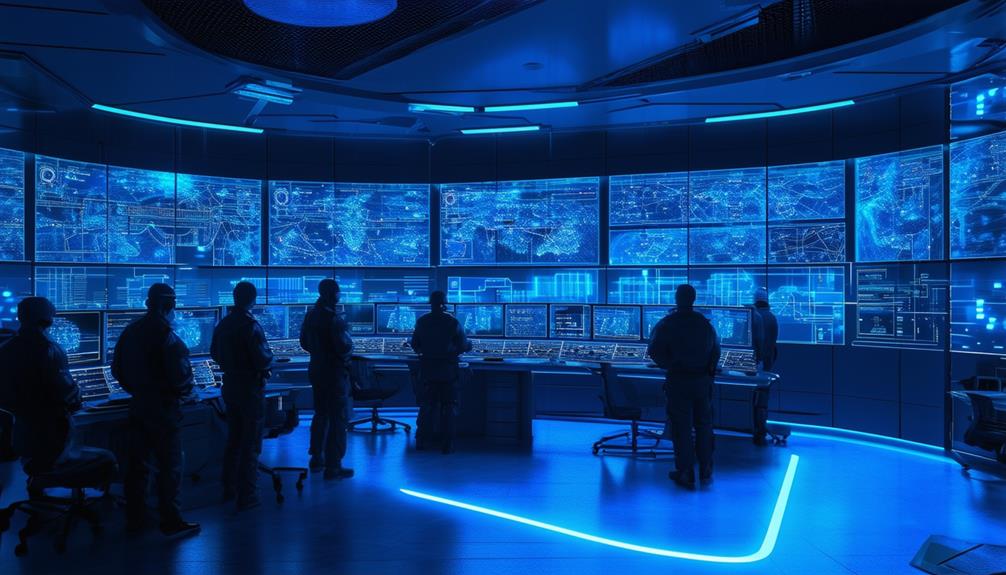
As we incorporate independent surveillance drones into our security infrastructure, it is becoming increasingly important to integrate these solutions seamlessly with our existing security operations systems. This integration amplifies the effectiveness of our all-encompassing security strategy. By combining AI-powered analytics with our existing security setup, we can create a holistic approach to risk management.
| Integration Feature | Benefits | Enhanced Security |
|---|---|---|
| Implementing AI Integration | Enhances Decision-Making | Faster Incident Resolution |
| Seamless Integration with Access Control | Optimize Resource Allocation | Improved Threat Response |
| Combining AI with Alarm Systems | All-encompassing Security Ecosystem | Enhanced Security Efficacy |
This dashboard of integration guarantees that our surveillance drones, access control, and alarm systems work harmoniously to detect and respond to threats more efficiently. The AI integration streamlines decision-making, resource allocation, and incident resolution, making our security operations more robust and responsive. This integrated approach significantly boosts our overall security effectiveness and response capabilities.
Applications of AI-Enabled Systems
In securing sensitive areas and protecting pivotal assets, AI-enabled systems are revolutionizing the way we identify and respond to potential threats. These advanced systems can analyze real-time video feeds for potential security breaches, leveraging facial recognition technology to restrict unauthorized access with an accuracy rate of over 99.5%. This is especially critical in high-security environments like airports and government facilities.
Here are four significant applications of AI-enabled systems:
- Enhanced Predictive Analytics: These systems help identify patterns and anomalies in data, enabling us to predict and prevent potential security threats.
- Intelligent Surveillance Cameras: AI-powered cameras can differentiate between humans, animals, and objects, triggering alerts based on predefined rules.
- Real-Time Threat Detection: By analyzing video feeds in real-time, AI-enabled systems can detect potential threats and alert security personnel instantly.
- Global Market Growth: The market for smart surveillance cameras is expected to reach $22.8 billion by 2025, highlighting the significant impact of AI-enabled security solutions on global security infrastructure.
The Future of AI Surveillance
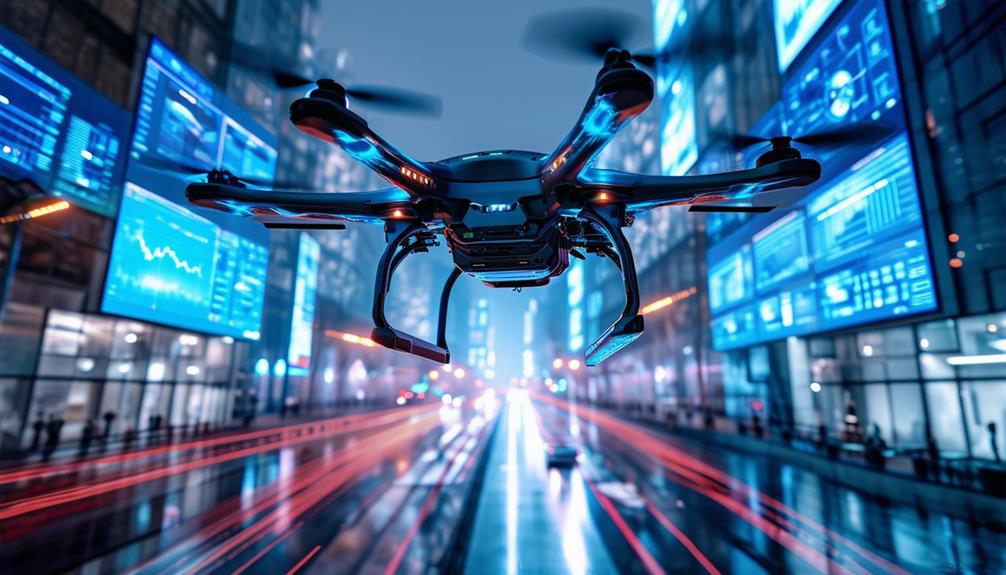
AI-powered surveillance systems are on a trajectory to revolutionize security infrastructure. These advanced technologies are transforming the landscape of security by predicting potential threats with unprecedented accuracy. Advanced AI algorithms can predict security breaches with an accuracy rate of over 90%, marking a significant shift towards enhancing overall security.
| Future of Security | AI for Enhanced Security | Impact of AI |
|---|---|---|
| Real-time threat detection | 90% accuracy in breach prediction | Reduces security incidents by up to 60% |
| Predictive security measures | Integrates AI for advanced threat analysis | Analyzes 100% more data than traditional systems |
| AI Continues to Evolve | Enhancing Overall Security | AI is Revolutionizing Security Infrastructure |
Challenges in AI Implementation
While AI-powered surveillance offers impressive security enhancements, its successful implementation is hindered by several challenges that must be acknowledged and addressed.
One of the primary concerns is the array of ethical issues that come with widespread data analysis and surveillance. This includes privacy worries due to the sheer volume of data being analyzed and the potential for misinterpretation or mismanagement. Additionally, facial recognition and behavior analysis technologies are fraught with ethical quandaries, as they can be prone to racial bias and misinformation. It's essential to address these concerns to secure the responsible use of AI surveillance.
Data security and integrity are vital to protect against unauthorized entry and cyber threats.
Technical challenges include fine-tuning algorithms for accurate detection and seamless integration.
Robust cybersecurity measures are necessary to safeguard personal data from cybercrime.
Compliance with GDPR regulations is necessary to make sure that AI surveillance systems operate within legal boundaries.
To successfully leverage AI-powered surveillance, we must confront and overcome these challenges.
Technical Advancements With AI
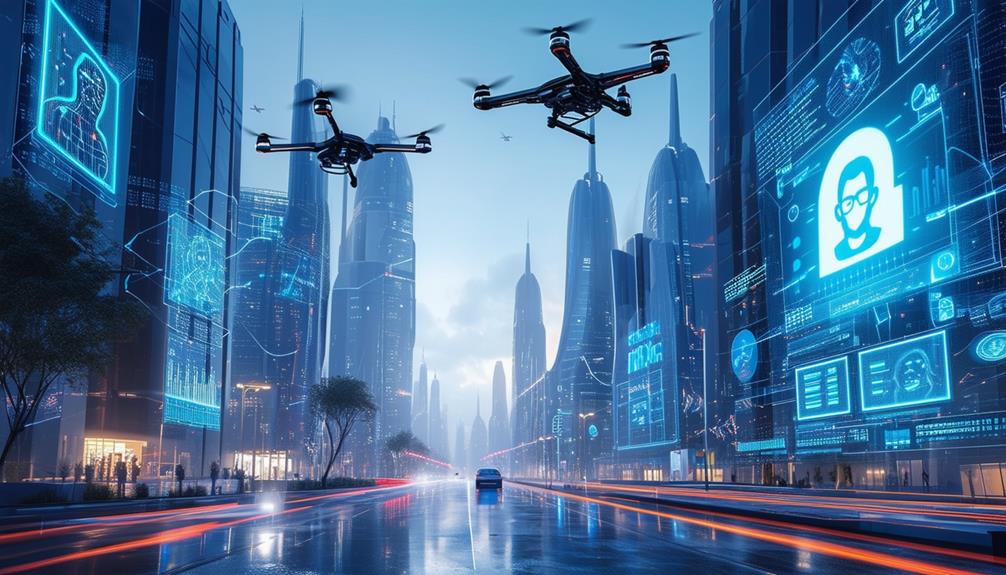
Recent advancements in facial recognition technology boast accuracy rates above 99.5%, greatly enhancing access control capabilities within AI surveillance systems. These AI-powered systems can analyze vast amounts of video data in real-time, which enables them to detect patterns and anomalies human observers may miss. By leveraging advanced algorithms and combining them with historical data, they can even predict security breaches for proactive threat prevention.
Moreover, AI algorithms can integrate with existing security operations seamlessly, creating a thorough security ecosystem. Another significant improvement comes from autonomous surveillance drones that enhance perimeter security. Their rapid deployment and autonomous navigation capabilities foster faster response times, ensuring a safer environment. Integrating these advanced technologies into our security framework will provide exceptional defense against increasingly sophisticated threats.
Frequently Asked Questions
How Does AI Help in Security and Surveillance?
"I leverage AI in security for enhanced threat detection through facial recognition, predictive analytics, real-time monitoring, and behavior analysis. I receive automated alerts based on pattern recognition from surveillance cameras, ensuring intrusion prevention and efficient emergency responses."
How to Use AI to Improve Security?
To enhance security, I implement real-time monitoring, facial recognition, and threat detection. I leverage behavior analysis and predictive modeling to identify anomalies, triggering automated alerts. This integration fosters biometric identification, ensuring data integration and advanced machine learning for best security.
What Is Leveraging AI in Cybersecurity?
To leverage AI in cybersecurity, I employ advanced algorithms for real-time threat detection, intrusion prevention, and behavior analysis to identify anomalies, generating predictive alerts. AI also enhances access control through facial recognition and robust data encryption.
How Can AI Be Leveraged?
I can greatly enhance security by leveraging AI in real-time monitoring for facial recognition and threat identification, using predictive analytics for data analysis and anomaly detection, and automating alerts through advanced video tracking and behavior analysis.