


I work on facial recognition software by implementing a structured workflow that includes face detection, feature extraction, and matching. Key deep learning models like ArcFace enhance accuracy. Integration with law enforcementilin
Key Takeaways
- Facial Recognition Workflow: Face detection, alignment, feature extraction, matching, and decision-making are the crucial steps in facial recognition systems for surveillance.
- Hierarchical Processing: Utilize deep learning models with hierarchical processing for accurate extraction and representation of facial features.
- Optimized Algorithms: Ensure the efficiency of facial recognition software by optimizing algorithms for quick processing and low latency.
- Parallel Processing: Leverage high-performance GPUs for parallel processing to handle large volumes of data and ensure efficient recognition.
- Configuring for User Needs: Adapt facial recognition software to specific user requirements through customization options to ensure seamless integration and effective use.
Face Recognition Workflow Steps
Author:
2024, July 11 – 5:32 UTC.
Deep Learning Model Essentials
In developing facial recognition software, selecting the appropriate deep learning model is essential. It must balance speed and accuracy by learning features from facial images using convolutional neural networks (CNNs) and large datasets. This is vital because CNNs are designed to handle the hierarchical processing of facial features, which enhances the recognition capability of the model.
To guarantee effective facial recognition, the following key aspects should be considered:
- Hierarchical Processing: Deep learning models process facial features in a hierarchical manner, extracting high-level representations for precise classification.
- Transfer Learning: Pre-trained models can be fine-tuned for specific facial recognition tasks, reducing the need for extensive training and computational resources.
- Computational Requirements: Deep learning models require significant computational resources for training and inference due to their complexity.
Recognition Use Cases Explained

Facial recognition software is currently used in various sectors, including law enforcement, healthcare, and retail, where its applications greatly enhance processes and safety protocols.
In law enforcement, facial recognition technology has significantly aided in criminal identification. For example, agencies can use software to quickly match facial images from crime scenes to known suspects in their databases. This technology enables swift identification, contributing to efficient case resolution.
Healthcare organizations leverage facial recognition software to ensure precise patient identification. This technology reduces the risk of misidentification and subsequent medical errors by utilizing unique facial features to confirm identities. Biometric patient identification solutions improve patient outcomes by reducing delays in treatment and enhancing data security.
Retailers integrate facial recognition technology to create personalized experiences for customers. Solutions like VIP recognition systems and emotion detection enhance customer service and streamline store operations.
One case study involving a Japanese convenience store effectively implemented facial recognition to create a cashless and cardless checkout system, showcasing the potential of this technology in retail.
Accelerating System Performance
To further enhance the capabilities of facial recognition systems, optimizing processing speed is vital for efficiency in real-time applications. This guarantees that the system can handle a large volume of facial images and videos quickly and accurately.
Here are some key strategies to accelerate system performance:
- Leveraging High-Performance GPUs: Utilize high-performance GPUs to boost facial recognition system processing speed. This can decrease the processing time for facial detection and recognition tasks, making the system more efficient.
- Implementing Parallel Processing: Implement parallel processing techniques to efficiently handle large volumes of facial images and videos in real-time. This involves breaking down the processing tasks into smaller, independent tasks that can be executed simultaneously.
- Optimizing Algorithms: Optimize algorithms and models for faster inference times and reduced latency in facial recognition tasks. This involves refining and adapting algorithms to minimize computational complexity and maximize performance.
Integration and Customization Tips
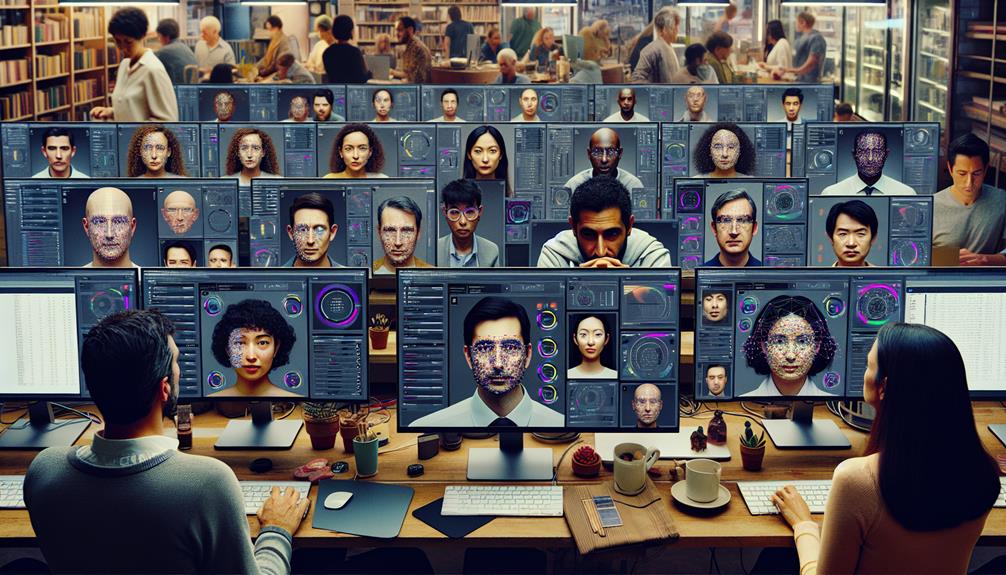
Across various facial recognition applications and platforms, integrating the software effectively comes down to choosing the right API/SDK, configuring it for precise user needs, and ensuring seamless interaction with existing infrastructure.
When selecting an API or SDK, it's essential to opt for one that offers customization options tailored to my specific requirements. This allows me to adapt the facial recognition software to my existing surveillance system, ensuring efficient monitoring capabilities.
To optimize the software's performance, I must consider multiple factors such as lighting conditions and individual preferences. By implementing user-specific settings, I can significantly enhance recognition accuracy. This custom approach enables the software to manage variables that often impact facial recognition success, such as angled or partially occluded faces.
Regular updates and fine-tuning are equally important to keep the software aligned with evolving surveillance demands. By focusing on these key integration and customization tips, I can effectively harness the power of facial recognition technology for enhanced security and monitoring in various settings.
Frequently Asked Questions
How to Improve Facial Recognition Technology?
To improve facial recognition technology, I incorporate diverse datasets, mitigate bias, and address privacy concerns while ensuring data security. I apply techniques like transfer learning and data augmentation to enhance accuracy and detect biases.
What Techniques Are Used to Train Models for Face Detection and Recognition?
When training models for face detection and recognition, I utilize techniques like data preprocessing, image augmentation, and feature extraction through Convolutional Neural Networks (CNNs), then optimize model architecture and hyperparameters via transfer learning.
How to Develop a Facial Recognition System?
To develop a facial recognition system, I collect a robust dataset, preprocess images, extract facial features, and train a deep learning model using facial recognition algorithms.
How Is Facial Recognition Used in Surveillance?
"I use facial recognition tech in surveillance to aid law enforcement while balancing privacy concerns and addressing ethical implications like bias detection, ensuring robust data security, and understanding the limitations of this emerging capability in diverse applications."






1 comment
Comments are closed.