
Facial recognition software—hero or villain? Law enforcement loves it for tracking criminals. But, uh-oh, it's notorious for privacy breaches. It matches faces using biometric wizardry, but let's not ignore its racial bias and incorrect IDs. Fans celebrate its banking and airport heroics. Critics shudder at surveillance nightmares. No federal rules? You bet. It misreads Black and Asian faces more frequently. A paradox of security and ethics. Curious about the ongoing saga? There's more to uncover.
Key Takeaways
- Facial recognition software aids law enforcement in solving crimes and conducting surveillance operations.
- The technology raises privacy and ethical concerns, particularly regarding mass surveillance and civil liberties infringements.
- Racial bias in facial recognition systems results in higher misidentification rates for minorities, impacting trust and accuracy.
- The absence of federal regulations leads to inconsistent state-level governance of facial recognition technology.
- Public opinion is divided, with many concerned about privacy violations and the potential misuse of the technology.
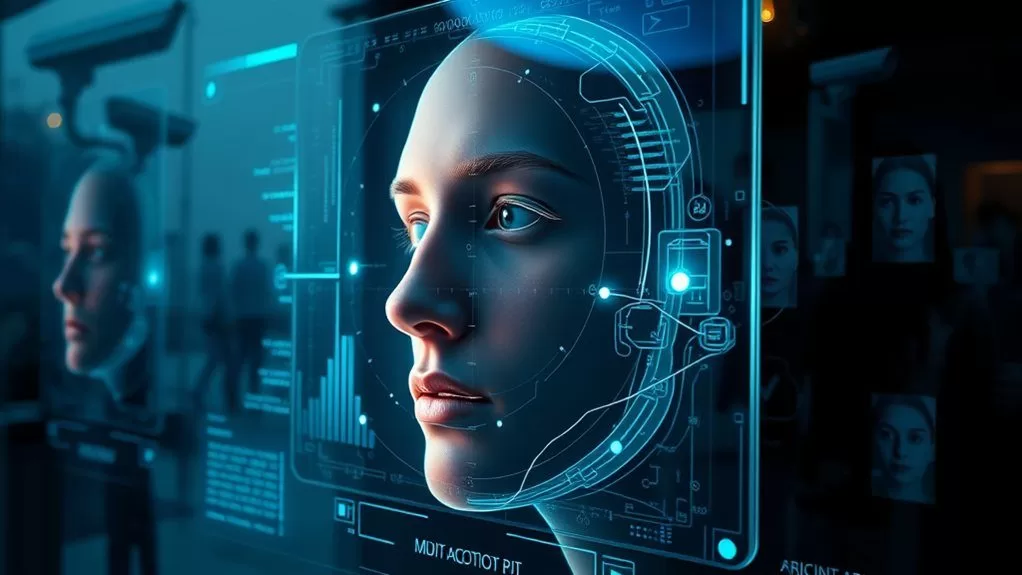
Facial recognition software: a marvel of modern technology or a privacy nightmare? This biometric technology promises to verify identities by matching facial features in images or videos against vast databases. It harnesses convolutional neural networks to analyze, compare, and verify these facial templates. Contactless and convenient, yes. But let's not get ahead of ourselves. It's less accurate than fingerprint recognition. A bit of a bummer.
Facial recognition systems have a straightforward job: detect faces, align them, extract features, and compare them against known faces. Simple, right? Wrong. The technology's applications span various sectors—security, finance, entertainment. It's everywhere. Yet, the promise of facial accuracy often collides with privacy implications. Especially when it's used in law enforcement for crime solving and surveillance, or in banking for identity verification. Even airport security and border control processes have embraced it, streamlining operations. Retailers? They must love it too, using it for targeted advertising by identifying consumer demographics.
But wait, there's more. Smart home appliances recognize users, enhancing customer experiences. Who knew a fridge could know who you are?
This technology isn't just about convenience. It's backed by complex techniques: face detection, alignment, and feature extraction. Thanks to neural networks, and convolutional ones at that, it's all possible. Traditional methods involved geometric and photometric approaches—fancy words for analyzing the distance between eyes and nose shapes. Advanced algorithms are now in play, handling variations in lighting and expressions. The accuracy of facial recognition is assessed by false positivity and negativity rates, which are key benchmarks for evaluating the performance of these systems. Despite its widespread use, public attitudes towards facial recognition are mixed, with many expressing discomfort over its potential impact on privacy.
But let's pause. The more it improves, the more it invades. A dichotomy.
Privacy and ethical concerns loom large. Facial recognition systems ignite debates about potential mass surveillance. Critics argue it infringes on civil liberties like freedom of assembly. Racial bias? A glaring issue, as systems often misidentify Black and Asian faces. The indiscriminate use without consent? A major ethical faux pas. The U.S. lacks a thorough federal regulatory framework, leaving some states and cities to fend for themselves. Illinois has its laws; San Francisco and Boston have their bans. It's a patchwork of regulations.
Technical limitations add fuel to the fire. Accuracy varies, with higher error rates for some demographics. Lighting and facial expressions complicate things further. Deepfakes pose security risks, threatening to bypass even the most advanced systems. And let's not ignore the flawed or biased databases powering this technology. Racial profiling is another concern, as facial recognition systems can amplify bias and lead to disproportionate targeting of marginalized communities.
Modern systems are improving, but the journey is fraught with challenges. Facial recognition: a tangled web of advancement and intrusion.
References
- https://www.innovatrics.com/facial-recognition-technology/
- https://www.theregreview.org/2024/12/28/seminar-facial-recognition-technologies/
- https://en.wikipedia.org/wiki/Facial_recognition_system
- https://ace-usa.org/blog/research/understanding-the-debate-on-facial-recognition-technology-in-policing-pros-cons-and-privacy-concerns/
- https://azure.microsoft.com/en-us/resources/cloud-computing-dictionary/what-is-face-recognition