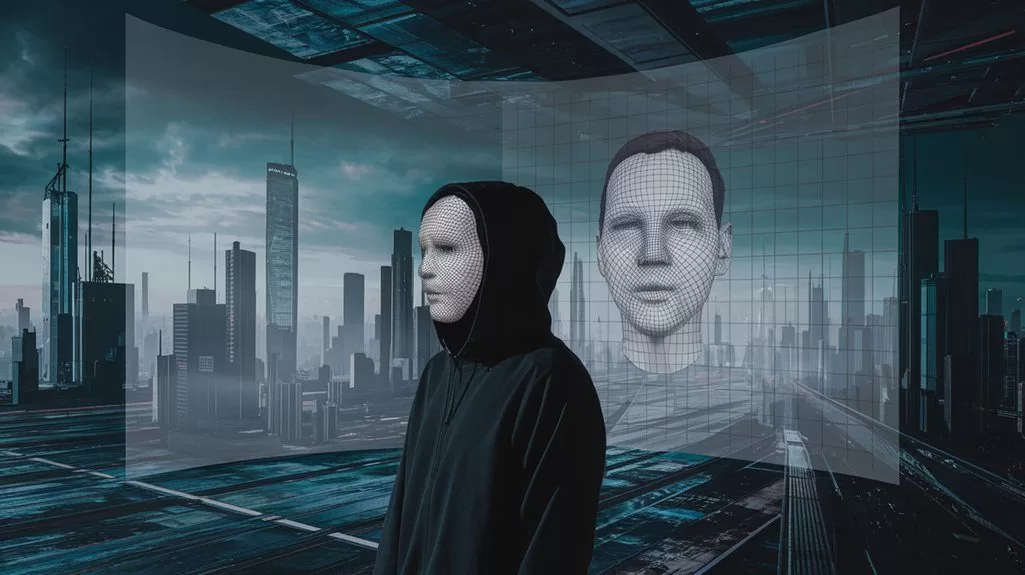


AI-powered facial recognition is an innovative yet controversial invention. It enhances security and convenience, from securing devices to personalizing shopping. But, it creeps into privacy, creating an uneasy feeling of surveillance everywhere. Faceprints stored, like digital fingerprints, pose storage and consent issues. Legal frameworks remain murky, leading to ethical headaches. It's a tech marvel with potential benefits. But sneaky side effects too. Want more on this technical roller coaster of privacy and ethics?
Key Takeaways
- AI facial recognition enhances security, but raises privacy concerns due to increased surveillance in public spaces.
- The technology's lack of clear legal frameworks leads to potential misuse and ethical challenges.
- Facial recognition applications streamline processes, yet risk unauthorized data collection and storage.
- Public unease grows as constant monitoring challenges the balance between security and personal privacy.
- Legal and ethical oversight are essential to address the double-edged implications of facial recognition technology.

While society grapples with the implications of AI, AI-powered facial recognition marches on, undeterred. The core technology underpinning this innovation is astounding. Face detection isolates faces from a sea of pixels using advanced algorithms. Feature extraction then pinpoints unique facial landmarks—eyes, nose, mouth. Facial encoding translates these into a numerical faceprint. Deep learning, with its neural networks, further refines pattern detection and adaptability. Verification and identification follow, comparing faces against vast databases. It's a technological marvel.
In practical terms, AI facial recognition finds its way into diverse applications. Security services use it for surveillance and access control, ensuring unauthorized individuals stay out. Personal devices like smartphones and laptops employ it for secure access. Retailers and marketers? They craft personalized experiences based on facial analysis. Banking and finance sectors leverage it to enhance customer verification. Digital onboarding becomes a breeze, streamlining identity checks across industries. The list goes on. Machine learning algorithms analyze and compare faces from images or video against a reference database, enhancing the efficiency of these applications. Facial recognition technology verifies identity using algorithms, which makes it crucial in sectors like commercial identification and security.
But hold on—there's a catch. Privacy concerns rear their ugly heads. Surveillance risks loom, particularly in public spaces where individuals feel like they're under a relentless gaze. Many regions lack clear laws governing the use of facial recognition. Data protection is paramount, yet ensuring faceprints are securely stored remains a challenge. The loss of consent is a real fear, especially when governments and law enforcement agencies misuse the technology. Public unease grows as people grapple with the idea of being constantly watched. Balancing security needs with privacy considerations is crucial to address these concerns. It's a double-edged sword.
The process itself is straightforward yet complex. Image capture kicks things off, followed by preprocessing to enhance image quality. Feature mapping identifies key facial features, leading to faceprint creation. Then comes face matching, where captured faces are compared to stored faceprints for verification or identification. Decisions are made swiftly. It's efficient, perhaps too efficient for comfort.
Efficient yet unsettling: facial recognition swiftly matches faces, raising concerns over its rapid, complex process.
Deep learning and neural networks play a significant role. Pattern detection becomes more sophisticated, adapting to changes in appearance like aging or facial hair. Convolutional Neural Networks (CNNs) dominate facial image analysis and encoding. Accuracy? It's improved, thanks to advances in neural networks. Scalability is achieved through distributed machine learning. It's impressive, but at what cost?
Ethical implications demand attention. Oversight is necessary to establish transparent guidelines for use. Legal frameworks are lacking. Balancing benefits and risks is essential. Transparency in use is critical. Public debate is encouraged. But is society ready to face the ethical dilemmas head-on? As AI-powered facial recognition forges ahead, the challenges remain formidable. It's progress, but not without its pitfalls.
References
- https://www.fraud.com/post/ai-face-recognition
- https://indiaai.gov.in/article/ai-and-facial-recognition-a-double-edged-sword
- https://www.innovatrics.com/facial-recognition-technology/
- https://mediatum.ub.tum.de/doc/1703633/pq5qo05ro5566l4zozyhvtwlh.Dissertation.pdf
- https://intellicoworks.com/blog/ai-face-recognition-technology/