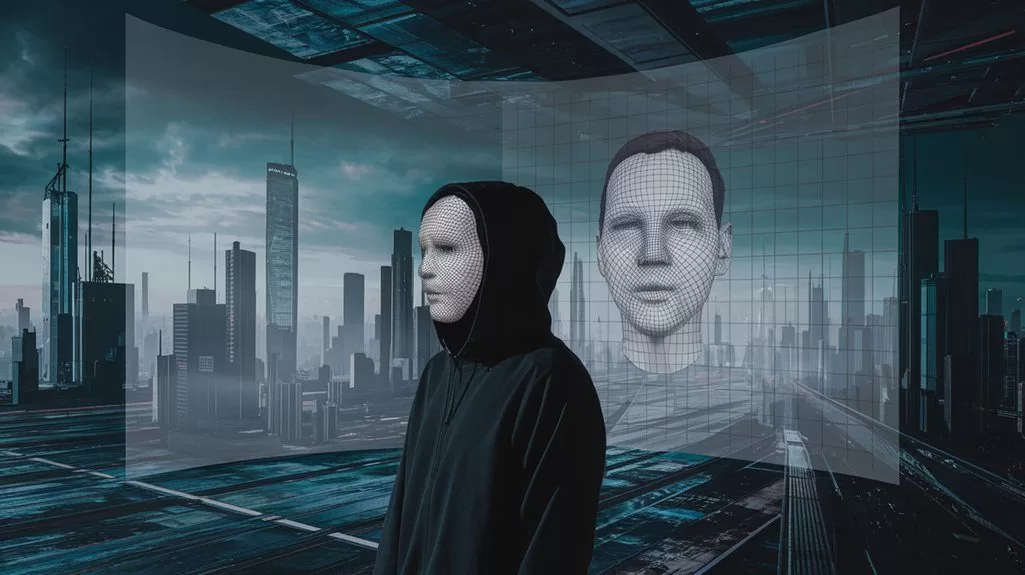


Outsmarting facial recognition technology is no walk in the park, but it's not impossible either. Masks, wigs, even some sci-fi makeup can confuse these systems. But don't break out the party streamers yet – advancements in recognition accuracy keep pushing the limits. It's a dance of cat and mouse, where tech tries to stay ahead. Ethical dilemmas loom large, poking at the balance beam of privacy and security. Curious for the real scoop?
Key Takeaways
- Masks, prosthetics, and wigs effectively alter appearance, confusing facial recognition systems.
- High-contrast makeup and tattoos add complexity, disrupting facial identification algorithms.
- CV Dazzle and adversarial patches create misleading patterns to evade detection.
- Environmental factors like lighting and pose can complicate accurate recognition.
- Continuous advancements in disguise techniques drive new solutions for maintaining privacy.
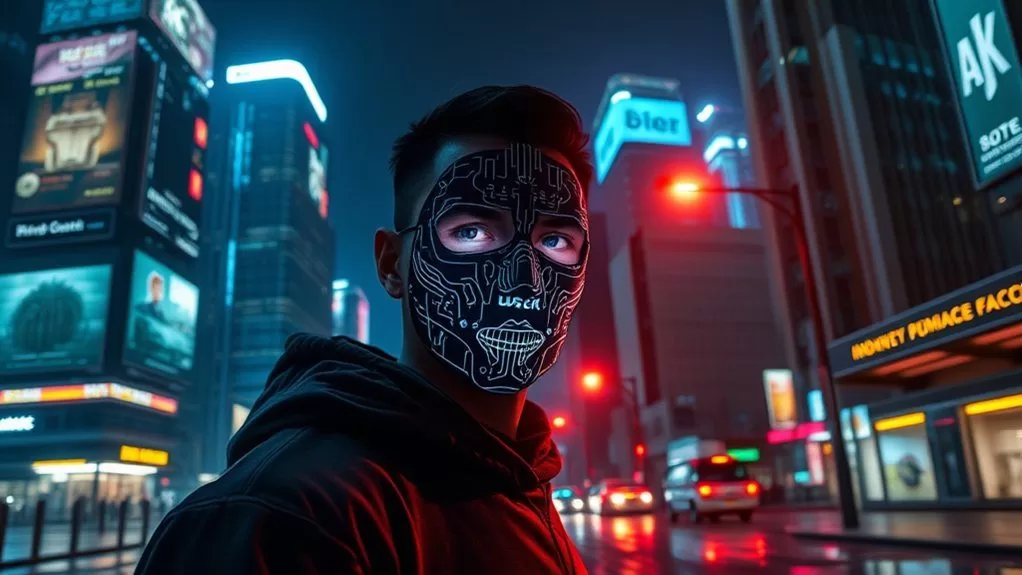
Why is everyone suddenly so interested in outsmarting facial recognition technology? Well, it seems the idea of being constantly watched isn't as appealing as one might think. Enter disguise techniques. From masks to prosthetics, individuals are employing a variety of methods to throw a wrench in the digital gaze. Masks are a straightforward way to evade these systems. They simply cover the face. But not all masks are created equal. Some are designed with such intricacy that they can make a group of people appear identical to the system, thanks to 3D-printed prosthetic faces.
Makeup, often relegated to the world of beauty, now serves as a countermeasure. High-contrast patterns and strategic darkening can confuse those all-seeing algorithms. Tattoos and piercings, though a more permanent change, add another layer of complexity to an individual's appearance. Then there are wigs and accessories. Simple yet effective. They change the visual cues enough to slip past many recognition systems. The risk of misidentification is a significant concern, as biased algorithms can lead to false arrests, especially affecting marginalized communities.
High-contrast makeup and accessories offer clever ways to outsmart facial recognition systems.
But technology has a few tricks up its sleeve as well. Enter CV Dazzle Makeup. This avant-garde combination of fashion and makeup employs asymmetrical, high-contrast designs to thwart recognition attempts. And don't forget adversarial patches—graphic prints that provide misleading patterns to cameras. Or face projectors, which overlay a different face onto one's own. LED visors also join the fray, using light to create visual noise, rendering faces unrecognizable to the prying eyes of AI.
Despite these efforts, one must consider the countermeasure effectiveness. It's a game of cat and mouse. Facial recognition systems rely on landmarks like eyes, nose, and mouth. Altering these with disguise techniques can disrupt the process. Environmental factors like lighting and pose further complicate matters. Yet, as technology advances, so does recognition accuracy—and its potential for misuse. The HyperFace Project effectively combines abstract patterns with makeup to confuse detection algorithms, showcasing the intersection of artistic expression and practical privacy solutions.
Research initiatives are tirelessly working to identify vulnerabilities and create new countermeasures. Biometric systems, like facial recognition, rely on pattern matching to analyze and compare unique features, making it critical to find innovative ways to outsmart them. Clothing patterns and subtle disguises like minimal makeup offer potential solutions without drawing unwanted attention. Even free disguise kits are making the rounds, providing simple methods to evade detection.
However, it's not all rainbows and unicorns. There are ethical considerations to weigh. Balancing privacy concerns with the benefits of facial recognition technology is no small task. As the debate rages on, one thing is clear: the quest to outsmart facial recognition is as much about maintaining personal privacy as it is about pushing the boundaries of art and technology. In a world where surveillance is king, individuals are finding creative ways to reclaim their anonymity.
References
- https://www.popularmechanics.com/technology/security/g28719483/trick-surveillance-systems/
- https://drrajivdesaimd.com/2018/12/03/facial-recognition-technology/
- https://www.theregister.com/2025/01/15/make_up_thwart_facial_recognition/
- https://www.nist.gov/blogs/taking-measure/facing-facts-keep-our-biometrics-secure
- https://www.businessinsider.com/clothes-accessories-that-outsmart-facial-recognition-tech-2019-10