


The military dances with AI champions to give orders and gather intelligence. Efficiency and precision have skyrocketed. AI plays the puppet master, automating data-heavy tasks, freeing up human strategists. Handy, right? But, oh the irony, we now lean on our digital friends to minimize human error. Intelligence gathered and missions executed with fewer blunders. Yet, we must eye AI with a hint of skepticism. Curious about the complexities lurking behind this integration? There's more…
Key Takeaways
- AI automates data-heavy tasks, enhancing command efficiency and freeing strategic minds for critical decision-making.
- Autonomous systems in military operations boost situational awareness and operational precision while minimizing human error.
- AI-driven predictive analytics optimize logistics and resource allocation, ensuring timely supply delivery in challenging environments.
- AI enhances intelligence gathering through rapid analysis, improving strategic decision-making and maintaining information control.
- AI-powered combat simulations provide realistic training scenarios, enhancing soldiers' readiness and effectiveness without traditional training risks.
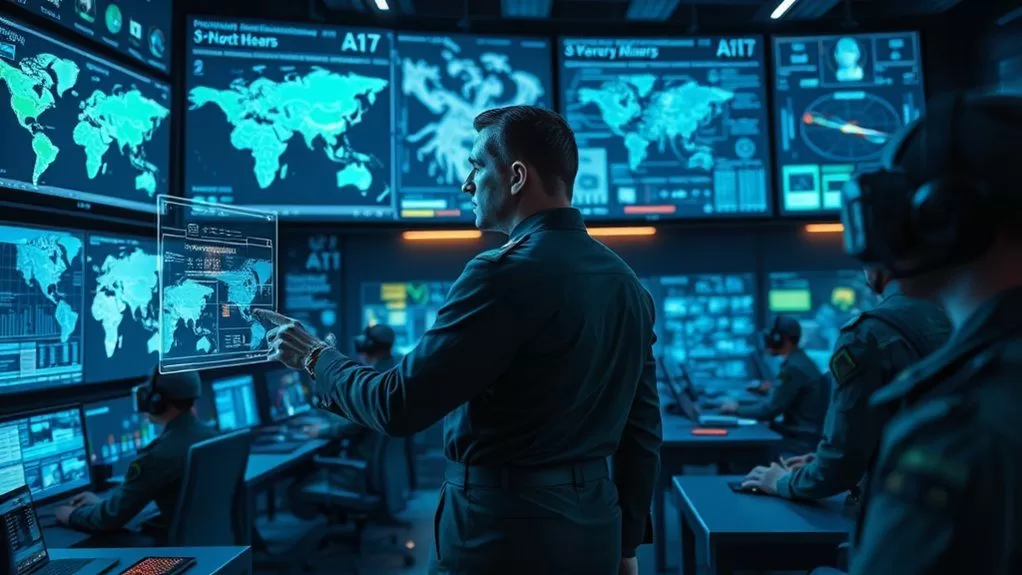
The military's dance with artificial intelligence is nothing short of revolutionary. AI Integration into military operations has transformed command efficiency. Envision this: vast amounts of data analyzed in the blink of an eye, strategic minds no longer bogged down by tedious tasks. Instead, they're free to focus on vital decisions. The result? Enhanced operational efficiency.
AI automates data-heavy tasks, freeing personnel to engage in more strategic activities, all while increasing speed and accuracy in decision-making processes. It's a no-brainer: AI systems boost situational awareness by analyzing immense datasets, minimizing human error in high-stakes environments. The evolution of information operations over time reflects significant adaptations to technological advancements, underscoring the military's strategic use of AI. AI-powered systems also enhance border security, providing real-time analysis and automated decision-making capabilities that optimize resource deployment for swift responses.
Logistics management? Say goodbye to the old ways. AI streamlines resource allocation, ensuring the right materials are in the right hands at the right time. But let's not sugarcoat it; this isn't just about logistics. Autonomous weapon systems are a game-changer. Drones and UAVs, powered by AI, execute surveillance and targeted strikes with precision.
Swarms of drones operate as coordinated units, autonomously analyzing and reacting in real-time. Offensive and defensive military capabilities are taken to new heights, reducing the need for human intervention in high-risk missions. It's both exhilarating and terrifying.
Intelligence gathering and analysis have also received an AI makeover. Imagine deep learning models analyzing images and videos, identifying objects, and tracking movements with unerring accuracy. Satellite imagery and drone footage are processed efficiently, making manual methods seem archaic.
AI systems detect enemy troop movements and positioning faster than ever, enhancing strategic decision-making. AI algorithms assist in rapid data analysis, informing strategic planning with real-time insights. It cuts through human bias like a hot knife through butter, providing data-driven insights that bolster command structure. The rapid analysis supports troops, especially in high-pressure situations.
In the domain of cybersecurity and information warfare, AI is the sentinel. It detects threats and defends against attacks with a vigilance that would make even the most dedicated human operators jealous. By analyzing vast data pools, AI predicts vulnerabilities, maintaining strategic information control during conflicts.
Combat simulation and training have also entered the AI age. AI-driven simulations present realistic battlefield scenarios—no more risky live exercises. Soldiers train in environments that prepare them for diverse scenarios, enhancing readiness and effectiveness without the added danger.
Military AI adoption is not just an arms race; it's a technological marathon. The strategic edge in AI is essential for maintaining future military power. The stakes are high, and the competition is fierce. AI champions, indeed.
The use of AI in military logistics is becoming increasingly sophisticated, with autonomous vehicles enhancing supply chain efficiency and predictive analytics optimizing the delivery of supplies in remote or hostile areas. Military AI adoption is not just an arms race; it's a technological marathon. The strategic edge in AI is essential for maintaining future military power. The stakes are high, and the competition is fierce. AI champions, indeed.
References
- https://www.unaligned.io/p/ai-in-military-applications
- https://csiac.dtic.mil/articles/artificial-intelligence-as-a-force-multiplier-in-u-s-military-information-campaigns/
- https://ideascale.com/blog/ai-military-advancements/
- https://www.armyupress.army.mil/Journals/Military-Review/English-Edition-Archives/March-April-2025/AI-Cyber-Information-Operations-Integration/Journals/Military-Review/MR-War-Poetry-Submission-Guide/
- https://sdi.ai/blog/the-most-useful-military-applications-of-ai/