Facial recognition is both lauded and criticized. It's nifty for catching crime, but worries abound. Privacy invasion? Check. Bias against dark skin? Sadly, yes. Sure, it speeds up banking and boosts security, but trust issues loom large. Who likes being watched, even if it's for "safety"? Automation threatens jobs, too. Advances by companies like Alcatraz AI suggest exciting possibilities, though missteps can be costly. Curious what happens next?
Key Takeaways
- Facial recognition enhances security but raises significant privacy concerns and ethical implications.
- The technology aids in real-time identification, boosting efficiency across various sectors.
- Bias and inaccuracies in facial recognition systems pose risks of wrongful identification.
- Regulations like GDPR and BIPA attempt to address privacy but can't ensure complete security.
- Public concerns persist about surveillance and privacy invasion despite technological advancements.
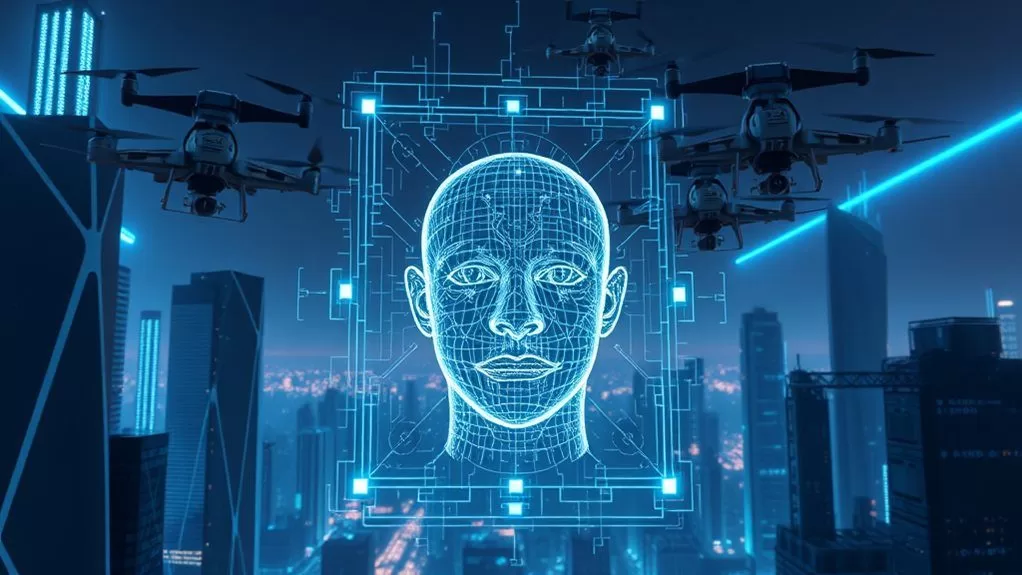
In a world where technology seems to know more about us than we do ourselves, AI-powered facial recognition stands as both a marvel and a menace. It's the shiny new toy that promises to keep us safe while simultaneously peering into the depths of our privacy. The ethical implications of this technology are as vast as the universe it's trying to conquer.
Sure, it can grant access to buildings, prevent crimes, and even alert authorities to unwanted guests. But at what cost? Privacy concerns loom large, like a shadow over a sunny day. Facial recognition is increasingly integrated across various industries for efficiency, demonstrating its wide-ranging applications that extend beyond just security.
A technological marvel with a steep price—our privacy hangs in the balance.
Facial recognition is the darling of security applications. Access control in commercial and residential settings? Check. Surveillance systems that can identify and track people in real-time? Absolutely. Crime prevention and real-time alerts for banned individuals? You bet. Facial recognition is also widely used in health and safety measures, ensuring proper protective gear is worn and reducing the risk of workplace accidents.
But here's the kicker: it's not perfect. Bias issues persist, especially against those with darker skin tones. And while the magic of pattern recognition and liveness detection makes it all seem foolproof, there's always a chance of error. Oops, wrong person. Better luck next time. Biased training data often leads to these inaccuracies, underscoring the need for more diverse datasets.
Let's talk about privacy, or the lack thereof. Data breaches could expose sensitive information faster than you can say "oops." Even with biometric data privacy regulations like GDPR and BIPA, there's no guarantee of absolute security. A false sense of safety, perhaps.
The ethical implications in law enforcement are particularly dicey. Imagine being wrongly identified as a criminal because the system decided your face was 'suspicious.' Not exactly the kind of attention anyone wants.
Yet, the technology marches on, infiltrating sectors beyond security. In banking, facial recognition promises to reduce fraud and speed up transactions. In public safety, it helps locate individuals in large crowds.
But while the efficiency is impressive, the societal concerns about technological risks are hard to ignore. The public perception isn't always rosy. Concerns over job displacement and privacy invasion are like a bad smell that won't go away.
Still, companies like Alcatraz AI push the envelope, offering seamless, contactless access control solutions. Their integration of AI enhances recognition capabilities in complex environments.
It's almost as if they're saying, "Look how clever we are!" But cleverness doesn't negate the ethical implications or privacy concerns. It's a balancing act on a tightrope, high above the ground.
References
- https://www.cyberlink.com/faceme/insights/articles/228/how-to-use-facial-recognition
- https://www.asisonline.org/security-management-magazine/monthly-issues/security-technology/archive/2021/december/facial-recognition-technology-the-good-the-bad-and-the-future/
- https://www.tridon.com/ai-facial-recognition-technology-the-future-of-security/
- https://www.mdpi.com/2075-4698/14/12/271
- https://alcatraz.ai