


NASA's recent acquisition of Clearview AI's shady facial recognition tool is raising eyebrows. Known for scraping billions of photos without consent, Clearview is a darling of over 2,200 law enforcement agencies. Its use at NASA, meant for security and auditing, ironically compromises privacy. Critics fret over misidentifications and data management, while NASA's silence adds to the unease. With NASA embracing this technology, the trade-off between security and privacy seems lopsided. The story isn't over.
Key Takeaways
- NASA's acquisition of Clearview AI software raises significant privacy and ethical concerns due to its controversial data-scraping practices.
- Clearview AI's history of mistaken identifications has led to legal issues and increased scrutiny regarding its use by NASA.
- Critics question NASA's transparency and decision-making process regarding the adoption of Clearview AI for security purposes.
- The balance between security and privacy is debated, especially with the potential misuse of facial recognition technology.
- Clearview AI's compliance with U.S. data privacy laws is claimed, but concerns persist about personal data management and security breaches.
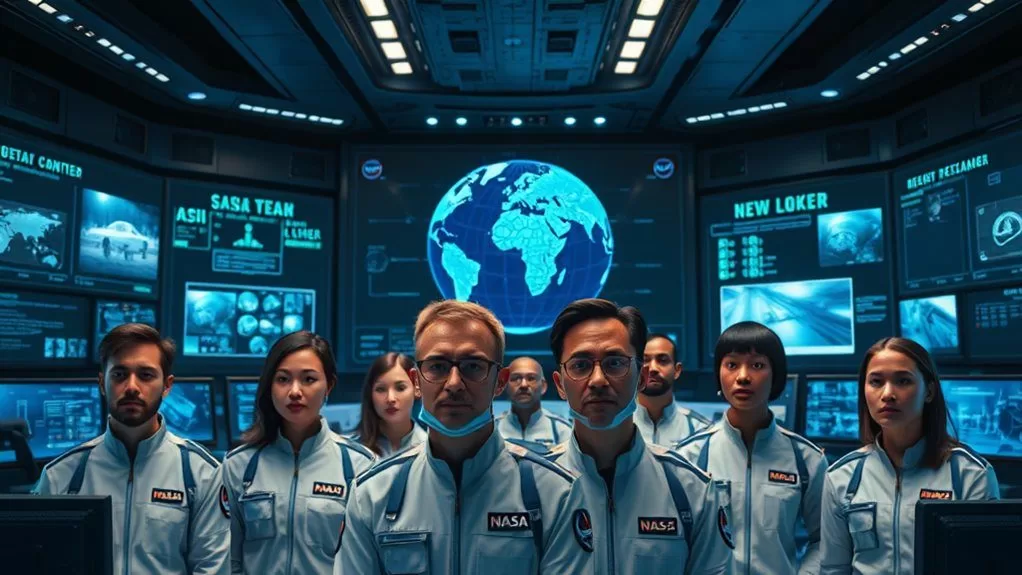
Despite its storied legacy of exploring the cosmos, NASA has recently plunged into murkier waters with its acquisition of Clearview AI's controversial facial recognition software. Clearview AI, a surveillance startup, has gained notoriety for scraping billions of photos from social media platforms without consent. This raises a cacophony of privacy rights alarms. Yet here we are, with NASA buying into it, citing a need for high-level security and auditing functions for its Office of Inspector General (OIG). But let's not kid ourselves: this move has raised eyebrows. Understandably.
NASA's leap into facial recognition with Clearview AI raises privacy alarms amid its quest for tighter security.
Clearview's technology, while touted for its security benefits, is not without its flaws. Mistaken identifications have led to innocent individuals facing legal nightmares. This isn't just an oops moment—it's a major privacy rights issue. Critics argue that the potential for misuse is vast, with no shortage of ethical questions around consent. Clearview's involvement with over 2,200 law enforcement agencies paints a picture of widespread adoption, albeit shadowed by controversy. In comparison, NASA has banned the use of China's DeepSeek AI technology due to national security and privacy concerns, highlighting the broader trend of U.S. agencies evaluating foreign technology. The risk of misidentification with such technology poses significant legal challenges, especially for marginalized communities.
NASA, on its part, maintains that Clearview complies with U.S. data privacy laws. Okay, but there's more to ponder than just legal boxes being ticked. Transparency in government decisions is essential. Yet the lack of clarity on how Clearview manages personal data is unsettling. The OIG, an agency reporting directly to Congress, is tasked with oversight. But how effectively it scrutinizes such technologies is, shall we say, up for debate. Interestingly, NASA's acquisition follows a data breach that exposed Clearview's client list, raising further concerns about the security of such sensitive information.
The applications for Clearview AI at NASA are pretty straightforward—monitoring and identifying individuals within NASA premises. This aligns with broader security strategies, including collaborations with private entities. But does this justify potential privacy trade-offs? That's the million-dollar question.
While other government agencies like ICE and Interpol have also utilized facial recognition technologies, NASA's involvement adds an unexpected twist to its traditionally space-bound narrative.
In comparison, other AI technologies, like the banned DeepSeek AI, faced scrutiny due to security concerns. Different tools, different risks. Yet Clearview's surveillance focus sets it apart from AI models like ChatGPT, which serve less contentious purposes. The choice of technology reflects specific security needs, but it also raises questions about where to draw the line between security and privacy.
References
- https://futurism.com/nasa-ai-surveillance-software
- https://www.nbcphiladelphia.com/news/business/money-report/nasa-becomes-latest-federal-agency-to-block-chinas-deepseek-on-security-and-privacy-concerns/4095118/
- https://beamstart.com/news/nasa-caught-purchasing-controversial-ai-1742071680
- https://www.asau.ru/files/pdf/522538.pdf
- https://oig.nasa.gov/wp-content/uploads/2023/12/ig-23-012.pdf