


Implementing facial recognition for security monitoring starts with understanding privacy regulations like GDPR and CCPA, and guaranteeing informed consent. I then focus on comprehensive technical training covering data privacy, encryption, and troubleshooting. The next step involves selecting and customizing appropriate APIs or SDKs using AI and ML techniques. I always conduct extensive testing before deployment to ensure dependability. Designing the system to handle large data volumes and integrating real-time threat alerts with SIEM tools is crucial. High-performance hardware and remote access capabilities streamline security. Dive deeper to explore all the facets essential for a successful implementation.
Key Takeaways
- Ensure compliance: Obtain informed consent and adhere to GDPR and CCPA regulations for data privacy.
- Select appropriate APIs/SDKs: Choose APIs/SDKs tailored for facial recognition with robust security features.
- Implement robust encryption: Encrypt all biometric data to safeguard against breaches.
- Conduct thorough training: Equip team members with knowledge in data privacy, technical aspects, and troubleshooting techniques.
- Test extensively before deployment: Perform rigorous testing to ensure system reliability and accuracy.
Privacy and Compliance
To guarantee compliance with privacy regulations like GDPR and CCPA, we must first thoroughly understand the requirements and implications of these laws when implementing facial recognition technology. These regulations mandate that we obtain informed consent from individuals before collecting their biometric data. This guarantees that everyone is aware of how their data will be used and stored.
Data minimization is another essential principle. We should only collect the necessary biometric data required for our security monitoring purposes. This approach not only aligns with privacy regulations but also reduces the risk of data breaches by limiting the volume of sensitive information we handle.
To further safeguard biometric data, encryption is non-negotiable. Encrypting biometric data ensures that even if unauthorized access occurs, the data remains unreadable and secure.
Additionally, transparent policies on data collection and usage are vital. By clearly communicating our data practices, we build trust with users and ensure compliance with GDPR and CCPA. Transparent policies should detail what data is collected, how it's used, and the measures in place to protect it.
Training and Implementation
Effective training and implementation of facial recognition technology depend on equipping team members with in-depth knowledge of its operation, data privacy regulations, and troubleshooting techniques.
To successfully implement facial recognition software, I start by conducting thorough training sessions. These sessions cover the technical aspects of the software, including how to use the system for security monitoring and automated attendance tracking.
Understanding data privacy is vital. I make sure my team is well-versed in data encryption methods and secure storage practices to protect biometric data. We follow transparent policies regarding data collection and usage, complying with regulations like GDPR and CCPA. This transparency builds trust and guarantees we respect individual privacy rights.
Additionally, I stress the importance of customer behavior analysis. By utilizing facial recognition data, we can make data-driven decisions to improve customer experiences.
Training also includes advanced troubleshooting techniques to address any system issues promptly, ensuring uninterrupted operation.
Software Development

Building on the foundation of extensive training and data privacy knowledge, I now shift my focus to the intricacies of software development for facial recognition systems. The first step involves selecting suitable APIs or SDKs tailored for facial recognition. These tools must integrate seamlessly with security cameras, guaranteeing they can handle real-time data processing.
Customization is essential. Each face recognition system must be adapted to specific use cases, whether it's user authentication or broader security monitoring. Utilizing Convolutional Neural Networks (CNNs) allows for advanced feature extraction, enhancing the system's accuracy. Artificial Intelligence, Machine Learning, and Deep Learning techniques are fundamental in refining these models, ensuring they can reliably recognize faces under various conditions.
Testing is another crucial aspect. Before deployment, I thoroughly test the software to guarantee it meets accuracy and reliability standards. This involves evaluating the system's performance across different scenarios to identify and rectify potential weaknesses.
Furthermore, developing user authentication features using facial recognition can greatly strengthen security measures. By customizing these features, I optimize the system's performance, guaranteeing it effectively meets the demands of security monitoring applications.
Software development services play a crucial role in this process, providing the necessary expertise to create robust and efficient systems.
Scalability and Features
Ensuring the scalability of facial recognition systems involves designing them to handle increasing volumes of data and user interactions efficiently. Scalability guarantees that as your business grows, the system can seamlessly expand without compromising performance. This is vital for maintaining robust security monitoring.
One essential feature for a scalable system is an audit trail. This capability provides thorough tracking of access attempts and system usage, guaranteeing that every interaction is logged for security and compliance purposes. Integration with SIEM tools further enhances this by offering real-time threat alerts and analyzing system activities. This integration allows for proactive security monitoring, guaranteeing that potential issues are identified and addressed promptly.
Compliance with regulations such as GDPR and CCPA is non-negotiable. These regulations mandate strict data protection and privacy measures, guaranteeing that the facial recognition system handles personal data responsibly. Transparent policies on data collection and usage not only help in maintaining compliance but also build trust with users. They demonstrate a commitment to privacy and reassure users that their data is protected.
Real-time Operations
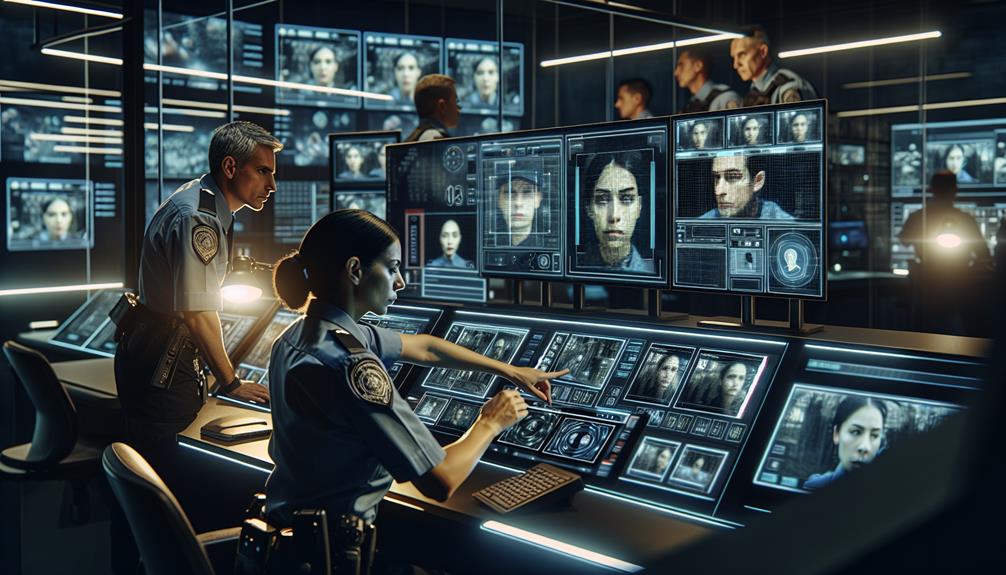
Real-time operations in facial recognition demand the swift processing and analysis of data as it's captured, enabling immediate identification and response to potential security threats. To achieve this, I leverage AI technology and efficient learning algorithms to guarantee that Face Detection and recognition are both rapid and accurate. These algorithms must be finely tuned to detect unique facial features and respond within milliseconds, which is essential for maintaining robust security and effective access control.
Implementing real-time operations means deploying high-performance hardware capable of handling large-scale data processing. This setup guarantees that the system can continuously monitor and analyze faces without lag, providing proactive security measures. Each facial recognition frame must be scrutinized instantly, allowing the system to make quick decisions based on the most current data.
Moreover, integrating Remote Access capabilities allows me to manage and monitor the system from any location, enhancing security oversight. The goal is to create a seamless and responsive facial recognition environment where real-time operations not only boost security but also streamline access control.
This approach assures that potential threats are identified and mitigated promptly, maintaining a secure and controlled environment.
Frequently Asked Questions
How to Implement a Face Recognition System?
To implement a face recognition system, I'd first define the scope and objectives, then utilize facial recognition algorithms, guarantee proper system integration, address data privacy, assess hardware requirements, and focus on image preprocessing, real-time processing, accuracy assessment, and security implications.
How Does Facial Recognition Work Step by Step?
To understand facial recognition, I capture an image, preprocess it with image processing techniques to enhance facial features, use machine learning and neural networks to detect facial landmarks, and compare it with a facial database for real-time monitoring.
How Is Facial Recognition Used for Security?
Facial recognition is used in security for biometric authentication, access control, and criminal identification. It enhances surveillance applications through real-time detection, machine learning algorithms, and facial database management. Privacy concerns and security integration are key considerations.
What Techniques Are Used to Train Models for Face Detection and Recognition?
To train models for face detection and recognition, I utilize data preprocessing, feature extraction, convolutional neural networks, transfer learning, image augmentation, hyperparameter tuning, loss function selection, model evaluation, and real-time deployment. This guarantees peak accuracy and efficiency.





5 comments
Comments are closed.