

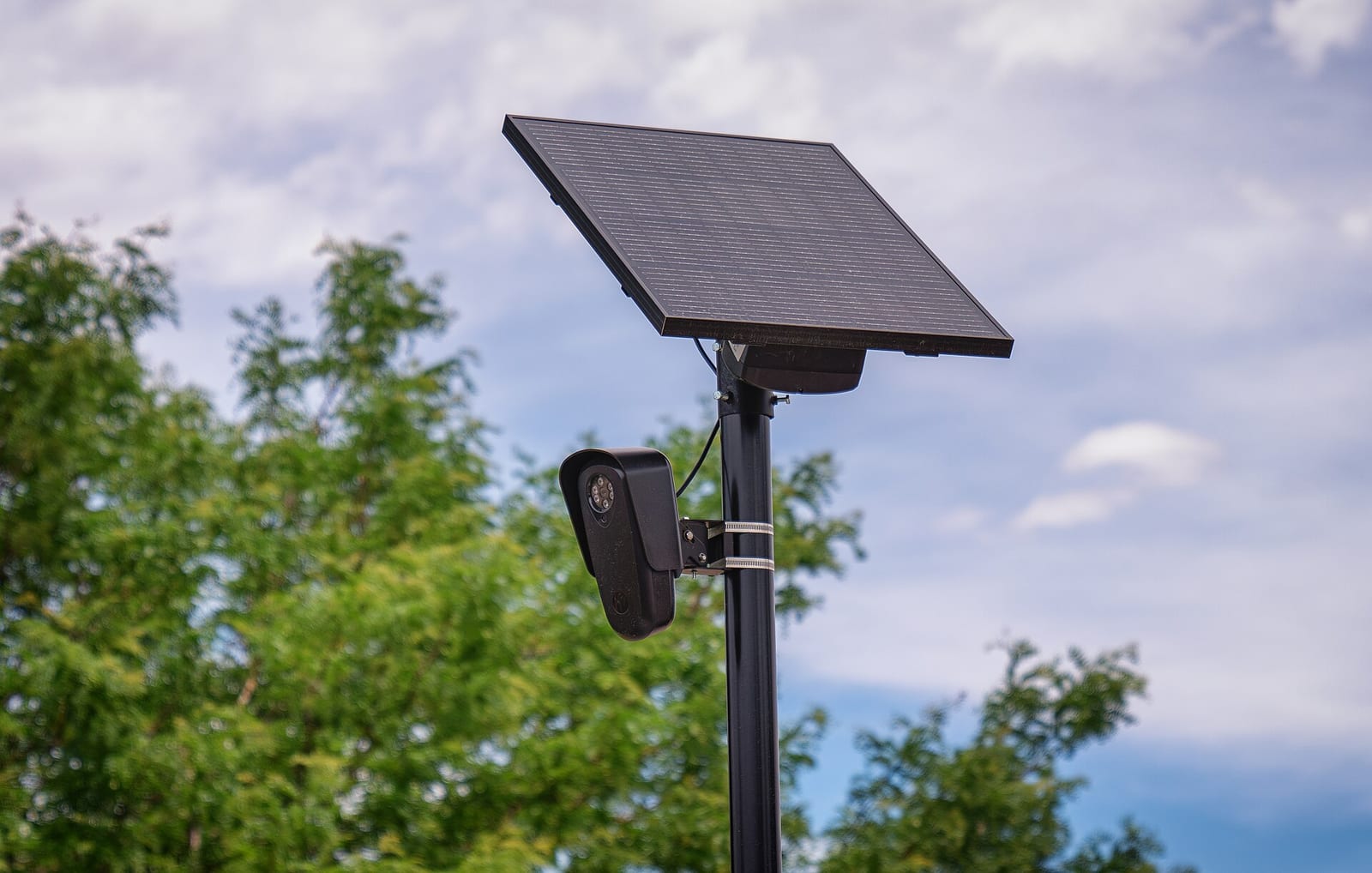
A Flock camera is a license plate reader made by Flock Safety. It photographs vehicles that pass, reads the plate, and logs the make, color and other visible details with the time and place. Police can search those records, and agencies can choose to share them with each other. Flock's FAQ says it works with more than 6,000 communities. Volunteers have mapped many of the cameras on DeFlock, and your city's records show who can search the data where you live.
The last section lists free, legal steps for finding out what your own town does. Facts are current as of November 5, 2026.
What a Flock camera records
Flock describes its cameras as built to focus on vehicles in public view. It lists the plate, make, model, color, and other visible features such as bike racks, trailers and toolboxes. The company states that the cameras do not use facial recognition.
Privacy groups read the same capability differently. The ACLU of Oregon says Flock cameras are more powerful than older plate readers because they record and analyze every passing vehicle, including scratches, dents and other identifiers. In its view, a pattern of sightings across many cameras can reveal where a person goes, such as meetings, doctors' offices and religious institutions.
Flock cameras are one brand of a wider category called automated license plate readers, or ALPRs. The ACLU's Get the Flock Out toolkit lists other vendors, including Axon, Vigilant Solutions and Genetec. A volunteer-built map site says about 77 percent of the cameras it shows are tagged as Flock devices, and the rest come from other makers (that site is third-party and its counts are not official).
What a Flock camera looks like
Flock's own implementation guide describes mounting the camera and a solar panel on an existing pole, or on a 12-foot breakaway pole that Flock supplies. The volunteer map site reports them most often near intersections, city limits and neighborhood entrances.
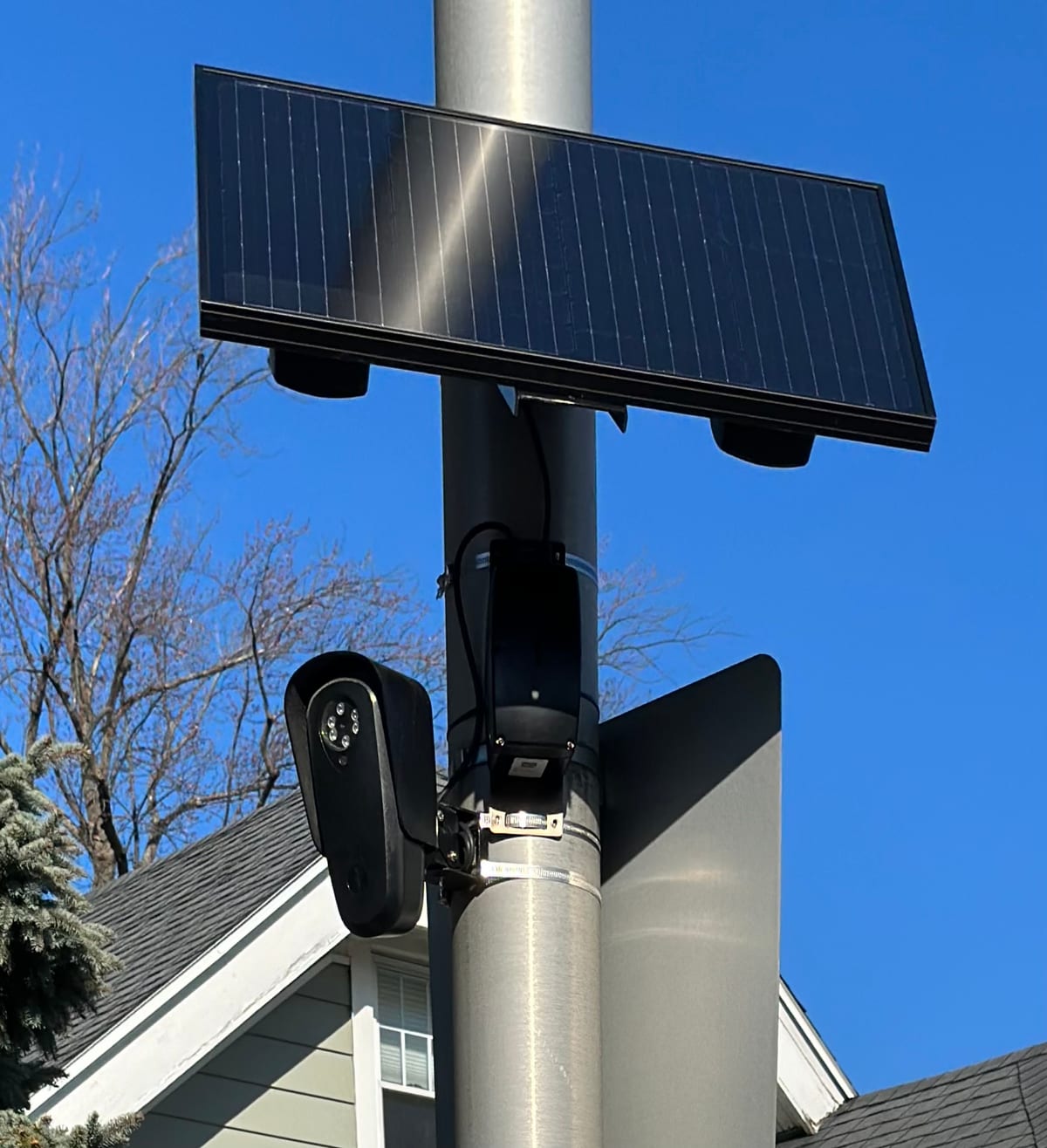
Some Flock cameras are not on poles. The ACLU of Oregon notes that the company also sells units that are not fixed in place, such as trailers.
How long the data is kept
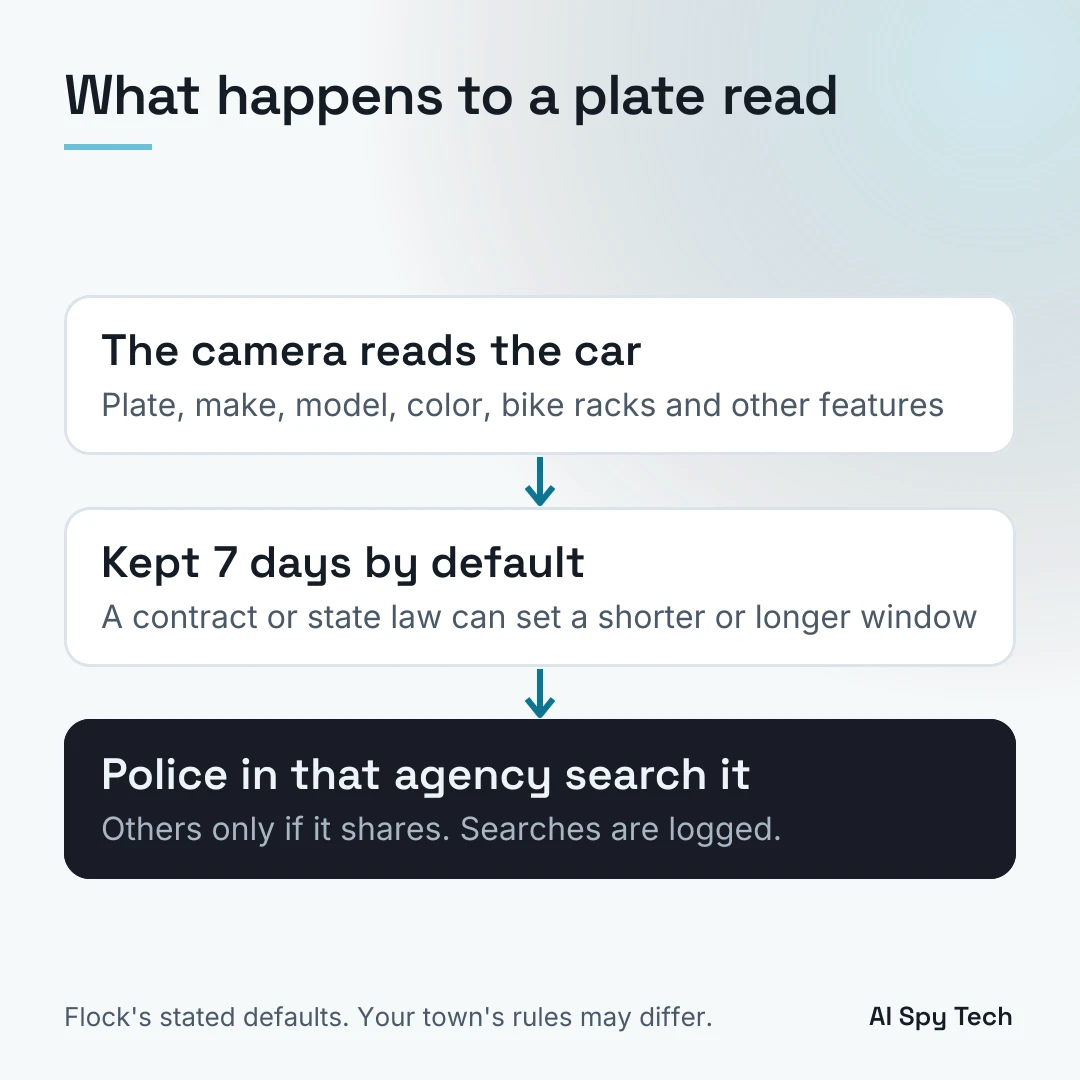
Flock says the default is 7 days. In a June 2, 2026 post, the company states that data is automatically deleted on a rolling schedule, 7 days by default, and that the actual window is set by each agency's contract and by state or local law. Some communities run shorter windows, Flock says, and others run longer. Flock's evidence policy also describes data being stored for seven days and then deleted.
Your town's number may be different. In Norfolk, Virginia, the Institute for Justice describes a 30-day window during which officers can download as much as they want from the database. Some states set a ceiling by statute, according to the National Conference of State Legislatures' ALPR statute summary, updated September 28, 2026:
| State | Rule in the NCSL summary |
|---|---|
| Washington (SB 6002, 2026) | Delete within 21 days unless an exception applies |
| Virginia (Code 2.2-5517) | 21 days for system data, 2 years for audit-trail data |
| Iowa (321P.4) | Delete within 30 days |
| California (Vehicle Code 2413) | State Highway Patrol data kept no more than 60 days, unless used as evidence in felony cases |
A MultiState report from September 23, 2026 says Connecticut also enacted a 21-day limit (SB 397) in 2026, and that New Mexico and Kentucky passed ALPR laws as well. NCSL counts at least 28 states with statutes that address ALPR use or data retention.
Who can search the data
Police in the customer agency can search it. Beyond that, Flock's post on data deletion says agencies are not enrolled in any sharing relationship by default, and that any decision to share, local, regional or federal, belongs to the customer, can be changed at any time, and is logged. Flock's CEO made the same point in a June 2025 statement, quoted in a University of Washington Center for Human Rights report: "It is a local decision." That report adds that Flock gives customers two monthly audits, one of their own users' searches and one of outside users' searches of their network.
The sharing question became a public dispute in 2025.
- In May 2025, 404 Media reported that local police were running Flock searches on behalf of Immigration and Customs Enforcement, according to the UW report. The searches surfaced because officers typed terms like "ICE" or "illegal immigration" into the required reason field.
- On August 25, 2025, the Illinois Secretary of State announced an audit finding that Flock had allowed U.S. Customs and Border Protection to access Illinois cameras, in violation of state law. The Secretary ordered access shut off. The office said Flock leadership was unaware of the CBP pilot program, and that Flock paused its pilot with CBP and other federal agencies nationwide.
- The UW researchers found that at least eight Washington law enforcement agencies had enabled direct sharing with U.S. Border Patrol at some point in 2025, based on public records they obtained.
Flock's position, as stated in the company posts above, is that sharing is controlled by customers and logged. The UW researchers note that Flock's safeguards rely on officers entering honest search reasons, and that discrepancies between Flock's audits and other documents make it impossible for outsiders to determine the current scope of access. Both statements can be true, and the second is the reason records requests matter (see below).
Where the cameras are, and how to find them
Flock does not publish a public map of its cameras. Several free tools fill part of the gap.
DeFlock
DeFlock is a volunteer project. Its map says camera locations come from volunteers and the OpenStreetMap community, not from a company or a government agency. The ACLU's toolkit links the project's main site at deflock.org. A volunteer map is incomplete by nature: a camera appears only after someone has seen and reported it, and coverage is better in big metro areas.
This page does not copy DeFlock's data. Open the map and zoom to your town.
Atlas of Surveillance
The Electronic Frontier Foundation's Atlas of Surveillance tracks which local agencies use surveillance technology, including plate readers. It tells you whether your police department or sheriff uses them, not where each camera stands.
City transparency portals
Many agencies that use Flock publish a Flock-hosted transparency page. The ACLU's toolkit calls these portals "barebones" and suggests searching your city's name plus "Flock transparency portal." Two examples are El Cajon Police, California and the Spokane County Sheriff, Washington. A public list is kept at footnote4a.org. If your agency has no portal, that is not evidence it has no cameras.
Are Flock cameras legal?
The first federal ruling on a Flock network went the city's way. Most of the limits so far come from state laws.
The leading court case is Schmidt v. City of Norfolk. Two residents, represented by the Institute for Justice, sued in October 2024 and argued that Norfolk's network of more than 170 cameras violated the Fourth Amendment. The Institute for Justice reports that a federal district court ruled for the city on January 27, 2026, and that the residents appealed. Courthouse News reported the ruling as holding the city's use constitutional. The IJ page lists appellate briefs filed on April 13 and July 23, 2026. A ruling from the Fourth Circuit was not found as of November 5, 2026.
States are legislating more than courts are deciding. Washington's 2026 law, according to the NCSL summary, allows ALPR use only for specific purposes, bars use for immigration enforcement, requires registration with the attorney general, and lets people injured by a violation sue for damages. Illinois law bars sharing plate data for investigating reproductive health care or immigration status, and requires out-of-state agencies to sign a written declaration first. The MRSC explainer walks through the Washington law for local governments.
What Flock cameras cost and who pays
Local governments pay, usually from a general budget. A December 16, 2025 staff report from Dixon, California lists a Flock proposal for eight more cameras: $24,000 a year for the platform, plus a one-time $650 installation fee per camera, for a first-year total of $29,200 paid from the General Fund. That works out to $3,000 per camera per year. A staff report from Indio, California describes a five-year agreement for 45 cameras at $2,500 per camera per year, plus a proposal to add 27 more at $3,000.
Cost varies by contract and year, and the contract is a public record in most places.
Cities that cancelled or paused
Cancellations picked up in 2026. Ars Technica reported on August 28, 2026 that Secure Justice, an advocacy group, had recorded 214 cities and counties that have dropped Flock since 2021, 90 of them in August 2026 alone. That count comes from an advocacy group, not an official register.
Flock's reply, from spokesperson Courtney Terlecki in the same article, is that "new city partnerships have outpaced nonrenewals by approximately 10 to one" so far in 2026. The article gives no count of new customers.
A few examples, each from local or official reporting:
- Evanston, Illinois deactivated its cameras and ended its contract on August 26, 2025, citing the Secretary of State's audit and Flock's admission that it lacked distinct permissions for a federal pilot.
- Santa Cruz, California voted 6-1 on January 13, 2026 to end its contract, according to Santa Cruz Local. Sponsors cited tensions with ICE and weak trust after Flock's response to data breaches. The council left room for a possible replacement system.
- Asheville, North Carolina voted 5-2 on August 25, 2026 to end its contract, according to Mountain Xpress.
- Lynchburg, Virginia's council voted on September 3, 2026 to end its contract, WSLS reported, and WSET reported debate continuing about how and when the cameras come down.
- Columbus, Ohio's mayor paused police use of the city's 65 cameras on September 3, 2026 after the city found an officer may have misused them, per Ideastream.
Canceling is not always quick. The Verge reported that after Plymouth, Minnesota voted to end its contract, Flock did not respond for more than a week, and the city's chief had staff unplug the cameras. The company later said removal could take up to 60 days.
One more development involved a large partner. Amazon's Ring and Flock had planned an integration. On February 12, 2026, Ring announced the two companies had canceled it. Ring said the integration never launched, so no Ring customer videos were shared. CNBC reported the decision came amid backlash over a Super Bowl ad.
What you can do
All of these are free and legal.
Find out whether your town uses them
Search your city's name plus "Flock" and "ALPR." Open DeFlock's map and the Atlas of Surveillance. Check for a transparency portal as described above.
Read the paper trail
The ACLU's toolkit recommends searching your city's agendas and minutes for "automated license plate reader," "ALPR" and "Flock," including the consent agenda, where purchases can pass without discussion. Ask whether the council voted on the contract.
Ask your council
The ACLU suggests questions that fit in one email: how many cameras are in use, where they are, what the city pays, what the retention period is, who the data is shared with, and whether the council approved the contract.
File a public records request
The ACLU of Iowa published a step-by-step guide, last updated August 18, 2026. It is written for Iowa, but the document list works anywhere. Check first whether the documents are already public, find the agency's records custodian, and request contracts, invoices, use policies and search audit logs showing which agencies searched your local cameras. Add a date range, and expect that agencies may charge reasonable fees. Each state has its own deadlines, so look up your state's open records law before sending.
If you would also like to shrink what other companies hold about you, see our guide to removing personal information from data broker sites. For a different kind of tracking, see PimEyes and face search.
Check your state's law
The NCSL summary above is the quickest way to see whether your state caps retention, limits sharing, or bars uses such as immigration enforcement.
Do not cover your plate
Plate covers and blockers are sold online. They are also illegal in many states, so check yours before buying anything. California's AB 1085 makes it an infraction, with a $1,000 fine, to manufacture a product intended to obscure or interfere with the visual or electronic reading of a plate, according to the California DMV's December 26, 2025 summary of 2026 laws. Florida Statute 320.061 bars attaching a covering or other material that interferes with the legibility or detectability of a plate, a second-degree misdemeanor, while allowing frames that leave the number and decal visible. The steps above carry no such risk.
Frequently asked questions
Can a Flock camera track me in real time?
A camera logs a vehicle only when it passes that spot, so a record is a sighting and not a live GPS feed. The concern raised by the ACLU of Oregon is the pattern: many sightings within the retention window can show routines. Flock's stated default is 7 days, so the window is often short, but it depends on the contract and state law.
Does Flock share data with ICE?
Flock says sharing is the customer's decision and is logged. The record shows mixed outcomes. The Illinois audit found federal Customs and Border Protection had access through a pilot Flock then paused, and UW researchers found Washington agencies sharing with Border Patrol in 2025. The Illinois Secretary of State describes ordering CBP access shut off. Washington's 2026 law now bars ALPR use for immigration enforcement, per NCSL. What happens in your town depends on its agency settings, which a records request can reveal.
How do I know if my city has Flock cameras?
Check DeFlock's map, the Atlas of Surveillance, and a search for your city plus "Flock transparency portal." If none shows anything, ask the police department or file a records request. A city can have cameras that volunteers have not yet mapped.
Can a city cancel a Flock contract?
Yes, and many have in 2026. The terms depend on the contract. Some cities ended theirs at once, some waited for the term to run out, and Plymouth, Minnesota found removal took longer than it wanted. Read the termination clause in your own city's agreement.
How is Flock different from other plate readers?
Flock's pole units run on solar power and feed Flock's own search system, where agencies that agree to share can search each other's cameras. The ACLU of Oregon says Flock cameras log vehicle details beyond the plate. Vendors such as Axon, Vigilant Solutions and Genetec make other ALPR systems, and some cities that dropped Flock have not dropped plate readers.