

Start with the free steps. Ask Google to drop results that show your phone number, address or ID numbers, using its Results about you tool. Opt out of the large people-search sites one at a time, starting with Whitepages and Spokeo. California residents can send one free request through the state's DROP system to every registered data broker. Paid removal services file the same opt-outs for you and repeat them, because listings come back.
Nobody can delete everything. People who try usually find they can remove some of it and limit what spreads next. The goal here is a smaller, harder-to-find footprint.
Prices, laws and policies below are as of November 5, 2026. Each one links to the page it came from.
Where your information comes from
Two kinds of sites hold most of what a stranger can find about you. People-search sites such as Whitepages and Spokeo publish profiles with addresses, phone numbers and relatives. Data brokers are the wider group: companies that collect personal information and sell or license it to other businesses. Many people-search sites buy from brokers, and brokers get records from public filings, marketing lists and other brokers.
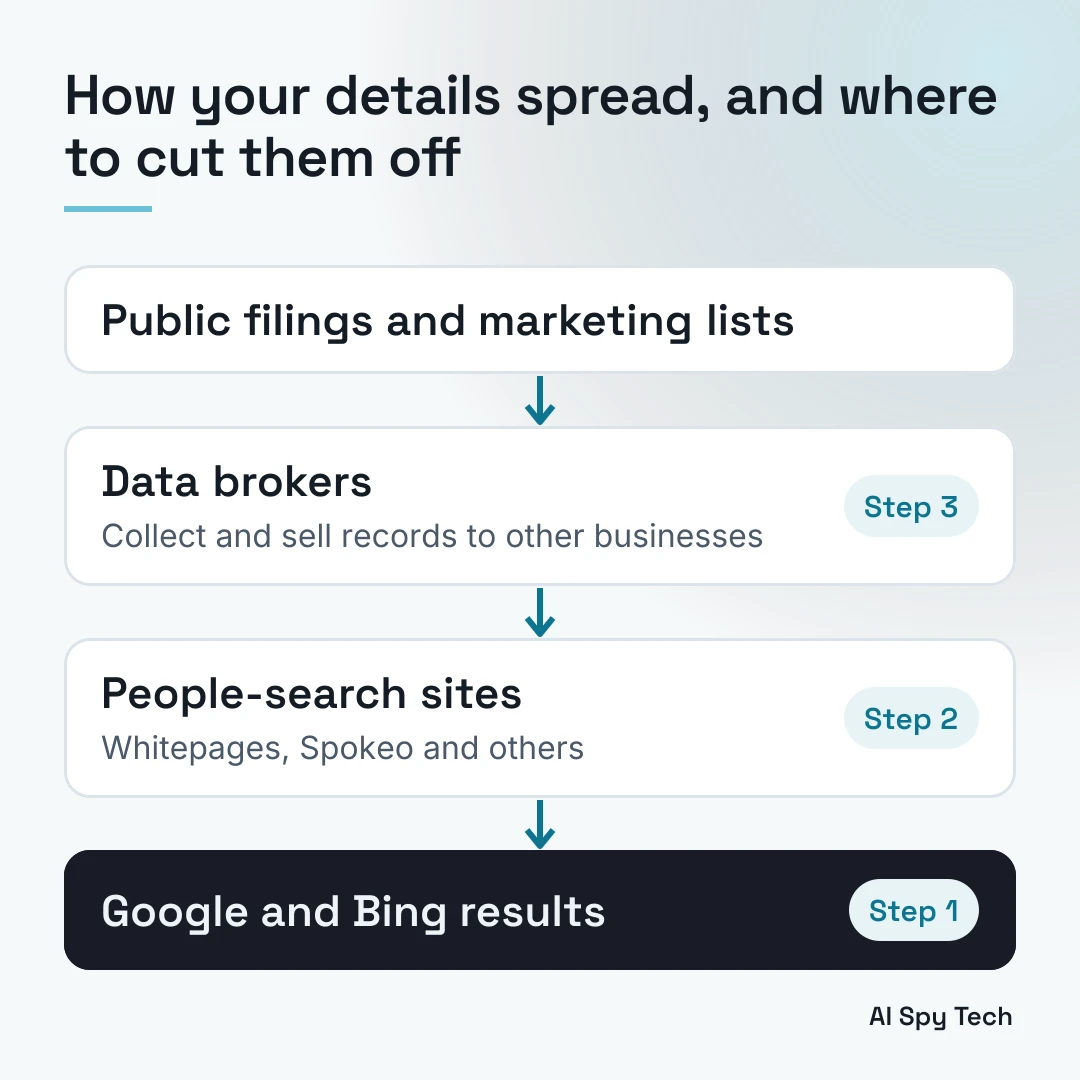
California requires brokers to register. The state's DROP page says its tool reaches more than 600 registered data brokers, and the live list sits in the CPPA data broker registry. Texas, Oregon and Vermont also run registries, according to a California Lawyers Association comparison. Counts vary by state and by year, so treat any single number as a snapshot.
Before removing anything, search your own name, phone number and address in Google and Bing, and save the URLs. ESET's removal guide also starts with an audit, before search engines, source sites and brokers.
Step 1: Remove it from Google
Google's Results about you tool finds search results that contain your contact details and lets you ask for their removal. Google's help page lists what it will consider removing:
- your address, phone number or email address
- government ID numbers such as a Social Security or tax ID number
- bank account and credit card numbers
- images of your signature or ID
- private records such as medical records
- confidential usernames and passwords
- doxxing content, meaning personal details posted with threats or calls to harass
The process is a request form: you give Google the URLs of the pages that show the information. The tool can also watch for new matches and send notifications. On February 10, 2026, Google added government ID monitoring, so the tool can now look for your driver's license, passport or Social Security number, according to Google's announcement. Adding those numbers is optional, and existing users choose which ones to monitor.
What Google removal does not do
Google removes the result, not the page. Its help page says it only removes information from Google Search, not from the site that hosts it, and that it will not remove content of public interest such as news. A removed result can still be reached by anyone who has the direct link or searches another engine. To get a page itself taken down, contact the site owner or the broker, which is what Step 2 covers.
Step 2: Opt out of people-search sites
Each site has its own form, and none of them share requests. The table lists the opt-out pages that could be opened and read in November 2026, with what each page asks for.
| Site | Opt-out page | What it asks for | Stated timing |
|---|---|---|---|
| Whitepages | whitepages.com/suppression-requests | The URL of your profile, then a phone number for a verification call, per Whitepages' help article | Not stated for the online tool |
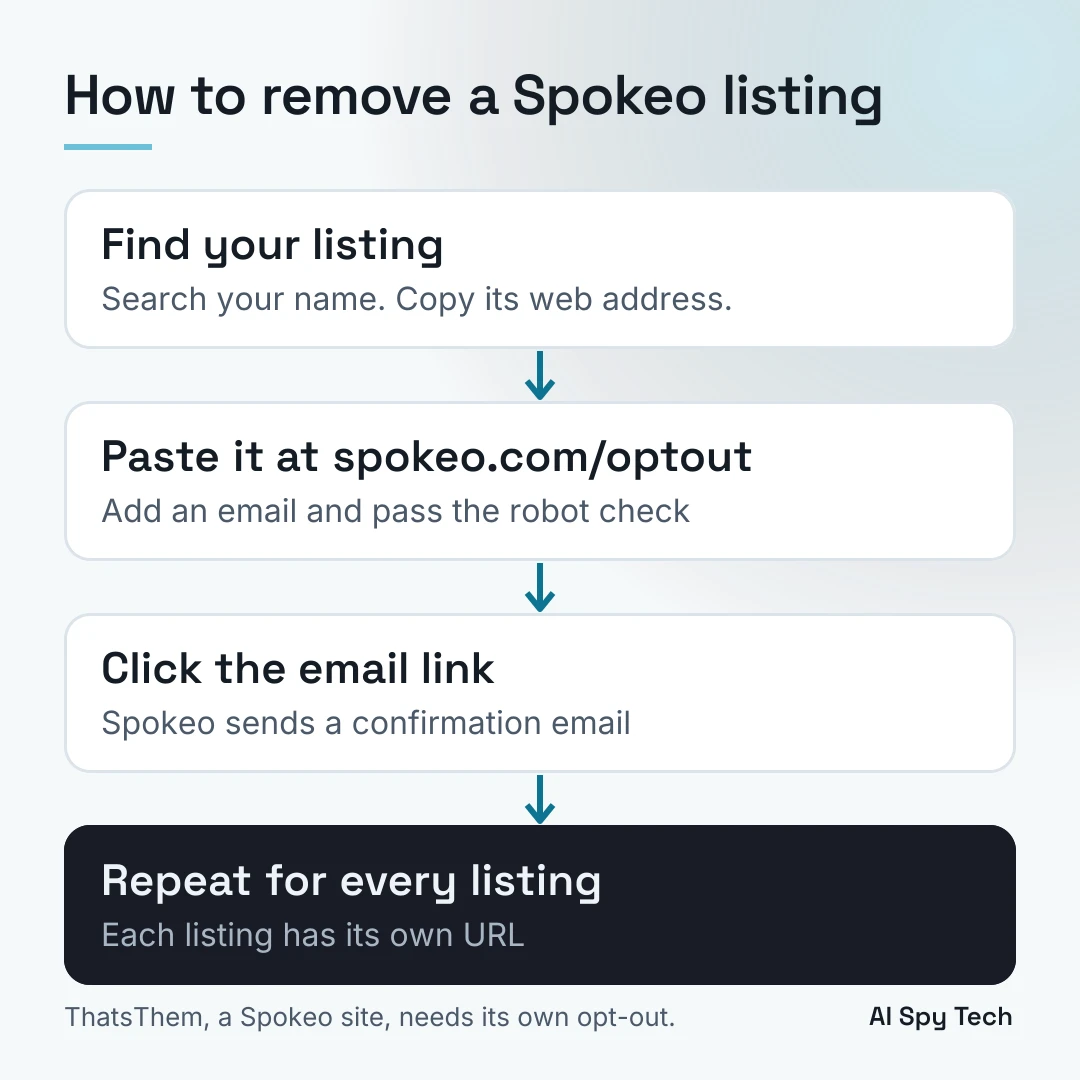
| Spokeo | spokeo.com/optout | Profile URL and an email address, then a confirmation email | 24 to 48 hours |
| ThatsThem (run by Spokeo) | thatsthem.com/optout | Full name, street address, city, state, ZIP code, email address and phone number | Typically within 72 hours |
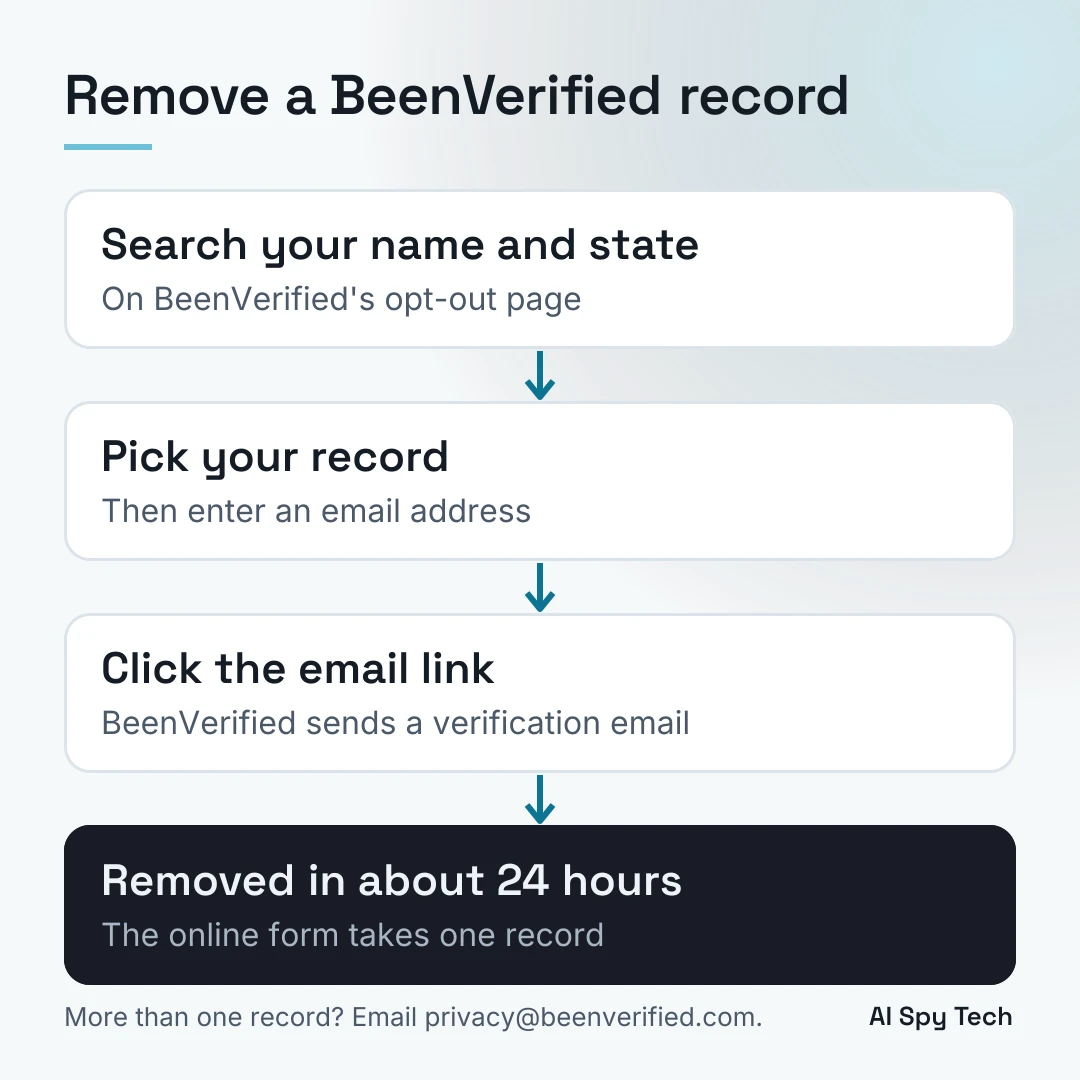
| BeenVerified | beenverified.com/app/optout/search | Search for your record, pick it, confirm by email | About 24 hours after the confirmation email |
| PeopleConnect (Intelius, TruthFinder, InstantCheckmate, USSearch) | suppression.peopleconnect.us | An email address, then a verification link | Not stated on the page |
| FastPeopleSearch | fastpeoplesearch.com/removal | Name, email address and a captcha, then an email link | 3 days; the email link expires after 24 hours |
Some details worth knowing before starting:
- Whitepages says that once a listing is removed, "all known connected listings are also removed," per its consumer privacy rights page. If a listing you believe is yours still shows afterward, it asks you to send it to a customer service agent. The Whitepages opt-out guide has every step, including a route with no phone.
- Spokeo says each listing has its own URL and must be opted out on its own. Its privacy policy says its tool does not cover ThatsThem, which is why ThatsThem has its own row above. Spokeo also runs AnyWho, PeopleWin, FreePeopleDirectory and Family.me, per its filing with California's data broker registry. The Spokeo opt-out guide covers all of them.
- BeenVerified's online form removes one record per person. For any others, its opt-out page asks you to email privacy@beenverified.com. Its California registry filing lists 13 sites it runs, including PeopleLooker and PeopleSmart. The BeenVerified opt-out guide has every step.
- PeopleConnect describes its Suppression Center as one free tool that covers the brands it owns, so a single request there reaches Intelius, TruthFinder, InstantCheckmate and USSearch.
- Spokeo, BeenVerified and FastPeopleSearch all send a link to an email address. A dedicated email address for opt-outs keeps the confirmations in one place.
TruePeopleSearch and Radaris are also popular targets, but their opt-out pages could not be read on November 5, so they are left out of the table. Check each site directly rather than relying on a third-party guide.
People-search sites are not the only place a name and face can turn up. Face-search engines are a separate problem with their own opt-outs, covered in the PimEyes guide.
Step 3: Use your state's law
California: DROP
California residents have the strongest free option. The Delete Request and Opt-out Platform, DROP, lets you send one deletion request to every broker registered with the state. The CPPA approved the rules on November 13, 2025, effective January 1, 2026, and the request form at consumer.drop.privacy.ca.gov opened to consumers that month.
Brokers have to act on a schedule. Starting August 1, 2026, they must check DROP at least once every 45 days and process deletion requests. The state warns that it can take up to 90 days for the status of a request to update, and that timing varies by broker, according to the DROP page. DROP is for California residents only.
Other states
California is not the only state with a deletion right. As of October 28, 2026, MultiState counts 24 states with comprehensive consumer privacy laws, and CDP.com reports that 20 of them were in effect as of July 2026, with four more starting in 2027 and 2028. These laws typically let a resident ask a business to delete personal information, a right that the IAPP state tracker follows as one of the standard rights. Unlike DROP, they work company by company, so the people-search opt-outs in Step 2 are still the practical route outside California.
Federal rules
There is no federal equivalent. The Consumer Financial Protection Bureau proposed a data broker rule under the Fair Credit Reporting Act in December 2024 and withdrew it on May 15, 2025.
Step 4: AI assistants and chatbots
Voice assistants and chatbots keep their own copies of what you say to them, and the controls sit in each product's settings.
Alexa
On March 28, 2025, Amazon ended the "Do Not Send Voice Recordings" option, which had kept audio processing on the device for a few Echo models. The Associated Press reported that it applied to the 4th generation Echo Dot, Echo Show 10 and Echo Show 15, and that people using it were moved automatically to "Don't save recordings." Amazon told the AP it is focusing on privacy tools that work with generative AI features that rely on its cloud.
Amazon's Alexa privacy page says recordings are saved by default. To delete them, open Review Alexa History and remove recordings one at a time or delete a whole day. To stop the buildup, go to Settings, Alexa Privacy, Manage Your Alexa Data, then "Choose how long to save recordings." The options are save until deleted, 18 months, 3 months, or "Don't save recordings." Choosing the last one deletes previously saved recordings, though Amazon says it can take up to 36 hours to apply.
ChatGPT
In ChatGPT, open Data controls and turn off "Improve the model for everyone," as described in OpenAI's help article. That setting does not delete saved chats. Temporary chats are not used to improve the models, but OpenAI may keep a copy for up to 30 days for safety. Chats you delete are removed from OpenAI's systems within 30 days, with exceptions for legal or security reasons, per its privacy policy.
Meta AI
Meta's help center describes a right to object for people in the EU and UK under the GDPR. A US opt-out for AI training was not found on Meta's own pages on November 5, 2026, and MIT Technology Review reported in 2024 that none existed for US users. Meta does offer a form for people whose personal information shows up in a Meta AI response, and it asks for the prompt and a screenshot as evidence.
DeepSeek
DeepSeek's privacy policy, in the English version dated February 14, 2025, states that it stores collected information on servers in the People's Republic of China. On October 19, 2026, the Department of Homeland Security ordered DeepSeek products removed from federal civilian agency IT systems. The Guardian reported that the notice cites the location of the servers and the access Chinese law gives its government to company infrastructure. The Commerce Department had already barred it from government devices in 2025, and several states issued similar bans.
Why listings come back
Brokers keep collecting. A profile you suppressed in March can be rebuilt in June from a new purchase record, a new address or a list bought from another broker. Incogni says on its pricing page that some requests take more than 30 days and that one-time removals can leave data reappearing, which is why it resends requests. That is a vendor's description of its own service. ESET's guide lists the same problem, why information reappears, among its common questions.
A practical rhythm: search your name again every few months, and repeat the opt-outs for any site that has a new listing.
Paid removal services, honestly
A removal service signs up for the same opt-outs on your behalf, scans for new listings and resubmits. It saves hours. It does not reach everything, and it does not change what brokers collect next.
What the one independent test found
Consumer Reports published the most-cited test on August 8, 2024. It signed 28 volunteers up for seven services and checked 13 people-search sites. After four months, 117 of 332 items found for the service groups had been removed, which is 35 percent. Among the services, Optery removed 68 percent, EasyOptOuts 65 percent and DeleteMe 27 percent, according to the study's own table. Researchers who opted out by hand removed 70 percent.
Incogni and Aura were not in the study. The results are more than two years old, and Optery objects to the method: it says the volunteers gave the services limited information and skipped optional features, and that only 13 sites were tested while its paid tiers cover far more. The study found that doing it yourself works if you have the hours, and that the quality of paid services varies widely.
The four services
Prices below are from each company's own page, read November 5, 2026. Broker counts are each company's claim and were not independently checked.
| Service | Price | Coverage (company claim) | Page |
|---|---|---|---|
| Incogni | Standard $7.99 a month, billed $95.88 a year; Unlimited $179.88 a year | 420+ data broker sites | Pricing |
| Optery | Free plan; Core $39, Extended $149, Ultimate $249 a year | 380+, 555+ and 625+ sites by tier | Pricing |
| DeleteMe | $129 for one year, or $209 for two years | Count not stated on its pricing page | Pricing |
| Aura | $12 a month billed annually, or $15 billed monthly | 425+ data brokers | Data removal |
Incogni's plans come with a 30-day money-back guarantee. Its monthly Standard plan is $15.98 a month, per the FAQ on the same page. The Unlimited plan adds custom removal requests for sites outside its standard list. A fit: someone who wants hands-off, recurring removals at the lowest annual price in this table.
Optery's free plan gives an exposure report with screenshots and tools to opt out yourself. Its Ultimate tier is the one Consumer Reports tested. A fit: someone who wants to see what turns up before paying anything, or who wants screenshot proof of each removal.
DeleteMe describes its process as experts and proprietary technology finding and removing your information. A fit: someone who wants people, not only software, working the requests. Weigh its 2024 test result against any changes since.
Aura sells data removal as one piece of a security bundle that also lists antivirus, a VPN, a password manager, credit monitoring and $1 million of identity theft insurance. A fit: someone who would buy those other tools anyway. Anyone who only wants removal pays for features they will not use.
Frequently asked questions
Can you delete yourself from the internet completely?
No. Google can remove search results but not the pages behind them, brokers rebuild profiles, and public records held by agencies and courts follow their own rules. ESET's guide treats public records as a separate category from broker listings. The steps above reduce what is easy to find. They do not erase a person.
Does Google remove the page itself?
No. Google's help page says it removes information from Search results only, and that the content stays on the host website. Ask the site owner to take the page down if the goal is to remove the source.
Are data removal services worth it?
It depends on how many hours the opt-outs would take and how often they need repeating. Consumer Reports found manual opt-outs removed 70 percent of listings, which beat every service it tested. The services advertise coverage of hundreds of sites, well beyond the 13 it checked, and they re-run the work. Someone with an afternoon and a calendar reminder can do the free route. Someone who will not repeat it every few months is the person a service is built for.
How long do opt-outs take?
Stated timing ranges from about a day to three days for the people-search sites in the table above. For DROP, brokers must process requests every 45 days, and status updates can take up to 90 days, per the state's page. Chat deletions at OpenAI complete within 30 days, per its policy.
Do you have to give your ID?
Not for the people-search opt-outs above. They ask for a profile URL, a name or an email address, and Whitepages' online tool asks for a phone number for a verification call. DROP requires proof you are a California resident, according to the DROP page. Google's government ID monitoring is optional, and TechCrunch reported that existing users pick which numbers to add.
For how this site chooses and checks its sources, see the editorial standards. Camera networks that photograph vehicles are a separate privacy issue, covered in the Flock cameras explainer.