
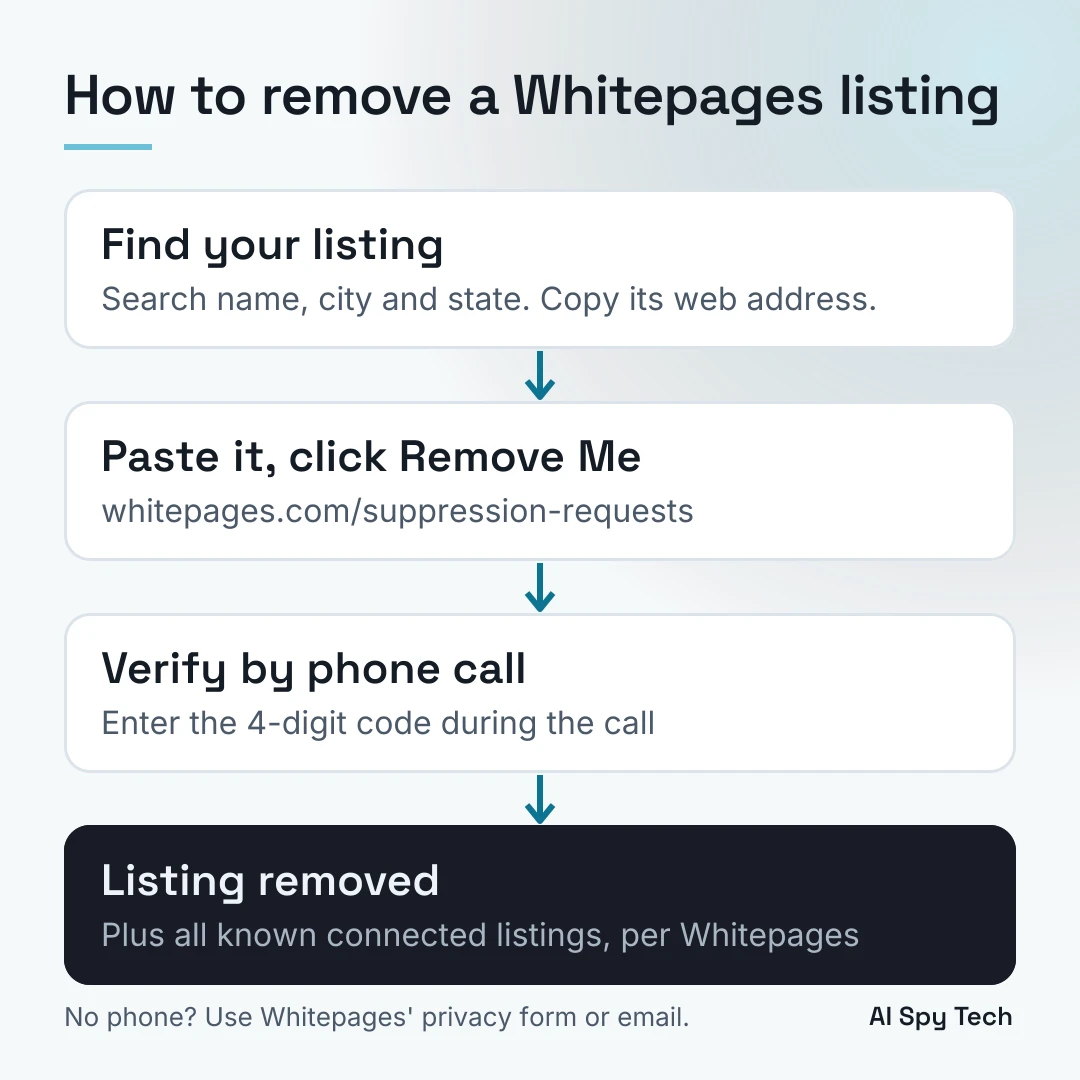
Whitepages removes your listing for free, and you do not need an account or a purchase. Find your listing on whitepages.com and copy its web address. Paste it into the opt-out form at whitepages.com/suppression-requests, click Remove Me, pick any reason and enter a phone number. Whitepages shows a 4-digit code and calls that number, and you enter the code during the call. Whitepages says that once a listing is removed, all known connected listings are removed too. If you have no phone, or the call fails, you can send the request through Whitepages' privacy form or by email.
Every step below comes from Whitepages' own help and privacy pages, read on November 7, 2026, and each one is linked. Whitepages is one site of many. The guide to removing your personal information covers Google, the other large people-search sites and state privacy laws.
What Whitepages is and what it shows
Whitepages runs a people search that shows names, addresses and phone numbers. Its help center says the company "aggregates and publishes publicly available contact and property information," gathers it from many sources and cross-checks it, and is not affiliated with any telephone company. It also sells Premium memberships with fuller contact details and background reports with criminal and public records.
Its privacy policy, updated June 22, 2026, states: "Whitepages Inc is a data broker under Texas State law." A data broker is a company that collects personal information and sells or licenses it to others. Whitepages also runs 411.com, whose footer reads "© Whitepages Inc."
Careful habits online do not keep a person off it. Someone posted on r/privacy that they used fake names on social media and read every set of terms they agreed to, and still found their real addresses, phone numbers and email addresses on Whitepages. Social media settings do not change a listing that is built from contact and property records.
Before you start
You need two things:
- The web address of your listing. It ends in a short reference code. Whitepages' own example is whitepages.com/name/Example-A-Person/Seattle-WA/Abcd12345ef.
- A phone that can take a voice call. The check is a phone call, not a text message.
Using the online tool also means agreeing to Whitepages' Terms of Service, according to its consumer privacy rights page. If you would rather not give a phone number or agree to the terms, use the form or email route described further down.
How to opt out of Whitepages, step by step
These steps follow Whitepages' help article, Edit or Remove a personal listing.
- Go to whitepages.com and search your first and last name with your city and state.
- Find the listing that matches you and click View Details. Check that the phone number and address are yours.
- Copy the web address from your browser's address bar.
- Open the opt-out page, paste the address and click Next.
- Check the details on the confirmation page and click Remove Me.
- Pick a reason for the request and click Next.
- Enter a phone number, read the agreement and click Call Now to Verify.
- A 4-digit code appears on the screen. Answer the call and enter the code when the call asks for it.
If it works, the page changes to confirm that Whitepages is processing the removal.
People on r/privacy have asked which reason to pick in step 6, worried that the wrong one would get the request refused. Whitepages' help article answers it: the reason "will not impact your opt-out request" and is only used to improve the product. The phone number in step 7 is collected to confirm the listing is yours, and Whitepages says it "will not be resold or used on our site in any way."
Connected listings
Whitepages' consumer rights page says: "Once a listing is removed, all known connected listings are also removed and the requester's information will not be sold by Whitepages in any capacity regardless of how/where the information was obtained."
After the removal goes through, search again with old cities and other spellings of your name. If a listing you believe is yours still shows, Whitepages asks you to send it to a customer service agent by form or email, the route in the next section.
No phone, or the call failed
If the call does not come through or the code fails, click the blue Request Help button in the tool. It opens a ticket with Whitepages' Customer Care team.
To skip the phone check, the consumer rights page lists two other ways to send the request:
- the online request form
- an email to privacyrequest@whitepages.com
Whitepages asks you to allow up to two business days for a reply, and says an agent may need more information before the request can be processed. Paste the web address of every listing into the message. Both routes sit in the California section of the page. Outside California, the documented fallback is the Request Help ticket, and residents of the 18 other states the page names can email support@whitepages.com.
One person on r/privacy could not get through the phone check and emailed Whitepages' support with every listing URL instead. Their advice afterward: check the search result pages and the relatives lists on other people's listings, because a name can still turn up there after the main listing is gone.
How long removal takes
Whitepages does not give a time for the online tool. These are the times it does publish:
| Request | Stated time | Source |
|---|---|---|
| Opt-out under California's privacy law | Up to 15 days, "often processed more quickly when feasible" | Consumer rights page |
| Opt-out of sale, 2025 | Median reply 16.8 hours (36,517 requests, 12 denied) | California privacy notice |
| Deletion, 2025 | Median reply 19.2 hours (3,193 requests, 3 denied) | California privacy notice |
| Form or email reply | Up to two business days | Consumer rights page |
| Search engine copies | Up to 30 days in some cases | Help article |
The 2025 figures cover the California privacy requests Whitepages received that year, which it reports under state rules.
Clearing old results from Google and Bing
Google or Bing can keep showing an old snippet with your phone number or address after the Whitepages page is gone. Both run free tools for people who do not own the site. Google's Remove Outdated Content tool updates results when Search shows information that is no longer on the site, per Google's help page. Bing's Content Removal Tool asks Bing to refresh a result, per Bing's help page. Both are for pages that have already changed, so use them after the Whitepages listing is removed. Each asks you to sign in.
What the opt-out removes, and what it does not
The opt-out takes your directory listing, meaning your name, address and phone number, off "public display on Whitepages' websites and applications," per the consumer rights page. The same page says the online tool also opts you out of the sale and sharing of your information.
Some things stay out of reach:
- Public records held elsewhere. The help article says Whitepages cannot hide information on "databases we don't control, such as public records."
- Other people-search sites. Whitepages says it "is only able to remove information on the services we provide," and suggests searching for other sites that publish your information.
411.com is a Whitepages site, but Whitepages' pages do not say whether one request clears both. Search your name on 411.com after the Whitepages removal goes through.
Extra rights in your state
Whitepages' consumer rights page names 19 states where residents have extra privacy rights: California, Colorado, Connecticut, Delaware, Indiana, Iowa, Kentucky, Maryland, Minnesota, Montana, Nebraska, New Hampshire, New Jersey, Oregon, Rhode Island, Tennessee, Texas, Utah and Virginia. In the 18 outside California, rights requests and appeals go to support@whitepages.com. In a state that is not on the list, use the listing opt-out above.
California
California residents can also ask Whitepages to delete their personal data, by the same form or email. The right has limits. Whitepages lists exceptions that include "public information that is made available by government agencies, including property records, street address and criminal records," and information used for a Premium subscription or another purchase. By those exceptions, a deletion request does not cover the public-record parts of a listing, so the listing opt-out is still the step that takes it off the site.
The state also runs DROP, a free system that sends one deletion request to every data broker registered with the state. Starting August 1, 2026, brokers must check DROP at least once every 45 days, according to the state's DROP page. Whitepages, Inc. is listed in the state's 2026 data broker registry, so a DROP request reaches it. The removal guide explains how DROP works and who can use it.
If your listing comes back
If you find your listing again, or another listing you believe is yours, Whitepages asks you to send a request to a customer service agent by form or email, per its consumer rights page.
Search your name every few months. Someone on r/Cybersecurity101 found their home address, an old address and a relative on a people-search site, and the replies gave two tips: use a separate email address only for opt-outs, and check again every quarter. The removal guide explains why people-search profiles get rebuilt after an opt-out.
The next sites to remove
Whitepages' help article says it is not the only company that publishes contact information. Spokeo, BeenVerified, FastPeopleSearch and the PeopleConnect brands (Intelius, TruthFinder, InstantCheckmate and USSearch) each have their own opt-out form. The removal guide lists each one with what it asks for, and compares four paid removal services that file these opt-outs for you and repeat them. Face-search sites need a separate opt-out, covered in the PimEyes guide.
Frequently asked questions
Is the Whitepages opt-out free?
Yes. Whitepages' consumer rights page says you do not have to create an account or make a purchase to submit an opt-out request.
Can I opt out of Whitepages without giving a phone number?
You can. Send the request through Whitepages' online request form or by email to privacyrequest@whitepages.com, and allow up to two business days for a reply. Whitepages lists this route in the California section of its consumer rights page. Only the online tool needs a phone number, which Whitepages says is not used for any purpose other than completing the opt-out.
How long does the Whitepages opt-out take?
Whitepages gives no time for the online tool. Opt-outs under California's privacy law can take up to 15 days, and its 2025 report shows a median reply of 16.8 hours for opt-out of sale requests. Search engines can keep showing the old listing for up to 30 days.
Does removing my Whitepages listing remove me from Google?
Not right away. Whitepages' help article says search engines can show information cached from its sites for up to 30 days in some cases. Google's Remove Outdated Content tool can clear an old result once the Whitepages page is gone. Other sites that list you need their own opt-outs.
Does it remove my listing from 411.com?
Whitepages runs 411.com, but its pages do not say whether one opt-out covers both. Search your name on 411.com after the Whitepages removal goes through. If a listing is still there, contact Whitepages through its privacy form.
Does the opt-out cover Whitepages Premium and background reports?
Not by name. Whitepages' consumer rights page says that once a listing is removed, the requester's information "will not be sold by Whitepages in any capacity regardless of how/where the information was obtained."
Is there a separate route under the Daniel Anderl Act?
Yes. Whitepages has a help article for requests under the Daniel Anderl Security and Privacy Act "or a similar act." Use the privacy form, choose "I would like to have my information deleted," give your state of residence, and paste the web addresses of your listing and your family members' listings into the description. Whitepages says an agent follows up within 48 hours.
If a step above no longer matches what you see on Whitepages, the editorial standards page says how to report an error and how this site checks its sources.