
Most hidden cameras sit inside something that already has power and faces a bed, a shower or a toilet: a smoke detector, a clock, a USB charger or a power strip. The best free check is slow and low-tech. Look at what faces those spots, read the model label on anything odd, then turn off the lights and sweep the room with a flashlight held next to your eye, watching for the small glint a lens gives back. Your phone camera can show the infrared lights of a night-vision camera, and a Wi-Fi scan can list cameras on the network you are on. None of these finds every camera, and store-bought detectors did only a little better than a flashlight in a university test. If you find one, leave it where it is, photograph it, leave the room and call the police yourself.
Where hidden cameras are usually hidden
A hidden camera needs three things: a view of the room, a power source and an object nobody looks at twice. Osceola County, Florida, Sheriff Marcos Lopez listed phone chargers, electrical outlets, stuffed animals, remotes and smoke detectors as hiding places, and said of the smoke detector cameras, "You can buy them on Amazon" (Spectrum News 13, 2024). In a 2023 Maryland case, a couple staying at an Airbnb found cameras inside the smoke detectors in the bedroom and the bathroom (Montgomery County Police). In South Korea in 2019, police said about 1,600 motel guests were filmed and streamed online by cameras hidden in TV boxes, wall sockets and hair dryer holders (CNN).
Check these first:
- Smoke detectors, especially one mounted right over the bed
- Clocks that face the bed
- USB wall chargers, power strips and outlets
- TV boxes, remotes and anything on the TV stand
- Hair dryer holders and wall hooks in the bathroom
- Stuffed animals
Guests who post online about finding a camera describe the same handful of objects: a smoke detector placed oddly close to the bed, a power strip in a room that did not need one, a hook on a bathroom wall that points at the shower.
Cameras also hide behind things. In a study at Washington University in St. Louis, the cameras people struggled to find with a light were tucked under a bookshelf and behind books, and a camera built into a clock fooled the light because glass over the lens bounced it away (HeatDeCam paper, 2022).
5 free checks, in order
You need your phone and a few minutes per room. Start with the bedroom and bathroom.
1. Look from the bed and the shower
Stand where you are most exposed: the bed, the shower, the toilet, the spot where you change. Every object that faces you is a candidate. Look for a tiny hole or dark dot with no clear purpose, a cable running into something that should not need power, and two of something where one would do. Check the tops of shelves and the ceiling too.
2. Read the label
Most electronics carry a printed label with a brand and a model number. Photograph it and search the model number, or run the photo through Google Lens. A real smoke detector comes up as a smoke detector, and a camera sold as a "smoke detector camera" comes up as a camera. Guests who post about finding a camera over a bed often confirmed it this way, and others cleared a false alarm the same way, by matching the label to the real maker.
Look without taking anything apart. A smoke detector you unscrew stops protecting you, and a camera you open is evidence with your fingerprints on it.
3. Sweep with a flashlight in the dark
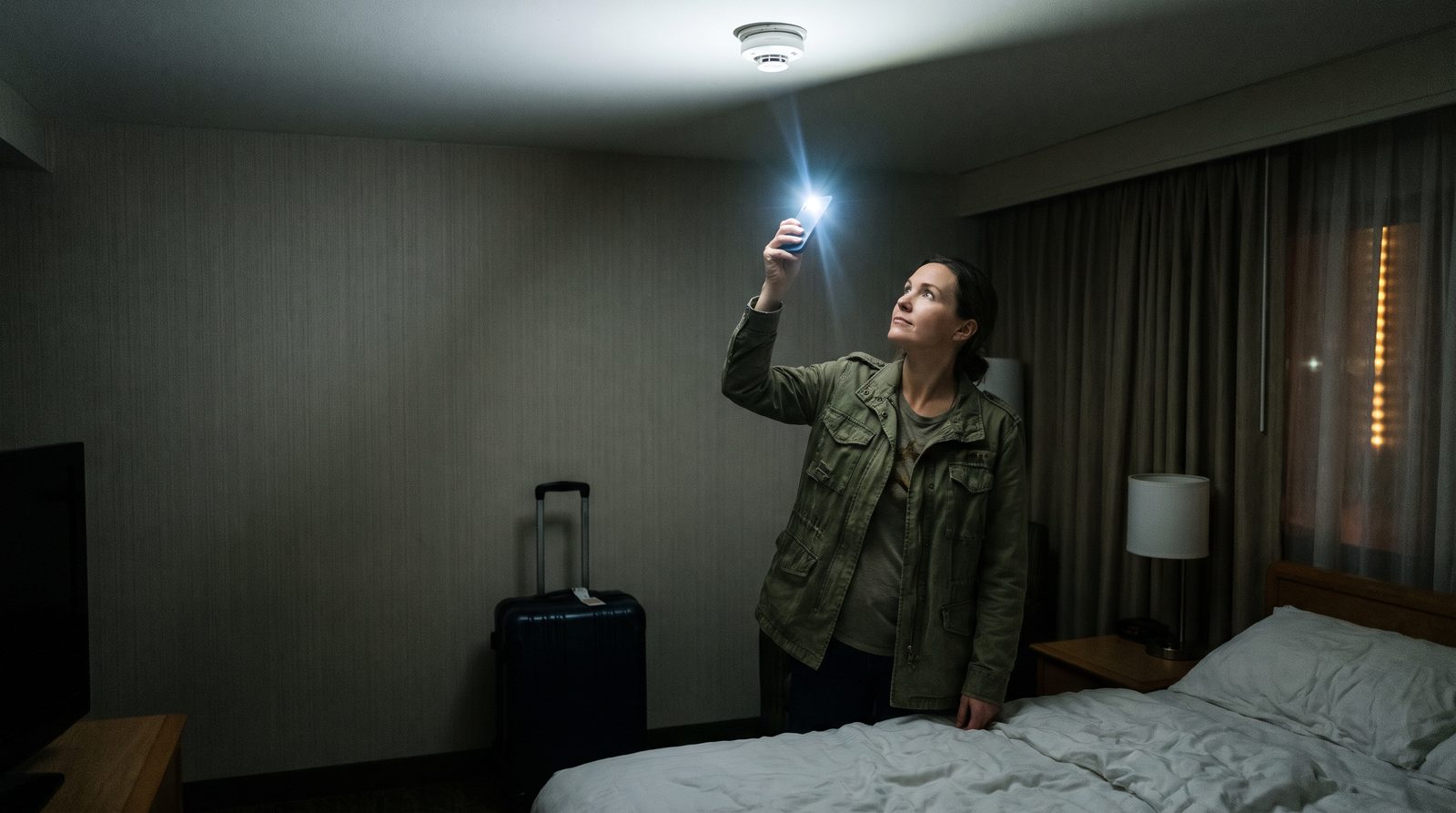
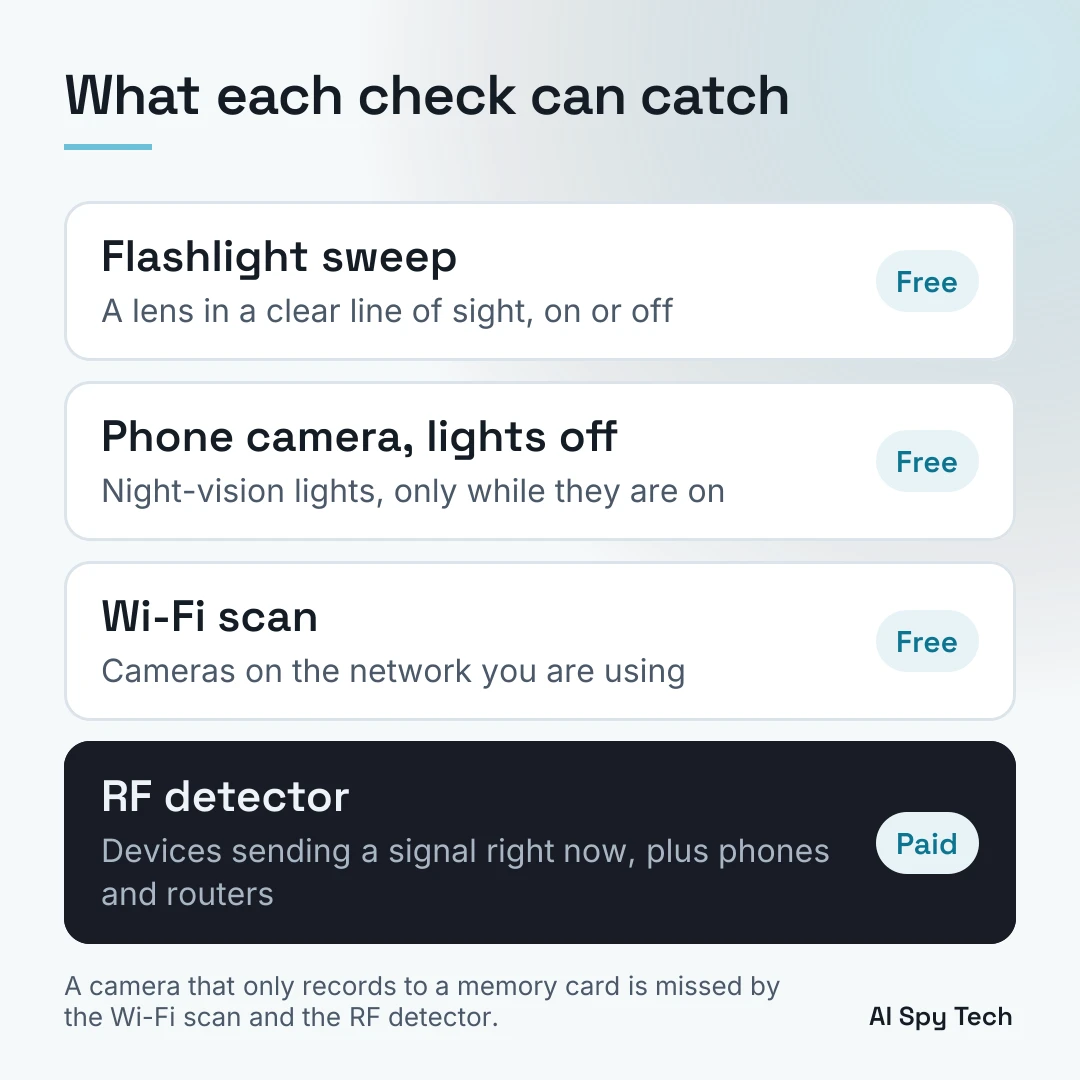
A camera lens reflects light straight back toward its source, an effect researchers call retro-reflection (Optics Express, 2024). Turn off the lights, close the curtains, hold your phone's flashlight right beside your eye and sweep slowly, one wall at a time. A lens shows up as a small, sharp point of light. Wirecutter's Thorin Klosowski described it to NPR as "kind of a blue reflection" (NPR), and Sheriff Lopez gives the same advice: lights off, flashlight on, look for a reflection from any normal-looking device. Wired's sweep guide recommends it as well.
The light has to reach the lens, so a camera behind books or behind glass can stay hidden, as the St. Louis study found.
4. Check for infrared with your phone camera
Cameras that record in the dark light the room with infrared LEDs. Your eyes cannot see that light, but many phone cameras can. Test your phone first: point a TV remote at the camera, press a button and watch the screen. The New York Times suggested this remote test in its 2019 guide to finding bugs. If the remote's light does not show, switch to the front camera and try again. An expert quoted by The Washington Post suggests the same: lights off, front-facing camera, look for infrared LEDs (Washington Post).
Then scan the room on screen with the lights off. A camera only gives itself away this way while its infrared lights are on, so a camera recording in daylight, or one without night vision, shows nothing.
5. Scan the Wi-Fi network
If you are on the rental's Wi-Fi, a free scanner app such as Fing lists the devices on that network, and Fing says it can also show a camera's brand and model. A device named for a camera brand on a network that should hold only a router and a TV deserves a closer look.
The limits are real. Fing's own guide says it can only find cameras on the network you scan, and that hotel Wi-Fi often uses client isolation, so a scan may not show other devices at all. Carnegie Mellon researchers who built a Wi-Fi device finder called Lumos noted that a host can put devices on a separate network from guests, and that a camera avoids Wi-Fi detection if it stores video locally, uses a wired connection or uses another kind of radio (Lumos, USENIX Security 2022). A camera that only records to a memory card, with no network connection, never shows up on a scan.
Stop at scanning. Do not try to log in to the router or to a device you find.
Do hidden camera detectors and apps work?
Somewhat, and less than their boxes say. The best public test found for this page comes from Washington University in St. Louis. Thirty-six people, split into four groups with one method each, searched a room holding 5 hidden cameras, including ones disguised as a charger and a clock (HeatDeCam paper, 2022):
| Method | Share of cameras found (average) | False alarms in the study |
|---|---|---|
| Flashlight | 40% | 3 |
| Lens finder (red LEDs, steady light) | 42.2% | 2 |
| RF detector (G319) | 46.7% | 8 |
| HeatDeCam (thermal prototype) | 86.7% | 1 |
HeatDeCam is the researchers' own tool, which spots the heat a running camera gives off. A separate 2021 study of another prototype, LAPD, which uses the depth sensor found on some phones, had 379 participants: they found 46.0% of hidden cameras by eye and 88.9% with the tool (LAPD, ACM SenSys 2021). Both are university prototypes.
What each store-bought type does:
- RF detectors beep when they pick up radio signals, so they catch a camera that is sending video over Wi-Fi, Bluetooth or a cell connection at that moment. They miss a camera that records to a memory card, and they also beep at phones, routers and smart TVs. In the St. Louis test the RF detector found more cameras than the flashlight or the lens finder and raised the most false alarms; the researchers noted it kept beeping near ordinary electronics such as a wireless mouse.
- Lens finders are small viewers ringed with red LEDs. Look through one, and a lens in view flashes back as a bright dot. They work on cameras that are switched off, but like a flashlight they need a clear line to the lens.
- Detector apps promise more than a phone can do. Some say they find cameras through magnetic readings, but a phone's compass sensor reacts to magnets and metal, which nearly every electronic device has. No independent test of these apps turned up in the research for this page, and Klosowski told NPR he does not love them.
Our take: a flashlight and a careful look do most of the work. A lens finder or an RF detector is a second check for people who travel often, and it does not replace looking.
Hidden camera detectors worth a look
Each of these comes from a brand with its own website.
SpyFinder Pro
The SpyFinder Pro, made by KJB Security Products, is a lens finder only. You look through a viewer ringed by bright red LEDs, and a lens shows up as a blinking dot. KJB lists a range of 2 to 45 feet, a light control with three settings for distance, and two AAA batteries. It suits frequent travelers who want a faster sweep than a flashlight. It finds lenses, not microphones or trackers, and shiny surfaces glint too, so go slowly.
See the SpyFinder Pro on Amazon
Lawmate RD-30
The RD-30 does both checks in one pocket device: an RF detector that covers 20 MHz to 6 GHz, per Lawmate, and a red-LED lens finder. It fits someone who wants both tools without carrying two. In a hotel full of Wi-Fi and phones, expect the RF side to go off often, and lean on the lens finder there. On Amazon it is sold by a third-party store, not by Lawmate.
See the Lawmate RD-30 on Amazon
Prepared Hero Privacy Pen
The Privacy Pen from Prepared Hero is the budget pick: a pen-sized RF detector that beeps or vibrates, a light for spotting lenses and a door-motion alarm, charged over USB-C, with no app. It is for light packers. It has no viewfinder, so the lens check works best in a dark room, and the RF side only hears devices that are transmitting.
See the Prepared Hero Privacy Pen on Amazon
One thing not to buy: a signal jammer. The FCC says federal law prohibits consumers from operating jammers in the United States. Skip any gadget sold as both a detector and a jammer.
Airbnb, Vrbo and Booking.com camera rules
Airbnb announced a global ban on indoor security cameras on March 11, 2024, and the rule took effect on April 30, 2024. Its help center says hidden cameras are strictly prohibited and that indoor cameras are banned in any room, even turned off or disconnected. Outdoor cameras, including doorbell cameras, are allowed only if the listing says where they are, and never where people expect privacy, such as an enclosed outdoor shower or a sauna. Noise monitors are allowed indoors if the host discloses them and keeps them out of bedrooms, bathrooms and sleeping areas, though hosts do not have to say where they are. Hotels listed on Airbnb can still have cameras in indoor common spaces such as lobbies, and Airbnb makes an exception in Japan, where some homes are legally required to have an entryway camera.
Vrbo's surveillance policy says devices must never monitor the inside of a rental, including by pointing in from outside, and hidden or disguised devices are never allowed. Outdoor cameras may cover only access points, and the listing has to disclose them in writing; a camera visible in a listing photo does not count. Noise monitors are allowed if disclosed and if they do not record or transmit audio.
Booking.com is looser. Its rules for properties ban cameras in areas rented only by the guest and in private areas such as toilets, showers and saunas, and ban secret recording devices. Cameras are allowed outdoors and in common areas such as lobbies and shared kitchens. When you rent a whole property, those areas no longer count as common.
Before you book, read the listing for disclosed cameras, and ask the host in writing about anything unclear. A written answer is a record if something goes wrong later.
Are hidden cameras illegal?
In bathrooms and bedrooms, usually yes, but the details depend on the state. The federal Video Voyeurism Prevention Act covers capturing images of a person's private areas without consent, with a fine or up to a year in prison, but only in federal jurisdiction such as federal land and ships, not in a typical rental. State laws do most of the work. CNN's 2024 investigation counted recording someone in a private space as a felony in 21 states and a misdemeanor in 28 states, Washington, D.C., and at the federal level (CNN).
Ohio's law is a typical example. Ohio Revised Code 2907.08 bars secretly recording someone in a place where they have a reasonable expectation of privacy for the purpose of viewing their private areas. It is a second-degree misdemeanor, and a fifth-degree felony when the victim is a minor. Laws like this one turn on intent and private areas, so a camera in a living room may break Airbnb's rules without being voyeurism under criminal law. For your own situation, ask the police or a lawyer where you are staying.
What to do if you find a hidden camera
- Leave it in place. Police can then see it where it was found, and you do not handle evidence or a working smoke detector.
- Photograph and film it where it sits, then the room around it and its label. Airbnb's AirCover page tells guests to document problems with photos or videos.
- Cover it if you must stay in the room until help comes. Sheriff Lopez says you can put tape over suspicious devices in a short-term rental.
- Leave. The Maryland couple left the house and reported the cameras to police from a nearby store. Police then searched the home, and the man accused of installing the cameras was arrested.
- Call the police yourself. CNN reported in 2024 that Airbnb does not, as a matter of practice, notify law enforcement. Vrbo tells guests to contact local police if they have any concern for their safety.
- Report it to the platform or the hotel. Airbnb's 24-hour safety line can connect you to local emergency services, and a refund or rebooking request has to reach Airbnb or the host within 72 hours of discovery. Vrbo says to contact it immediately and that guests may be eligible for a refund.
If you think images of you were shared online, the Cyber Civil Rights Initiative's safety center says to document and preserve all evidence first. The removal tools for intimate images, including StopNCII.org, NCMEC's Take It Down for images taken before age 18, and the FTC's TAKE IT DOWN Act process, are covered in the PimEyes and face search guide.
FAQ
Can my phone detect hidden cameras?
Partly. Its flashlight can show a lens glint, its camera can show the infrared lights of a night-vision camera, and a scanner app can list devices on the Wi-Fi you are using. A camera that records to a memory card with its lights off gives a phone only one clue, the lens glint, so the careful look and the flashlight sweep matter most.
Can hidden cameras work without Wi-Fi?
Yes. Many record to a memory card, and some send video over a cell connection. Neither shows up on a Wi-Fi scan, which is why the visual checks come first.
Are cameras allowed in Airbnbs?
Not indoors since April 30, 2024, in any room and whether or not the host discloses them. Outdoor cameras are allowed if the listing says where they are and they do not cover private spots such as an outdoor shower.
What does a hidden camera look like with a flashlight?
A small, sharp point of light that comes straight back at you, which Wirecutter's Thorin Klosowski describes as bluish. Glass, mirrors and shiny plastic can glint too, so get closer before you decide.
How common are hidden cameras in rentals?
No reliable rate exists. CNN reported in 2024 that an Airbnb representative testified to 35,000 customer support tickets about surveillance devices over a decade, some of them harmless, such as a malfunctioning doorbell camera. In South Korea, more than 30,000 cases of filming with hidden cameras were reported to police between 2013 and 2018, according to Human Rights Watch. A few minutes of checking costs nothing.
Can someone record me with smart glasses?
Yes, openly. Camera glasses such as Ray-Ban Meta have a recording light, and the PimEyes guide covers what that camera can be paired with and where the glasses are banned.
How AI Spy Tech checks and sources its articles is described in the editorial standards. Platform rules and product listings on this page were read on November 7, 2026 and can change.