
The short answer
As of November 27, 2026, 15 of the 46 largest US store chains say in their own privacy policy that their cameras may read or record your license plate: Albertsons, BJ's, Costco, CVS, Dick's, The Home Depot, Kroger, Lowe's, Macy's, Meijer, Stop & Shop, Target, Ulta Beauty, Walmart and Wegmans. That is more than the 10 that say they may use facial recognition. Amazon's policy does not mention license plates.
Policies read November 27, 2026.
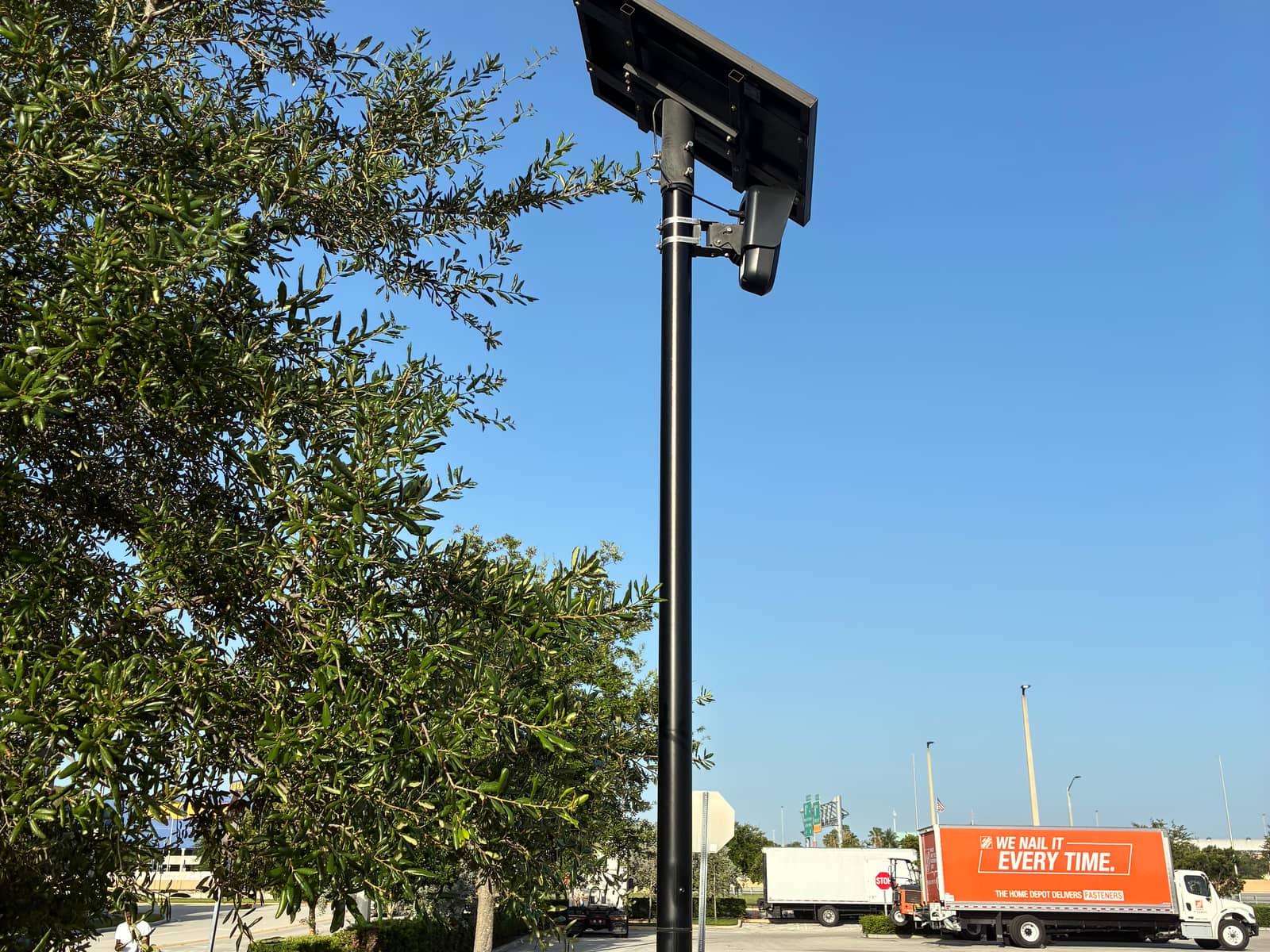
A license plate reader, often called an ALPR (automated license plate reader), is a camera with software that turns the plate in a photo into text a computer can search. Stores put them at lot entrances and in parking areas. Our Flock cameras guide explains how the best-known brand works.
Every big chain publishes a privacy policy, the legal notice that lists the personal information it collects. So we read the policy of each of the 46 largest chains on the same day and sorted what each one says about license plates. It is the same set of policies we used for our facial recognition count.
Key numbers
- 15 of 46 chains say their cameras may read or record license plates. (Each company's privacy policy, November 27, 2026.)
- 12 of the 15 use a plate reader term ("ALPR" or "license plate readers"); for Kroger and Albertsons it appears only in a heading or a linked California policy. The other 3 (Meijer, Stop & Shop and Wegmans) say their cameras capture plates. (Policies.)
- 4 of the 5 largest US retailers are on the list: Walmart, Costco, Kroger and The Home Depot. The fifth, Amazon, does not mention plates. (NRF Top 100 Retailers 2026; policies.)
- 9 chains say how long they keep plate data: from about 30 days (Target, Dick's, Ulta, Macy's) to about 180 days (Costco), and up to 12 months at Albertsons stores "highly impacted by crime" (its California policy). (Policies and plate notices.)
- 6 of the 10 chains whose policy names facial recognition also say their cameras capture plates: Albertsons, The Home Depot, Kroger, Macy's, Meijer and Wegmans. (Policies.)
- 26 of 46 policies do not mention license plates. That does not show a chain has no readers; see How we counted. (Policies.)
Which stores use license plate readers?
Fifteen say so. Each one in its own words:
| Store | What its privacy policy says | Where | How long it keeps plate data | Policy updated |
|---|---|---|---|---|
| Albertsons | "In some states, our cameras may capture license plate information." | Some states; California reader policy | 60 days; 12 months at stores "highly impacted by crime" (California policy) | Sept. 16, 2026 |
| BJ's | Data "collected or processed through our CCTV cameras, smart devices, closed-circuit television, recorded phone lines, license plate readers, and other technologies, where permitted by law" | Where permitted by law | Not stated | Not shown |
| Costco | "We use Automated License Plate Recognition (ALPR) technology to collect information relating to vehicles present on or near some Costco facilities." | Some facilities, including gas pumps and car washes | About 180 days | Oct. 22, 2026 |
| CVS | "we may use Automatic License Plate Recognition (ALPR) technology to collect information about vehicles near our CVS stores" | Near stores, where permitted by law | 60 days | July 1, 2026 |
| Dick's | "we may operate cameras outside our stores such as at entrances and parking lots, and those cameras can be equipped with Automated License Plate Readers (ALPRs)" | Entrances and parking lots | Generally 30 days | July 1, 2026 |
| The Home Depot | "We may use ALPR Systems where not prohibited by law" | Where not prohibited by law | "as long as necessary" | Dec. 29, 2025 |
| Kroger | "Some of our cameras may capture license plate data for security purposes" | Some cameras; its plate notice covers "select retail locations in California" | "as long as reasonably necessary" (plate notice) | Sept. 9, 2026 |
| Lowe's | "we use cameras with automated license plate reader ('ALPR') technology near and around parking areas" | "At some of our stores, and when allowed by law" | Typically up to 90 days, shorter in some states | March 11, 2026 |
| Macy's | "We collect vehicles' license plate numbers from cameras installed in our parking lots and surrounding areas." | Parking lots and surrounding areas | Typically up to 30 days (plate notice) | August 2026 |
| Meijer | "The license plate number of cars on our property," collected "from cameras installed in some of our parking lots" | Some parking lots | Not stated | Aug. 17, 2026 |
| Stop & Shop | CCTV recordings "which may include capturing license plate data, as explained in signage at some of our facilities" | Stores and other facilities | Not stated | July 1, 2026 |
| Target | "We may use Automated License Plate Recognition (ALPR) technology where not prohibited by law to collect information relating to vehicles present at or near Target stores." | At or near stores | About 30 days | Aug. 15, 2026 |
| Ulta Beauty | "We use Automated License Plate Recognition ('ALPR') systems where not prohibited by law" | Where not prohibited by law | Rolling 30 days | Sept. 30, 2026 |
| Walmart | "Automated License Plate Readers (ALPR) may also be in use on our properties, where permitted by law." | Its properties, where permitted by law | 60 days (plate notice) | Aug. 20, 2026 |
| Wegmans | Security cameras at "Some of our stores (including in exterior areas)" that "may capture license plate information" | Some stores | Not stated | Oct. 29, 2025 |
Most of the policies say "may." A policy describes what a company does or allows itself to do. It does not say which stores have readers today.
The reasons given are much the same: security, theft and fraud, and the safety of shoppers and staff. Walmart and Lowe's also list "parking enforcement." Costco says it uses plate data "to measure and mitigate traffic flow on our properties, at gas pumps, and at car washes." Macy's says its system compares plates "to license plate data provided by Macy's loss prevention and asset protection teams" and that it combines that data "with Personal Information in Macy's internal security databases."
Does Home Depot use Flock cameras? Lowe's? Walmart?
None of the 46 policies names the company that makes its cameras. Other public records do, for two chains.
- The Home Depot: A shareholder proposal printed in Home Depot's 2026 proxy statement says the company "deploys Automated License Plate Reader cameras in its parking lots, provided by vendor Flock Safety." In its answer, the board wrote that the company "may permit law enforcement agencies to access the still images captured by ALPR technology for authorized purposes only" and "has not authorized any law enforcement agency other than local and state law enforcement agencies to access this data." The board asked shareholders to vote against the proposal at the May 21, 2026 meeting. A Home Depot spokesperson told CyberGuy: "We do not grant access to our license plate readers to federal law enforcement."
- Lowe's: In August 2025, 404 Media reported that records the Electronic Frontier Foundation obtained from the Johnson County, Texas, Sheriff's Office showed the office could tap into Flock license plate cameras at 173 Lowe's locations around the US, and into cameras and gunshot-detecting microphones at dozens of Home Depot stores in Texas. Lowe's 2026 proxy statement carries a shareholder proposal from the AFL-CIO Reserve Fund asking for a report on the risks of sharing customer data; its supporting statement names license plate data. The board "unanimously recommends a vote 'AGAINST'" it.
- Both, in Connecticut: In May 2026, Connecticut's Senate and House Democratic leaders sent the two companies' CEOs eight questions about their plate readers, WFSB reported. One asks whether the companies require "a signed judicial warrant" before sharing the data with police.
- Walmart: Its separate plate notice, updated February 16, 2026, says plate data is kept "for a duration of 60 days" and that the system "is led by our Vice President, Chief Safety Officer." It names no vendor.
- Costco: It says it keeps plate data "approximately 180 days" and "does not sell ALPR Information to third parties."
- Target: It says plate data "is stored for approximately 30 days before it is permanently deleted" and "is not sold."
- Amazon: Its privacy notice says its physical stores "may use cameras, computer vision, sensors, and other technology to gather information about your activity in the store." It does not mention license plates.
How long do stores keep your license plate?
Nine of the 15 give a number.
| Store | What the policy says |
|---|---|
| Target | "approximately 30 days" |
| Dick's | "generally retained for 30 days" |
| Ulta Beauty | "a rolling thirty (30) day basis" |
| Macy's | "typically no more than 30 days" (plate notice) |
| Walmart | "a duration of 60 days" (plate notice) |
| CVS | "We delete ALPR information after 60 days" |
| Albertsons (California) | "deleted after 60 days if the vehicle is not involved in any suspected illegal activity," but "12 months" at a store "highly impacted by crime" |
| Lowe's | "typically no more than 90 days (though shorter in certain states)" |
| Costco | "approximately 180 days" |
Eight of the nine allow longer keeping for an investigation or a legal need. CVS says it deletes the data after 60 days "unless retention is otherwise necessary." The Home Depot and Kroger give no number: Home Depot keeps it "for as long as necessary for the Authorized Purposes," and Kroger's California notice "for as long as reasonably necessary."
Albertsons' California policy says two things. It says "we don't keep information on every license plate," and that it keeps plate data only when its asset protection team "has confirmed the related vehicle was involved in an incident and/or suspected crime." It also says plate data "is automatically deleted after 60 days if the vehicle is not involved in any suspected illegal activity." We report both lines and do not pick one.
Who do stores share plate data with?
| Store | Who the policy says may get it |
|---|---|
| Albertsons | Police "as part of our investigation packet if we file a case," and other retailers: "We may also work with other retailers to keep track of organized retail crime groups." With other retailers it "typically" shares "vehicle details (make, model, and color) and license plate information." (California policy) |
| Kroger | "third parties, such as law enforcement and other businesses, when reasonably necessary" (plate notice) |
| Lowe's | "select service providers who help us maintain the technology and the National Center for Missing and Exploited Children," plus a separate section on sharing with police |
| The Home Depot | Service providers, which may use plate data "that has been anonymized and aggregated for the improvement of their services," and police for listed purposes |
| Dick's | "law enforcement, contracted service providers ... and other third parties in specific investigations" |
| Ulta Beauty | Service providers and "third parties, including law enforcement," for listed purposes |
| Wegmans | "a limited number of Wegmans employees, third-party service providers, and/or law enforcement" |
| CVS | "never sold, but may be shared with appropriate third parties only as permitted for the stated purposes or if required to do so by government or law enforcement authorities" |
| Macy's | "We only disclose your data if required by law or legal process, or when we believe doing so will help protect the safety, property, or rights of individuals or Macy's." One example: "Responding to a request from state or local law enforcement." (plate notice) |
Ten of the 15 name police or law enforcement as a possible recipient: Albertsons, Costco, CVS, Dick's, The Home Depot, Kroger, Lowe's, Macy's, Ulta Beauty and Wegmans. Ten say they do not sell plate data or exchange it for money: Albertsons, Costco, CVS, The Home Depot, Kroger, Lowe's, Macy's, Target, Ulta Beauty and Wegmans (Home Depot, Kroger and Ulta with listed exceptions for sharing). Wegmans says its security information "is not shared, leased, or exchanged with third parties for anything of monetary value or any other form of profit." Albertsons' main policy adds: "While we don't regularly provide the information we capture in the parking lot to law enforcement, insurance carriers, and other third parties, from time to time we may be asked to do so."
Stores whose policy does not mention license plates
26 of the 46 policies do not mention license plates: 7-Eleven, Ace Hardware, Aldi, Amazon, Apple, AT&T, Best Buy, Burlington, Circle K, Discount Tire, Dollar General, Dollar Tree, Family Dollar, Giant Eagle, H-E-B, Kohl's, Nordstrom, Publix, Ross, ShopRite, Sherwin-Williams, TJ Maxx, Tractor Supply, Verizon, Walgreens and WinCo.
Five more mention plates without saying their cameras read them:
- Gap Inc. lists "license plate numbers" among in-store video and anti-theft data, next to "CCTV, video monitoring, employee body-worn camera technology."
- Hy-Vee lists "license plate scans" with video; "safety, security, and fraud prevention" is one of the listed uses. It names no place.
- Menards lists "Object detection information such as vehicle license plate numbers" under video and audio recording, and says it records video "in and around Menards® stores." It does not say a camera reads plates.
- O'Reilly Auto Parts lists "your license plate number" as vehicle information, next to mileage and oil changes.
- AutoZone lists a "license plate number if you voluntarily disclose it." It also says its parking lot cameras "track store traffic, stock, and vehicles."
Where the law limits it
No federal law covers a store's plate readers. A few states do:
| State | What the law says about a business's plate readers | Since |
|---|---|---|
| California | Any business that runs a plate reader must post a "usage and privacy policy" that lists, among other things, who may use the system, how it is monitored, the rules for sharing, and "The length of time ALPR information will be retained." The law sets no time limit for businesses. A person harmed by a violation may sue "a person who knowingly caused the harm," for actual damages of at least $2,500. (Civil Code 1798.90.5 to 1798.90.55) | Jan. 1, 2016 |
| Maine | "a person may not use an automated license plate recognition system," except the state transportation department, the State Police for commercial vehicle screening, and police. A violation is a Class E crime. (29-A MRSA 2117-A) | 2009 |
| Arkansas | Before 2025, a business could use one only for parking enforcement or to control access to secured areas. Act 668 now lets a "commercial business" use plate readers to promote public safety, deter crime and monitor access to its property. It may keep plate data no more than 60 days and "shall not sell, trade, or exchange captured plate data for any commercial purpose." (Act 668 of 2025) | Approved April 16, 2025 |
Two more states reach a store's reader only when its data goes to police. Illinois counts a privately owned reader "to the extent that data collected by the reader is shared with a law enforcement agency," and limits that sharing (625 ILCS 5/2-130). Minnesota's police rules use the same kind of wording (Minn. Stat. 13.824).
Most other state plate reader laws are written for police. Virginia's says it does not apply to systems used "By any state or local agency or any private entity for non-criminal justice purposes" (Va. Code 2.2-5517). New Hampshire's law says plate readers are "restricted to local, county, and state law enforcement officers" (RSA 261:75-b); we found no ruling on whether that reaches a store's own camera. Connecticut's 2026 law covers public agencies and their contractors, not a store's own system (Public Act 26-14).
Why the policies read alike. California's law lists what a plate reader policy must cover: purposes, who has access and their training, monitoring, sharing, the custodian, accuracy and how long data is kept. Many of the plate sections we read follow that list. Ulta Beauty's policy repeats California's definition almost word for word: "a searchable computerized database resulting from the operation of one or more mobile or fixed cameras combined with computer algorithms to read and convert images of registration plates and the characters they contain into computer-readable data." Home Depot's and Kroger's definitions use nearly the same words.
Can you make a store delete it? California's consumer privacy law (CCPA) gives a right to ask a business to delete personal information, but it does not mention license plates. Home Depot, Target and Menards do list a "license plate number" among the identifiers they collect, the same list as your name and email address, and each policy explains how residents of some states can ask what the company holds and ask it to delete it.
Find your store
Type a store name to filter the table. "Yes" means the policy says the company's cameras may read or record license plates. "No mention" means the policy does not mention license plates.
| Store | Says its cameras read or record plates | What the policy says | Policy |
|---|---|---|---|
| 7-Eleven | No mention | No license plate mention | Read |
| Ace Hardware | No mention | No license plate mention | Read |
| Albertsons | Yes, names plate readers | In some states, cameras may capture plates; California reader policy | Read |
| Aldi | No mention | No license plate mention | Read |
| Amazon | No mention | No license plate mention | Read |
| Apple | No mention | No license plate mention | Read |
| AT&T | No mention | No license plate mention | Read |
| AutoZone | Only if you give it | Plate number only if you give it | Read |
| Best Buy | No mention | No license plate mention | Read |
| BJ's Wholesale Club | Yes, names plate readers | Lists plate readers among its camera technologies | Read |
| Burlington | No mention | No license plate mention | Read |
| Circle K (Couche-Tard) | No mention | No license plate mention | Read |
| Costco | Yes, names plate readers | Plate readers at some facilities, gas pumps, car washes; kept about 180 days | Read |
| CVS | Yes, names plate readers | Plate readers near its stores, where permitted; deleted after 60 days | Read |
| Dick's Sporting Goods | Yes, names plate readers | Parking lot cameras may have plate readers; generally 30 days | Read |
| Discount Tire | No mention | No license plate mention | Read |
| Dollar General | No mention | No license plate mention | Read |
| Dollar Tree | No mention | No license plate mention | Read |
| Family Dollar | No mention | No license plate mention | Read |
| Gap Inc. | Lists plates, no camera named | Lists plate numbers with store video data; no camera named | Read |
| Giant Eagle | No mention | No license plate mention | Read |
| H-E-B | No mention | No license plate mention | Read |
| Hy-Vee | Lists plates, no camera named | Lists license plate scans with video data; no place named | Read |
| Kohl's | No mention | No license plate mention | Read |
| Kroger | Yes, names plate readers | Some cameras capture plate data, for security | Read |
| Lowe's | Yes, names plate readers | Plate readers near parking areas at some stores; typically up to 90 days | Read |
| Macy's | Yes, names plate readers | Plate readers in parking lots, checked against its loss prevention list | Read |
| Meijer | Yes, cameras capture plates | Cameras in some parking lots collect plate numbers | Read |
| Menards | Lists plates, no camera named | Lists plate numbers under video data; no camera said to read them | Read |
| Nordstrom | No mention | No license plate mention | Read |
| O'Reilly Auto Parts | Only if you give it | Plate number only as vehicle information | Read |
| Publix | No mention | No license plate mention | Read |
| Ross Stores | No mention | No license plate mention | Read |
| Sherwin-Williams | No mention | No license plate mention | Read |
| ShopRite (Wakefern) | No mention | No license plate mention | Read |
| Stop & Shop (Ahold Delhaize USA) | Yes, cameras capture plates | Store CCTV may capture plate data, with signs at some sites | Read |
| Target | Yes, names plate readers | Plate readers at or near stores where not prohibited; kept about 30 days | Read |
| The Home Depot | Yes, names plate readers | May use plate readers where not prohibited by law | Read |
| TJ Maxx (TJX) | No mention | No license plate mention | Read |
| Tractor Supply | No mention | No license plate mention | Read |
| Ulta Beauty | Yes, names plate readers | Uses plate readers where not prohibited; rolling 30 days | Read |
| Verizon | No mention | No license plate mention | Read |
| Walgreens | No mention | No license plate mention | Read |
| Walmart | Yes, names plate readers | Plate readers on its properties where permitted by law; kept 60 days | Read |
| Wegmans | Yes, cameras capture plates | Security cameras at some stores may capture plates | Read |
| WinCo Foods | No mention | No license plate mention | Read |
How we counted
- Which stores. The same 46 as our facial recognition count: the 50 largest US retailers on the National Retail Federation's Top 100 Retailers for 2026, compiled by Kantar from 2025 US sales, minus 2 that sell only online (Chewy and Wayfair) and 2 networks of independent pharmacies (Health Mart and Good Neighbor Pharmacy).
- Which documents. Each company's US consumer privacy policy, plus the separate plate notices that 4 of them link to (Walmart, Kroger, Macy's and the Albertsons California policy).
- When. All on November 27, 2026. 41 policies were saved with Firecrawl and 5 were read in a web browser. For this count we also read Stop & Shop, Menards and Gap in full in the browser again, and saved TJ Maxx and AutoZone in full with Firecrawl, the same day.
- How we sorted. We searched each policy for license plate, plate number, plate reader, plate recognition, ALPR, LPR and vehicle, and read every sentence around them. "Yes" needs the policy to name plate reader technology or to say its cameras capture plates. A plate number listed with no camera, or only as something you give the store, went in a separate group.
- Second count. A second reader sorted all 46 policies again without seeing our list. The two counts matched on 45. On Menards they differed, and we used the stricter group.
- What this does not show. A policy that says "may" does not prove a given store has a reader. A policy that says nothing does not prove a store has none. Kroger's plate notice and Albertsons' plate policy cover California. We did not visit stores, ask the companies, or check vendor or police records beyond those named above.
- What we did not count. Vehicle details you give for curbside pickup (Stop & Shop lists "Vehicle information if you choose to provide this information as part of scheduling a pickup order"), and employee data.
FAQ
Does Walmart have license plate readers? Walmart's privacy notice says "Automated License Plate Readers (ALPR) may also be in use on our properties, where permitted by law." Its separate plate notice says it keeps the data 60 days. (Walmart Customer Privacy Notice, updated August 20, 2026; Walmart ALPR Privacy Notice, updated February 16, 2026.)
Does Home Depot use Flock cameras? Home Depot's privacy statement says it may use plate readers where not prohibited by law, and names no vendor. A shareholder proposal in its 2026 proxy statement says the cameras are "provided by vendor Flock Safety," and the board's answer says it has let only local and state police access the data. (Home Depot Privacy and Security Statement; Home Depot 2026 Proxy Statement.)
Does Lowe's use Flock cameras? Lowe's privacy statement says it uses plate readers "near and around parking areas" at some stores, and names no vendor. 404 Media reported in August 2025 that sheriff's office records showed access to Flock cameras at 173 Lowe's locations. (Lowe's Privacy and Security Statement; 404 Media, August 6, 2025.)
Does Costco scan license plates? Costco's privacy policy says it uses plate recognition "on or near some Costco facilities," including to manage traffic at gas pumps and car washes, and keeps the data about 180 days. (Costco Privacy Policy, updated October 22, 2026.)
How long do stores keep license plate data? Of the 9 chains that give a number, Target, Dick's, Ulta and Macy's say about 30 days, Walmart and CVS 60 days, Lowe's up to 90 days and Costco about 180 days. Albertsons' California policy says 12 months at stores "highly impacted by crime." (Each company's policy or plate notice, read November 27, 2026.)
Can police get a store's license plate data? 10 of the 15 chains name police or law enforcement as a possible recipient. Home Depot's board says it has let only local and state police access its plate images. (Policies; Home Depot 2026 Proxy Statement.)
Sources
- Each store's privacy policy and plate notice, read November 27, 2026 (linked in the tables).
- National Retail Federation, Top 100 Retailers 2026, compiled by Kantar.
- The Home Depot, 2026 Proxy Statement, shareholder proposal on customer data privacy risks (item 8).
- Lowe's Companies, 2026 Proxy Statement, Proposal 6.
- 404 Media, August 6, 2025.
- WFSB, May 26, 2026.
- CyberGuy, Fox News, read November 27, 2026.
- California Civil Code 1798.90.5 to 1798.90.55 (SB 34, effective January 1, 2016).
- Maine, 29-A MRSA 2117-A.
- Arkansas Act 668 of 2025, approved April 16, 2025.
- California Consumer Privacy Act, as posted by the California Privacy Protection Agency, effective January 1, 2026.
- Illinois, 625 ILCS 5/2-130; Minnesota Statutes 13.824; Virginia Code 2.2-5517; New Hampshire RSA 261:75-b; Connecticut Public Act 26-14.
Policies read November 27, 2026.