
The short answer
Security researcher Jeremiah Fowler found an online database that held "approximately 2 billion credentials, including email addresses, login names, passwords, and more." It was "neither password-protected nor encrypted," and the data appeared to come from infostealer malware, which copies saved logins from infected computers (ExpressVPN research, November 24, 2026). Fowler reported it to the hosting provider, and "public access was restricted several days later." WIRED reports that Fowler "could not determine who owned the database" and that "It's unclear how long it was online or if anyone else accessed the information." WIRED reported it the same day, along with a second, unrelated database of mostly Chinese records. As of November 24, the data is not searchable on Have I Been Pwned.
Facts are current as of November 24, 2026.
What was in the database
Fowler's write-up lists what he saw:
- Login data in plain text. "The database contained 8,471 folders with credentials and account information in plaintext."
- More than passwords. In a sample he reviewed, Fowler saw logs that "may contain saved application credentials, browser passwords, cookies, session tokens, authentication artifacts, device information, and other application identifiers." The FBI says a stolen "Remember-Me" cookie lets a criminal "sign-in as the user without needing their username, password, or multifactor authentication (MFA)" (FBI Atlanta).
- Sorted by country. Some files had country codes in their names, "such as US, UK, FR, DE, ES, and MX."
- Detailed files on some victims. "An estimated 400,000 documents appeared to come from more advanced malware that created separate folders for individual victims." The folders were named "applications, cookies, edge, important files, and operating systems," with text files labeled "system, process, clipboard, brute force, passwords, and more." Fowler told WIRED: "If you had that, you own that person."
Fowler says the total "should not be interpreted as representing 2 billion individual victims." He writes that records like these "frequently contain duplicates, expired passwords, previously compromised credentials." He reviewed "a limited sample of the records." WIRED reports: "There is no indication that individual companies or institutions were breached to compile the data, Fowler says."
Which accounts were named
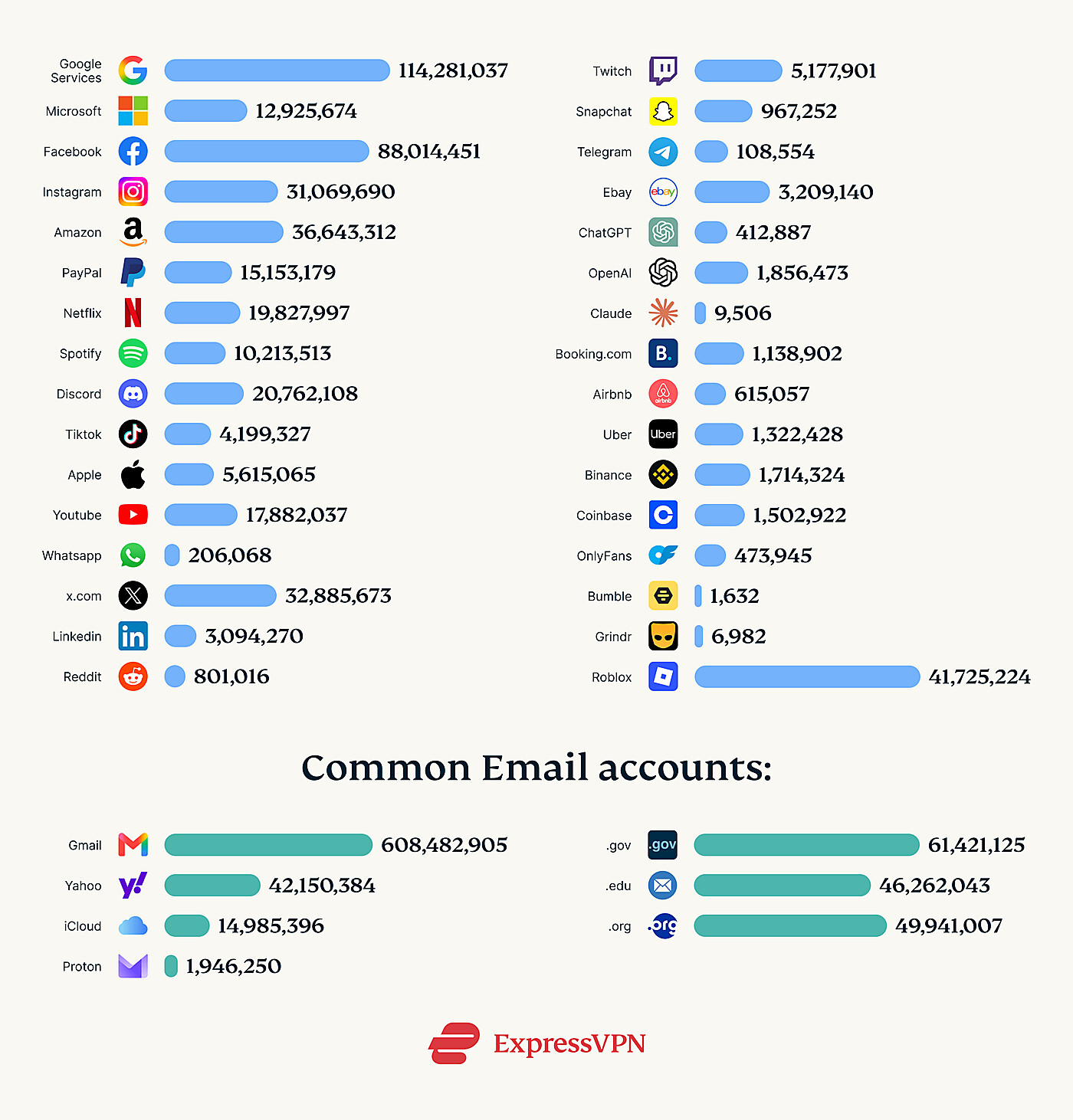
ExpressVPN published counts of lines that contained each domain name. It says the counts "may include duplicates." Selected rows from its chart:
| Account type | Lines in the database |
|---|---|
| Gmail addresses | 608,482,905 |
| Google services | 114,281,037 |
| 88,014,451 | |
| .gov email addresses | 61,421,125 |
| .edu email addresses | 46,262,043 |
| Roblox | 41,725,224 |
| Amazon | 36,643,312 |
| PayPal | 15,153,179 |
| OpenAI | 1,856,473 |
| ChatGPT | 412,887 |
| Claude | 9,506 |
The counts also include lines naming AI chatbot services. Our guide covers what AI chatbots keep and the settings to change.
The second database
The second find was separate. Greg Pollock of UpGuard found "a publicly accessible single-node Elasticsearch 8.13.0 cluster" in October 2026, "With no password or authentication of any kind" (UpGuard, November 19, 2026). It held "1.64 billion documents (about 259 GB)," including "roughly 840 million distinct national ID numbers" and "nearly 300 million phone-number records." UpGuard describes it as "personal data on people in mainland China." WIRED's headline figure of 3.5 billion adds the two finds together.
Can you check if you are in it
Not as of November 24, 2026. Have I Been Pwned, the free breach-checking site, had not loaded this data. The newest entry on its list of loaded breaches that day was Bromcom, added November 23.
Its free dashboard does show older stealer log data. That includes 183 million addresses from the Synthient stealer logs, loaded in October 2025 (Troy Hunt). Fowler writes that his find's folder structure "appears to differ from that of the datasets involved in the 2025 Synthient discovery" (ExpressVPN research). How to sign in and read the result: Have I Been Pwned: is it safe, and what a result means.