
In June, a video from "Facts Matter," an Epoch Times show, said in its description that a 2021 federal law "mandates that all new U.S. passenger vehicles starting in 2027 must include" technology that detects impaired drivers. The video describes infrared cameras aimed at the driver's face and a car that can slow itself down, pull over or refuse to start. It has been viewed more than 130,000 times.
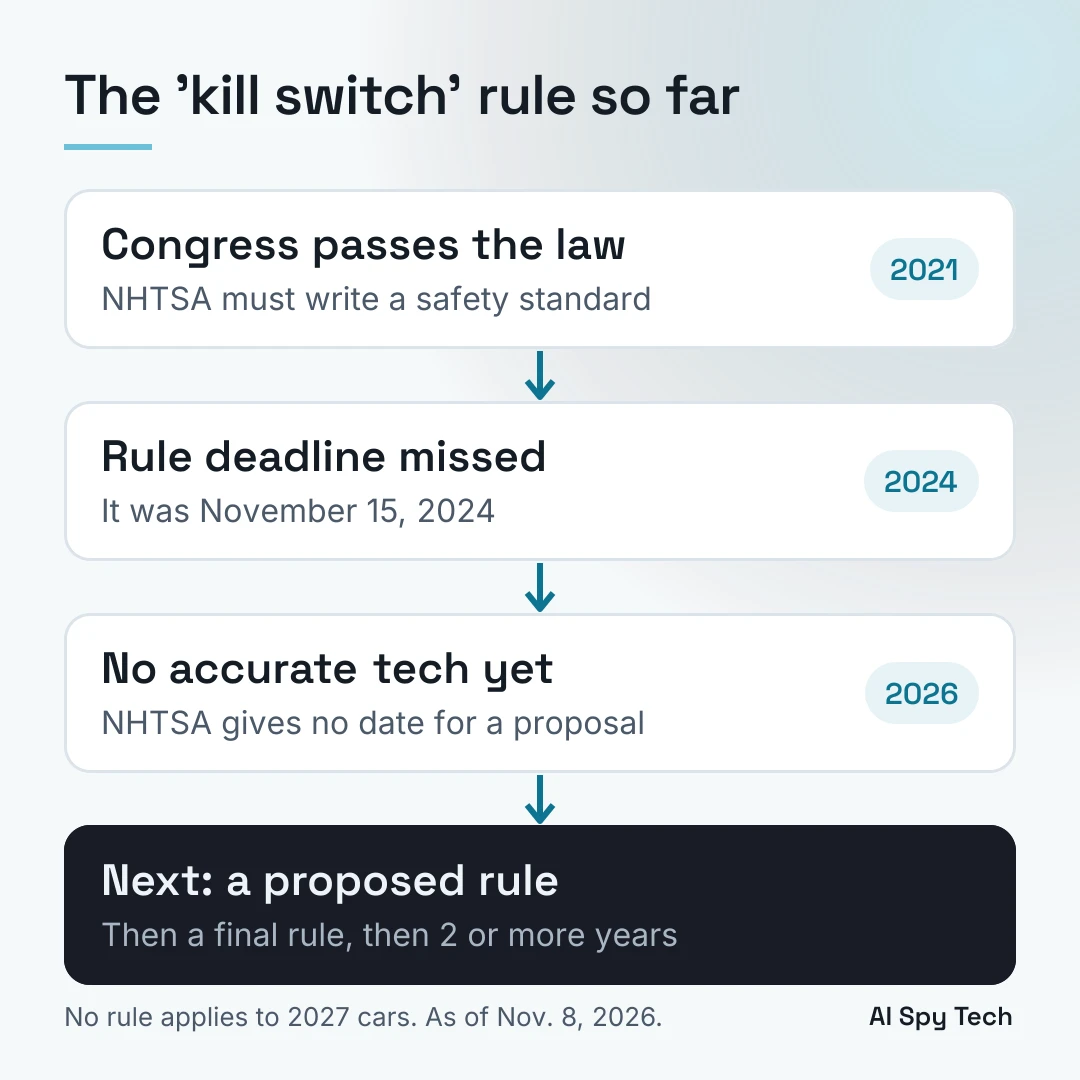
The law is real. It is Section 24220 of the 2021 infrastructure law, and it tells the National Highway Traffic Safety Administration (NHTSA) to write a safety standard for technology that stops drunk or impaired drivers. The 2027 date for cars is not. NHTSA has not written that standard, and it has not proposed one.
"2027 model year cars are not going to have any mandatory technology that can determine if you're intoxicated," Emily A. Thomas, associate director of safety at the Consumer Reports auto test center, told the magazine in July. Many new cars do already have a camera pointed at the driver, though, put there by the carmaker. What five carmakers say about that camera, and the settings to check, are below.
Facts are current as of November 8, 2026.
What the law requires, and where it stands
Section 24220 describes a system that can "passively monitor the performance of a driver of a motor vehicle to accurately identify whether that driver may be impaired" and "prevent or limit motor vehicle operation if an impairment is detected." A system that passively detects a blood alcohol level at or above the legal limit also counts. Passive means the driver does nothing, unlike an ignition interlock, where the driver blows into a tube before the car starts.
The law gave NHTSA until November 15, 2024 to issue a final rule. It missed that date. The law lets NHTSA push the deadline back, to November 15, 2027 at the latest, if the standard cannot yet meet federal safety law, and it must then report to Congress every year until the rule is issued. That 2027 date is for writing the rule, not for cars.
So far NHTSA has taken one formal step: an advance notice in January 2024 asking the public for information, with comments closed on March 5, 2024. The rule's entry in the federal regulatory agenda still lists it at the "Prerule Stage," with "Analyzing comments on the ANPRM" set for October 2026 and no date for a proposed rule.
NHTSA's February 2026 report to Congress explains the delay. Its research has not "found commercially available technology that detects driver alcohol impairment accurately and passively." Americans take an estimated 227 billion driving trips a year, so the agency warns that "even a 99.9 percent detection accuracy level could result in millions to tens of millions of instances each year where the technology would incorrectly prevent or limit drivers from operating their vehicles, or fail to prevent or limit impaired drivers from doing so." The report gives no date for a proposal.
Even after a final rule, carmakers get time. The law says the compliance date "shall be not earlier than 2 years and not more than 3 years after the date on which that rule is issued." A rule issued today could not apply to new cars before late 2028.
What the law does not say
"The phrase 'kill switch' is nowhere to be found in Section 24220, nor does it give the police or anyone else authority to remotely shut down a car for any reason," The Drive reported in October. The control the law describes sits inside the car: the car's own system limits driving when it detects impairment. NHTSA's report itself warns that stopping a car in its lane once it is moving "may lead to significant unintended consequences."
Members of Congress have tried to stop the rule in three ways:
- The House voted down amendments from Rep. Thomas Massie to block money for it on November 7, 2023 (201 to 229) and on January 22, 2026 (164 to 268).
- In June 2026, the House Appropriations Committee added an amendment from Rep. Michael Cloud to the 2027 transportation spending bill, H.R. 9170, that denies money for the rulemaking. The full House has not voted on the bill. Its last action was on June 5, 2026.
- A bill to repeal the section, the No Kill Switches in Cars Act (H.R. 1137), has sat in committee since February 2025.
Mothers Against Drunk Driving backs the law. In a June 2026 statement, it said the law does not authorize "law enforcement or any third party to access or shut down vehicles remotely." Supporters point to the death toll. In 2024, 11,904 people were killed in alcohol-impaired-driving crashes, 30 percent of all US traffic deaths, according to NHTSA. The Insurance Institute for Highway Safety estimated in 2020 that an average of 9,409 lives a year could have been saved if the most impaired drivers in 2015 to 2018 crashes had been kept below the legal limit. It also found that if new cars were required to have the systems, it would take 12 years to save 4,596 lives a year.
The camera that may already be in your car
Many new cars have a driver-monitoring camera: a small infrared camera, usually on the steering column or the top of the dash, that tracks where your head and eyes point. Carmakers add them for hands-free driving features and distraction warnings. NHTSA says most of these systems "are intended to detect driver drowsiness, inattention, and sudden sickness," not alcohol.
Five carmakers' own pages say this about their cameras:
| Carmaker and system | What the carmaker says |
|---|---|
| Subaru DriverFocus | Distraction warning data "does not leave the vehicle and is deleted when the vehicle is turned off." Face profiles are optional and "stored within the vehicle until it is deleted." (Subaru privacy notice) |
| GM Super Cruise | "The Driver Attention Camera does not record or share photos, audio or video." (GM Super Cruise guide) |
| Ford BlueCruise | The camera is on only while BlueCruise or lane centering is in use, and "no images, photos or videos are off-boarded from your vehicle to Ford during regular use." (Ford) |
| Tesla cabin camera | Images "do not leave the vehicle itself and are not transmitted to anyone, including us, unless you enable data sharing." (Tesla support) |
| Toyota driver monitor (2026 RAV4) | It detects "the position and direction the driver is facing, and whether their eyes are opened or closed." The manual page does not say whether images are stored or sent. (Toyota owner's manual) |
Europe already requires driver warnings like these. Every new car registered in the EU has needed a drowsiness and attention warning since July 7, 2024, and an advanced distraction warning since July 7, 2026. The EU regulation also says the systems must not "continuously record nor retain any data other than what is necessary," and that the data "shall not be accessible or made available to third parties at any time and shall be immediately deleted after processing." The US has no federal rule like it.
How to check the camera in your car
- Find it. A driver camera is a small dark lens facing you, often on the steering column or above the center screen. The owner's manual may call it a "driver monitor," "Driver Attention Camera," "DriverFocus" or "cabin camera."
- Read what the carmaker says about it. Open the carmaker's vehicle privacy notice and search it for "camera," "biometric" and "driver monitoring." Look for whether it says images stay in the car.
- Check the settings. On a Tesla, sharing is under Controls > Software > Data Sharing > Allow Cabin Camera Analytics. Subaru calls its face profile and distraction features "user activated and optional," and a saved face profile stays in the car until you delete it. Toyota lets you change the driver monitor in its customize settings, but turning it off also turns off the features that use the camera. Ford says BlueCruise gives escalating warnings and then hands control back to you when it senses the camera is blocked.
- Look up your car for free. Vehicle Privacy Report, a VIN lookup run by the company Privacy4Cars, gives "a rough idea of what sorts of data your car collects," as the Electronic Frontier Foundation puts it.
- Get your driving file. The car data case against GM was about the sale of driving and location data. In January 2026, the Federal Trade Commission barred GM from giving that data to consumer reporting agencies for five years. See how to get your driving file for free.
Driving data is one kind of broker file. For people-search sites and other data brokers, see how to remove your personal information, free steps first.
When NHTSA does propose a rule, anyone can comment on it at regulations.gov, in docket NHTSA-2022-0079. Until then, no rule under Section 24220 applies to any car on sale.
Frequently asked questions
Will 2027 cars have a kill switch?
No federal rule requires impairment-detection technology in any 2027 model. NHTSA has not proposed the rule, and the law gives carmakers at least 2 years after a final rule to comply. Some 2027 models will have driver-monitoring cameras because the carmaker chose to add them.
Can police shut off my car under this law?
No. Section 24220 says nothing about remote access or police. The Drive and MADD both say it gives no one the power to shut a car off remotely.
Has the law been repealed?
No. The House rejected amendments to cut off its money in November 2023 and January 2026. In June 2026, a House committee added the same kind of amendment to the 2027 transportation spending bill, H.R. 9170, but the full House has not voted on that bill.
When could the rule take effect?
NHTSA has not said. Its February 2026 report gives no date for a proposed rule. If NHTSA issued a final rule tomorrow, the earliest it could apply to new cars would be late 2028.
Does my car's camera send video to the carmaker?
It depends on the carmaker. Subaru, GM and Ford say their driver camera images stay in the car during normal use. Tesla says its cabin camera images leave the car only if you turn on data sharing. Check your carmaker's privacy notice and your car's data sharing settings.