
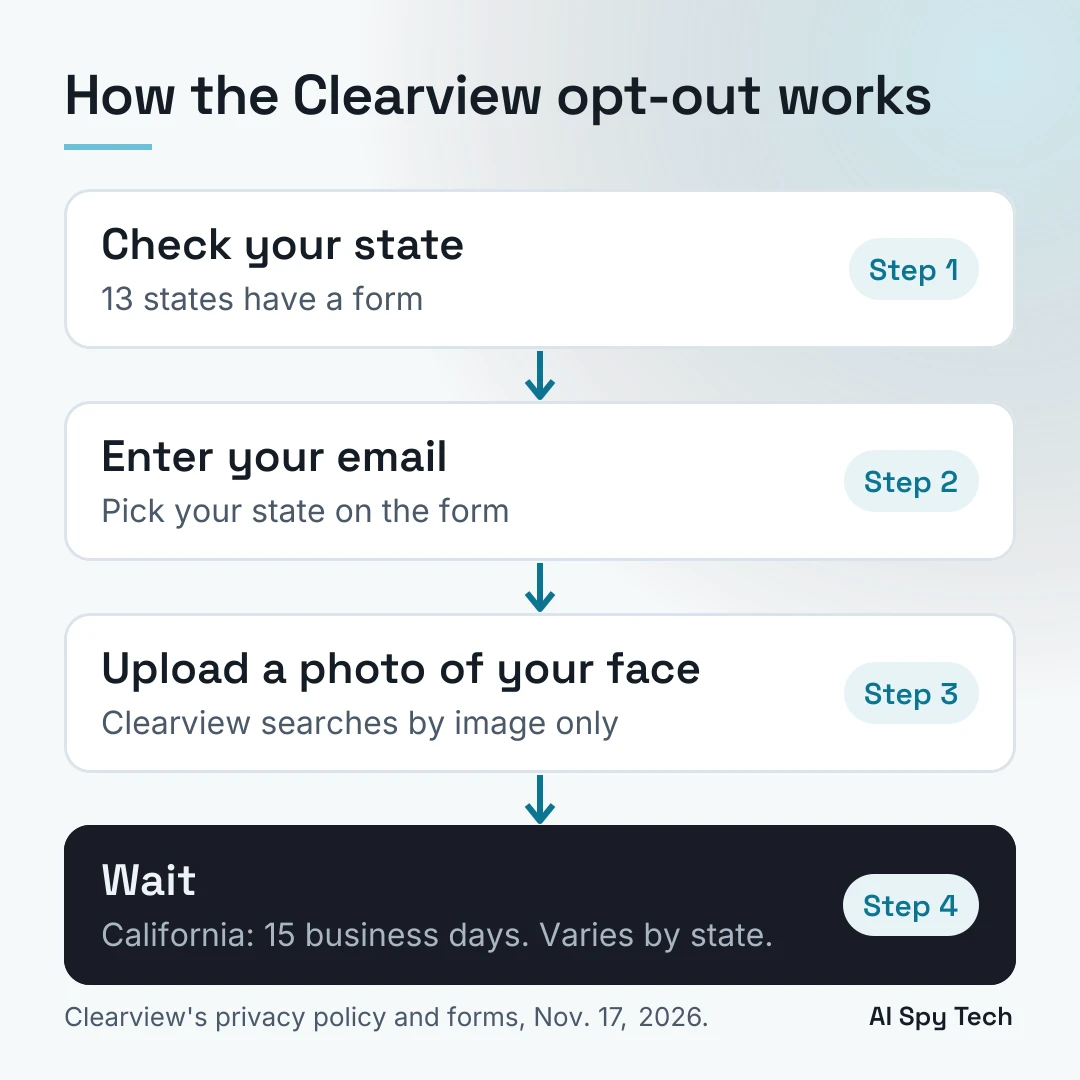
Clearview AI is a face search engine sold to police and government agencies. Its FAQ describes a database of more than 100 billion public images. People in 13 US states, including California, Illinois and Virginia, can opt out for free with a web form that asks for an email address and a photo of their face. Clearview says it honors a California opt-out within 15 business days. For six of the other states, its policy says 45 business days. People in the other 37 states, including Ohio and Texas, have no opt-out form on its site.
Every step below comes from Clearview's own pages and web forms and its California data broker filing, all read on November 17, 2026. For other face search sites, see the PimEyes guide.
What Clearview AI is and who uses it
An investigator uploads a photo of a face, and Clearview returns other photos from the web that look like the same person. Clearview's FAQ says police use it "in an after-the-fact manner, not in real-time," and that a search runs against public images from the internet and against "separate customer private image galleries." The FAQ says results are leads that the investigator must check through peer review and other means.
The same FAQ says Clearview sells only to vetted law enforcement and government agencies and to contractors working for them. Clearview says it does not offer the product in the EU, the UK, Australia or Canada. Inside the US, the FAQ says it is available in almost every state except Vermont, New Jersey, Illinois, Maine, Massachusetts and Montana.
Federal immigration agencies are among the buyers:
- Immigration and Customs Enforcement signed a $9.2 million contract in September 2025, which Forbes reported was Clearview's biggest award from any government department to that date.
- Customs and Border Protection planned to spend $225,000 for a year of access for Border Patrol's headquarters intelligence division and the National Targeting Center, Wired reported in February 2026. The contract described "over 60+ billion publicly available images," a lower figure than the FAQ gives today.
In September 2026, Wired found a prototype called InquiryIQ in files on Clearview's login page. It was built to take a Clearview match and assemble a profile from the web, with possible employers, aliases and associates. Clearview told Wired the tool had never been shipped to customers and was not planned for release in its current form.
Clearview works from photos after a crime. That makes it a different tool from the license plate cameras covered in the Flock camera guide.
What Clearview collects
Clearview's privacy policy says it collects "photos that are publicly available on the internet," any metadata stored in those files, and "information derived from the facial appearance of individuals in the photos." That derived information is a face vector, a numeric map of a face that software can compare. The policy says customers see the photos that match a search, and that Clearview "does not provide any third party with access to face vectors Clearview produces."
There is no name search. The multi-state request form says Clearview "does not maintain any sort of information other than publicly available photos" and "cannot search by name or any method other than image."
Clearview AI, Inc. is broker ID 1071 in California's data broker registry. In that filing it answered:
- Yes, it collects consumers' biometric data.
- Yes, in the past year it shared or sold consumers' data to the federal government, to other state governments, and to law enforcement when no subpoena or court order required it.
- No to collecting data on minors, precise location or immigration status, and no to selling to a foreign actor or to a developer of a generative AI system.
Is Clearview AI legal?
Clearview's FAQ calls its technology "entirely lawful." Courts and regulators have drawn limits around it.
Illinois, 2022. The ACLU sued under Illinois' biometric privacy law. A consent order signed May 11, 2022 permanently bans Clearview from making its faceprint database available to most businesses and other private entities anywhere in the US. It also bars Clearview from selling to any entity in Illinois, including state and local police, for five years, and it requires Clearview to let Illinois residents block their facial data.
The class action. A separate case gathered lawsuits from across the country. A federal judge approved a settlement on March 20, 2025 that gave the class no upfront cash, only a payment equal to a 23% stake in Clearview, owed if the company goes public or is sold, or taken as a share of its revenue. It was valued at $51.75 million based on a January 2024 estimate of the company's worth. On July 13, 2026, the Seventh Circuit vacated that approval in Weissman v. Clearview AI, No. 25-1673. The court found the deal procedurally deficient because no one represented people who were only in the nationwide class. Those members would have received one share each, against five for California, New York and Virginia members and ten for Illinois members. The case went back to the trial court, and no new settlement had been announced as of November 17, 2026. There is nothing to claim right now.
United Kingdom. On October 6, 2025, the Upper Tribunal ruled that the Information Commissioner had jurisdiction to issue an enforcement notice and a fine against Clearview. It sent the case back to the First-tier Tribunal to decide the rest of Clearview's appeal.
Netherlands. In September 2024, the Dutch data protection authority fined Clearview 30.5 million euros and said Dutch organizations that use it can expect fines too.
Austria. On October 28, 2025, the privacy group noyb filed a criminal complaint with Austrian prosecutors against Clearview and its managers. noyb says executives could face jail time if it succeeds.
Canada. On February 18, 2026, the British Columbia Court of Appeal dismissed Clearview's appeal (2026 BCCA 67). The commissioner's order stands: Clearview may not offer its service in BC and must make best efforts to stop collecting and to delete the facial data of British Columbians.
Australia. The privacy commissioner said in August 2024 that its earlier ruling still stands: Clearview must not collect images of people in Australia and must delete those it holds. The statement said: "I am not satisfied that further action is warranted in the particular case of Clearview AI at this time."
Who can opt out
Clearview's privacy and requests page, read on November 17, 2026, has request forms for residents of 13 states: California, Colorado, Connecticut, Delaware, Illinois, Iowa, Kentucky, Minnesota, Montana, Nebraska, New Hampshire, Utah and Virginia.
The privacy policy lists a 14th state, Nevada. Its Nevada section says Clearview does not sell covered information as Nevada law defines it, and it offers no Nevada form. The policy is plain about everyone else: "Currently, only those who are a resident of one of the following states may submit a consumer request for access, opt-out, and/or delete."
The choices differ by state. Illinois gets one form, to opt out of search results. Utah gets access, delete or opt out, and do not sell. California and the other 10 states add more, such as correcting data, and those 10 states have an appeal button.
How to opt out of Clearview AI, step by step
California and Illinois each have their own form. The other 11 states share one.
- Open the privacy and requests page and click the button for your state and the right you want. To keep your face out of search results, Californians can pick Do Not Sell/Share. In most other states, the page lists it as Delete/Opt-Out My Information.
- On the shared form, select your state. The form adds: "Please be prepared to provide a Government issued ID as proof."
- Enter an email address. The form says it is used to confirm when your request is complete.
- Upload a clear photo of your face. The form says files larger than 4 MB are not supported. The California form accepts PNG, JPG, TIFF, GIF or PDF.
- Tick the acknowledgment that your information is accurate and submit.
The Illinois form is shorter. You accept its biometric terms and upload a picture of yourself.
Do you need an ID?
The policy's general section says an opt-out needs "(1) your email address (2) a headshot of you," and an ID photo only for data access requests. The forms agree. But the sections for the 11 states on the shared form say Clearview will "typically require" an ID, and that form warns you may need one to prove where you live.
You can also leave a voicemail at (866) 637-0257. The policy's general section asks people not to email requests, though its Montana section lists privacy@clearview.ai as an option.
What happens after you opt out
Clearview's timing changes by state. All of it comes from the privacy policy:
| State | What the policy says |
|---|---|
| California | Opt-outs "within fifteen (15) business days." Access, delete and correct: 45 calendar days, or up to 90. |
| Colorado, Connecticut, Delaware, Minnesota, Montana, New Hampshire | Opt-outs "within forty-five (45) business days." |
| Nebraska | Opt-outs "within thirty (30) business days." |
| Virginia | A response within 45 calendar days, or 90 if more time is needed. |
| Illinois, Iowa, Kentucky, Utah | No time given. |
Blocked, not always deleted
For a California opt-out, the policy says Clearview uses your photo to "identify and suppress your information." The California form says that after an opt-out, deletion or limit request, "no image of you will be returned as a search result." A deletion request goes further: Clearview says it will delete your information "in our active records, unless an exception applies," and will tell you in writing why if it refuses.
Illinois works differently. Clearview's requests page says it keeps biometric information it can associate with Illinois "solely for the purpose of complying with Clearview AI's ongoing legal obligations" and blocks it from future searches.
Not every request goes through
The policy publishes Clearview's 2025 numbers for California requests:
| Request type | Received | Complied | Denied |
|---|---|---|---|
| Delete | 1,222 | 928 | 294 |
| Know or access | 1,069 | 674 | 395 |
| Opt out of sale or sharing | 764 | 543 | 221 |
| Limit sensitive information | 442 | 320 | 122 |
| Correct | 72 | 0 | 72 |
The policy does not say why requests were denied. For 2024, the registry filing shows 1,425 deletion requests, 1,185 completed and 240 denied.
If your request is denied in one of the 10 states with an appeal button, use the appeal form. If the appeal fails, the policy points you to your state attorney general. Californians can complain to the California Privacy Protection Agency.
Someone on r/privacy posted that an access request to Clearview, filed under European law, came back with photos of a different person.
Should you send a selfie?
Sending a face photo to a face search company is a trade-off. Here is what Clearview says it does with the photo, so you can weigh it yourself.
- Why it asks. The California form says Clearview "cannot search by name, email or any method other than image," so without a photo it has no way to find you.
- What happens to the upload. The shared form says the photos you send "will be deleted" when your request is done, and Clearview keeps "a record of your request."
- What California keeps. For deletion, opt-out and limit requests, the California form says Clearview keeps "a secure, encrypted copy of your image, stored separately from and unlinked to any other identifying information," used only so it does not collect or process your image again. The form gives no time limit for that copy.
- What Illinois keeps. The Illinois form says Clearview will "generate facial vectors from this picture" to find and block other photos of you, and that the photo will not appear in future search results. Clicking "I Accept" consents to the collection, use and storage of your biometric data under Clearview's Illinois retention policy.
- ID photos. The policy says ID images are used "solely to verify the identity of individuals who submit requests to know/access."
Those are Clearview's own statements. No outside audit of them was found in the sources reviewed for this page.
If your state is not listed
California's DROP. Clearview is a registered broker, so a request through the state's free DROP system is sent to it. DROP brokers match people on the details they enter in DROP. Clearview says it can match only by image. Its pages, read on November 17, 2026, do not say how it handles DROP requests. The photo form above is the route Clearview describes. The removal guide explains how DROP works for other brokers.
Other face search sites. PimEyes and FaceCheck.ID take opt-out requests from anyone, in any state. The steps are in the PimEyes guide.
Photos at the source. Clearview collects public photos, so making old profiles private or deleting photos you control shrinks what is public from now on. Someone on r/privacy asked whether deleting their social accounts was already too late, and the replies disagreed. Clearview's policy says scraped photos are deleted or de-identified "as soon as it no longer has a business use," and it does not say a photo removed from its source is removed from its database.
People-search sites. The guide to removing personal information covers the large people-search sites and when a paid removal service is worth it.
Frequently asked questions
Is Clearview AI legal?
Clearview's FAQ calls it entirely lawful. A 2022 Illinois consent order bars it from selling to most private businesses nationwide. Regulators in the Netherlands, British Columbia and Australia found it broke their privacy laws.
Does Clearview AI have my photo?
Clearview's route for checking is an access request, open to residents of the 13 listed states. You send a face photo and a redacted photo of your ID. Californians can ask up to twice in 12 months. Clearview's own access numbers show 395 of 1,069 California requests denied in 2025.
Can anyone use Clearview AI?
No. Its FAQ says access goes only to vetted law enforcement and government agencies and their contractors, after review by Clearview's legal department.
What happened in the Clearview AI lawsuit?
The class action settlement, a payment tied to a 23% stake in the company, was approved on March 20, 2025 and vacated by the Seventh Circuit on July 13, 2026. The case is back in the trial court, and no new settlement had been announced as of November 17, 2026.
How long does the Clearview opt-out take?
In California, Clearview says 15 business days. In Colorado, Connecticut, Delaware, Minnesota, Montana and New Hampshire it says 45 business days, and in Nebraska 30. The policy gives no time for Illinois, Iowa, Kentucky or Utah.
Does opting out delete my photos?
An opt-out blocks your face from search results, according to Clearview's California form. A deletion request asks Clearview to delete your information from its active records, unless an exception applies. In Illinois, Clearview says it keeps the data for legal reasons and blocks it. Either way, the original photos stay on the sites where they were posted.
How AI Spy Tech checks and sources its articles is described in its editorial standards. Clearview's forms, timing and state list on this page were read on November 17, 2026 and can change.