
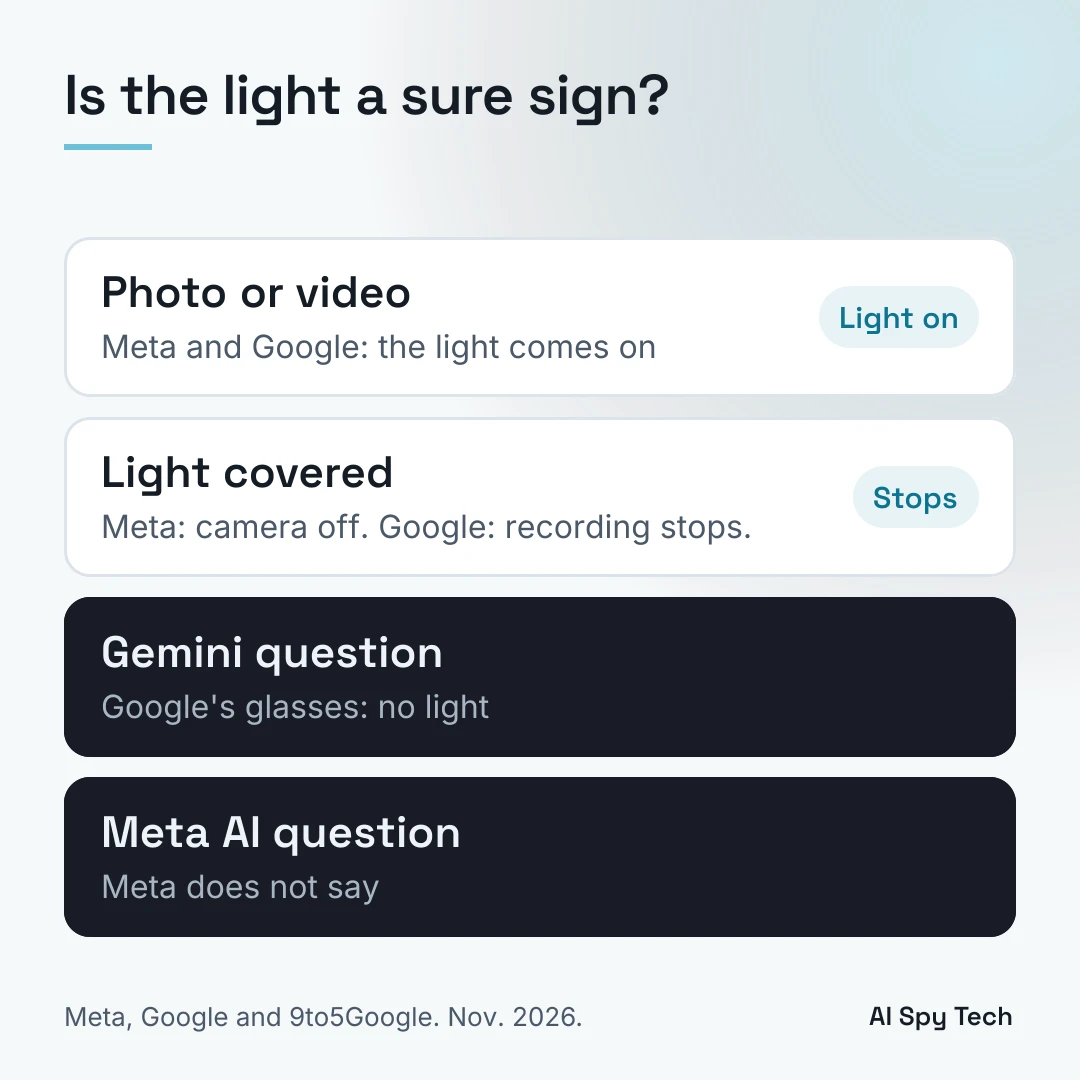
Most camera glasses have a small light on the front that comes on when they take a photo or video. On Ray-Ban and Oakley Meta glasses it is a white light that blinks. On Google's new glasses it sits on the right side of the frame. The light is a good sign, but it is not proof. Google's stays off when the wearer asks its AI a question, and Meta's privacy page describes its light only for photos and videos saved to the wearer's gallery.
Each maker's light is described below in its own words. Facts are current as of November 17, 2026.
What smart glasses look like, and where the camera is
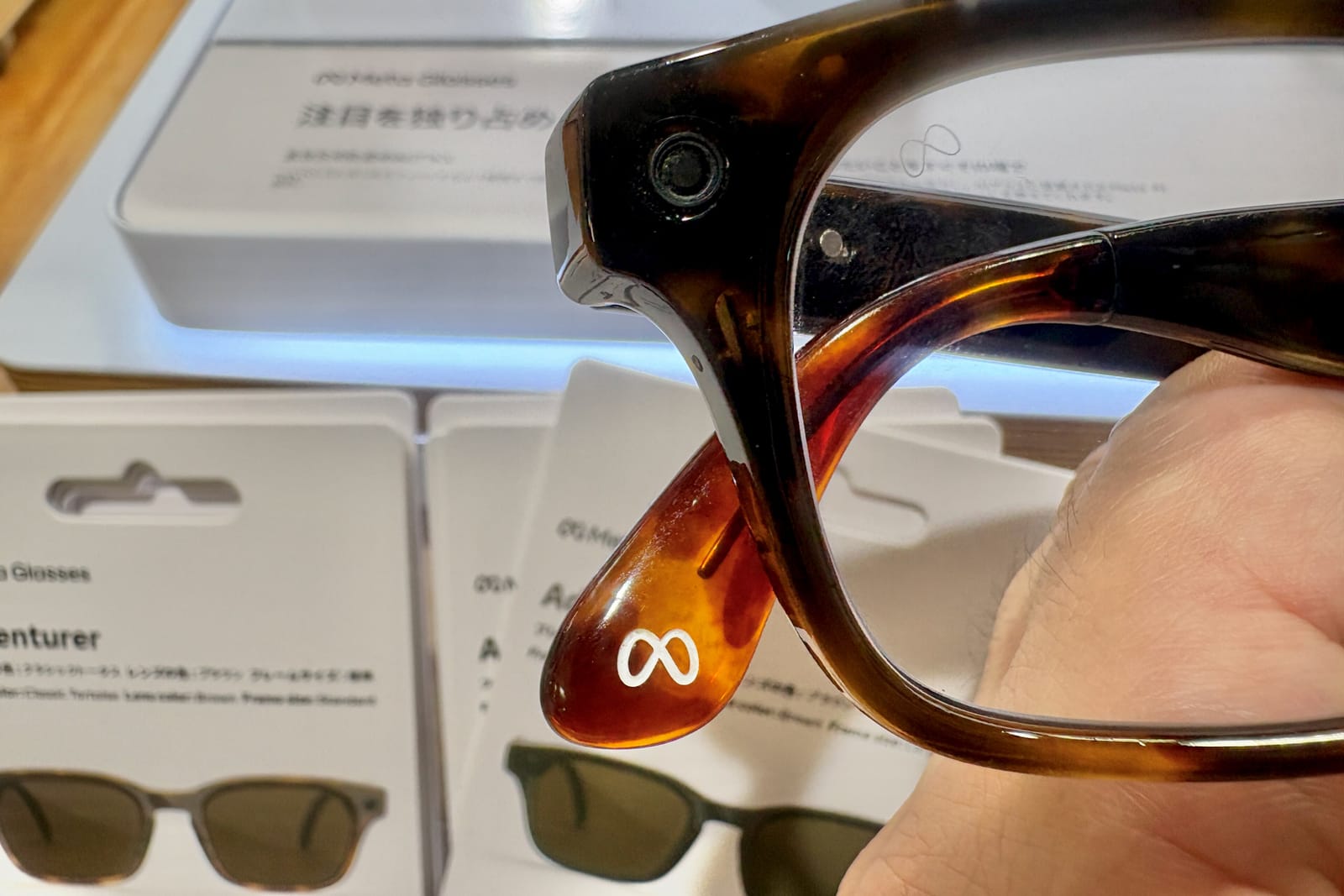
Most camera glasses look like ordinary frames. On Meta's glasses, Meta's accessibility help page says the camera "sits on the left of the glasses, at the top corner. It is a small circle about 3mm (smaller than your pinky) and has a ridge." The same page says: "The equivalent lens on the right frame of the glasses is the capture LED signal." Meta sells them under the Ray-Ban and Oakley names and as a cheaper $300 line called Meta Glasses, per Road to VR.
Google's glasses, built with Samsung and sold in Warby Parker and Gentle Monster frames, are on preorder now and ship December 10, 9to5Google reported; our post on Google's AI glasses covers them in full. Their light is on the right temple, per the image description in Google's privacy post.
Snap opened preorders for its Specs AR glasses on June 16, 2026, at $2,195. Snap said they "are expected to ship this fall in the United States, the United Kingdom, and France," per its announcement.
What do Meta glasses look like when recording?
A white light next to the camera blinks. Meta's privacy page gives the pattern: "When you're capturing a photo on Meta AI glasses for your gallery, the Capture LED light blinks briefly. When capturing video, it continues to blink for as long as you are recording."
A quick blink means a photo; steady blinking means video. No blink does not settle it, as the next sections explain.
What the recording light looks like on each brand
| Glasses | Where the light is | What the maker says it does | If the light is covered |
|---|---|---|---|
| Ray-Ban Meta, Oakley Meta, Meta Glasses | Front, right top corner, across from the camera | "a bright white light called a Capture LED that blinks to signify when content is being captured for your gallery" (Meta) | "they'll automatically disable the camera" (Meta) |
| Meta Ray-Ban Display | Not stated; Meta calls it the "bystander LED" | "turns on whenever the camera is active during a display recording" (Meta help) | Not stated separately for this model |
| Google and Samsung Intelligent Eyewear | Right temple | "When you take a photo or video for your gallery, an indicator light lets people around you know." (Google) | "designed to stop in-progress recording and not take photos or video" (Google) |
| Snap Specs | Not stated | "an LED indicator lights up when recording is taking place" (Snap) | Not stated |
Snap's announcement does not give the light's color or its place on the frame.
When the light is off but the camera may still see you
Both makers describe the light for photos and video saved to the gallery. The glasses also use the camera to answer the wearer's AI questions.
Google. "If you're just using Gemini for context, the light doesn't activate," 9to5Google reported. Google says the glasses "are designed to redact faces before sending images to Gemini," per its privacy post.
Meta. Meta's privacy page says that for Meta AI questions, "faces and license plates are automatically blurred if they appear in the frame, and images used to generate your answer aren't saved to your gallery." The page does not say whether the light comes on when the camera is used for a Meta AI question.
In an email to owners on April 29, 2025, Meta announced two privacy policy changes, The Verge reported. Meta's email to owners said "Meta AI with camera use is always enabled on your glasses unless you turn off 'Hey Meta.'" It also said "The option to disable voice recordings storage is no longer available, but you can delete recordings anytime in settings."
In July 2026 the Financial Times reported that Meta was testing prototype "super sensing" glasses and that executives "are planning not to activate the LED when the super-sensing features are being used," Ars Technica noted, adding that sources said the plans may change. More in our face search guide.
What happens if the light is covered
This section reports only what the makers say their glasses do.
Meta says: "If the glasses detect the Capture LED light was covered, physically tampered or destroyed, they'll automatically disable the camera." It adds that "No photos or videos can be taken for your gallery until the glasses detect that the light is unblocked," per its privacy page.
In July 2026, Meta began rolling out a mandatory v26 software update to Meta Ray-Ban, Meta Oakley and Meta Glasses that "will disable the camera if the device's capture LED has been tampered with or destroyed," Road to VR reported. Meta's terms already said owners "may not tamper with the Glasses or otherwise obscure or modify any of the features on the Glasses that signal to others that the Glasses are recording."
Google says its sensors "are designed to continuously check whether the indicator light is blocked," and that hardware defenses are designed to detect if the light's parts or wiring are "compromised or modified and automatically disable photo and video recording capabilities," per its Safety Center. The same page says that before using the glasses, wearers must agree not to record others without their permission, not to record in sensitive spaces and not to cover the outer indicator light.
Snap's announcement does not say what Specs do if the light is covered.
Free ways to check if smart glasses are recording you
Look at the frame. On Meta's glasses, look for two small circles at the top corners: one is the camera, the other is the light. A quick white blink means a photo; steady blinking means video.
Ask. A plain question, such as "Are your glasses recording?", costs nothing. Someone on r/privacy who lives in a two-party consent state asked how to tell, after reading about cases of doctors wearing smart glasses in closed offices. Replies pointed to Bluetooth scanner apps, and others noted that spotting the glasses is not the same as knowing they are recording. At a clinic, office or venue, you can ask about its policy on camera glasses.
Try a Bluetooth scanner app, and know its limit. Hobbyists have released apps that look for smart glasses nearby. Ars Technica tested them and reported:
- At best, they alert you when nearby glasses are turned on, by picking up the Bluetooth signal that pairs the glasses with a phone.
- They "cannot determine whether the glasses are actively recording."
- Walls and even a human body can block the signal, and false positives happen.
- App makers advise against confrontation.
Ars named Nearby Glasses (free on iOS and Android), Antizuck Smart Glasses Scanner ($3 on iPhone) and Zuckoff (free on iPhone; optional always-on scanning costs about $10 a year). An alert means camera glasses are probably nearby, not that you are being filmed.
For a room, not a person. Cameras hidden in a rental or changing room are a different problem. See how to detect hidden cameras.
Where smart glasses are banned
Rules differ by place. Here is what has been published:
- New York State courts. From July 20, 2026, the Office of Court Administration bans smart glasses "that contain a camera, microphone or computer in state, county, town and village courts." It applies to everyone, including attorneys and court staff, per the New York State Bar Association.
- Courts in England and Wales. The courts service told the Guardian in August 2026 that "the use of Meta glasses is prohibited." A source said glasses are taken at the door and returned when the owner leaves. The Guardian also reported bans at some UK restaurants, theatres and pubs, including Wetherspoons.
- Royal Caribbean. Smart glasses may be brought aboard but "may not be used" in the casino, restrooms, medical and youth facilities, "or any location where there is a reasonable expectation of guest or crew privacy," per the line's prohibited items FAQ.
- MSC Cruises. Its policy says "Devices capable of covertly or discreetly recording or transmitting data (e.g. smart glasses) are not allowed in ships public areas," as quoted by AL.com in February 2026.
- New York City nightlife. Basement in Queens says anyone wearing or bringing smart glasses "will be asked to leave and may be permanently banned." Nowadays and Cocktail Bed Stuy have similar rules, the New York Post reported in October 2026.
- DEF CON. The 2026 hacker conference reportedly banned smart glasses with no exceptions, per Ars Technica.
Norway's government is proposing a temporary ban in some places where "privacy is particularly important," such as healthcare facilities and gyms with changing rooms, AP reported on October 5, 2026. It is a proposal to parliament, not a law.
Is it legal to record someone with smart glasses?
This section is general information, not legal advice. For your own situation, talk to a lawyer in your state.
In the US, recording laws are mostly about conversations. Most states allow recording when one person in the conversation agrees, and that person can be the one recording. A smaller group requires everyone's consent. Justia's 50-state survey, last reviewed in September 2024, describes these states as requiring all-party consent for in-person conversations, some with conditions:
- California, Florida, Maryland, Massachusetts, New Hampshire and Pennsylvania.
- Illinois and Washington, "generally."
- Oregon, for in-person conversations (phone calls need only one party).
- Montana, which requires the "knowledge" of all parties rather than consent.
- Michigan, "technically," though Justia notes courts have found that people taking part in a conversation are not covered by the main law.
Delaware's law reads as all-party, but Justia calls it ambiguous. A 2012 Congressional Research Service report lists 10 all-party states. Its list leaves out Maryland, whose statute allows a recording only where "all of the parties to the communication have given prior consent."
California's law covers a "confidential communication," per Justia. Courts and venues can add their own rules on top.
Biometric law. Illinois' Biometric Information Privacy Act (BIPA) covers face scans. As summarized by Biometric Update, it requires a public policy on keeping and destroying biometric data, plus written notice and informed written consent before collecting it. It lets people sue for $1,000 per negligent violation or $5,000 per intentional or reckless one.
Meta glasses lawsuits: what they claim, where they stand
These lawsuits are pending. Below is what each complaint alleges. None had been decided as of November 17, 2026, in the sources reviewed.
Bartone v. Meta (N.D. Cal., No. 3:26-cv-01897). Gina Bartone and Mateo Canu filed it on March 4, 2026, against Meta and Luxottica of America, Fortune reported. The complaint says footage from the glasses' AI features is sent to Meta's servers and then to a subcontractor in Kenya, where workers view and label it to train Meta's AI. It says Meta's "designed for privacy, controlled by you" marketing was false. A separate proposed class action in the same federal court, amended in late August, now has more than 70 people who bought, used or were recorded with the glasses, the Los Angeles Times reported. Some say they did not know the glasses were recording. Meta disagrees with the allegations and intends to fight them, per the Times.
Alvarez v. Meta (N.D. Ill.). Filed in September 2026, it alleges Meta used photos from Facebook and Instagram, of users and non-users, to train a facial recognition system known internally as NameTag, in violation of BIPA, per Biometric Update. Meta had not filed a substantive response when Biometric Update reported it. The Los Angeles Times reported that Meta has not released the feature, and a Meta spokesman told it, "we are not building a universal face database."
Subia v. Meta (N.D. Cal., No. 3:26-cv-12135). Filed October 19, 2026. The complaint says Angelo Subia's glasses recorded his conversations, including with doctors and financial institutions, without his saying "Hey Meta," per Bloomberg Law. The complaint claims violations of the California Invasion of Privacy Act. Meta said in a statement that Meta AI "is initiated by saying 'Hey Meta' or by touch" and that people can review and delete their voice logs.
Facial recognition glasses: what exists today
Neither Meta nor Google has released a feature that names the people in front of the glasses, per the sources reviewed. The pieces exist separately, and our other guides cover them:
- In 2024, two Harvard students linked Ray-Ban Meta glasses to face search sites to put names to strangers, a demo they called I-XRAY. Details and opt-outs are in our PimEyes guide.
- The New York Times reported in February 2026 that Meta had considered a "Name Tag" feature, and code for it was removed from Meta's app in June. Background: Meta's face matching and our PimEyes guide.
- Google says Gemini on its glasses is designed not to recognize faces, and its app rules ban facial identification. See Google's AI glasses.
- Europe's data protection board and Senators Markey and Wyden raised concerns this fall; see the Google glasses post.
A free step is to make a stranger's lookup harder. Opt out of face search sites with the PimEyes guide, then cut the link from your name to your address with how to remove your personal information.
Frequently asked questions
Can you tell if someone is filming you with Meta glasses?
Usually, for photos and video. Meta says a white light next to the camera blinks briefly for a photo and keeps blinking during video, and that the camera is disabled if the light is covered or tampered with. Meta's page does not say whether the light comes on when the camera is used for a Meta AI question.
Are smart glasses recording me without me knowing?
For saved photos and video, Meta and Google both use a light. When the wearer asks Google's Gemini about what they see, the light does not come on, 9to5Google reported. The undecided Subia v. Meta lawsuit alleges Meta glasses recorded conversations without the wake phrase.
Where can't you wear Meta glasses?
Published bans include New York State courts, courts in England and Wales, parts of Royal Caribbean and MSC ships, some New York City clubs, some UK pubs and theatres, and DEF CON 2026. Ask any venue for its own rule.
Is it legal to record someone with smart glasses?
It depends on the state and the setting. Most US states allow recording a conversation if one person in it agrees. A smaller group, including California, Florida and Pennsylvania, requires everyone's consent for in-person conversations, some with conditions. This is general information, not legal advice.
Do Meta glasses have facial recognition?
Not as a released feature, as of the sources reviewed. The Los Angeles Times reported that Meta has not released its name tagging feature, and a pending Illinois lawsuit alleges Meta trained such a system on Facebook and Instagram photos.
Maker pages and policies on this page were read on November 17, 2026 and can change.