
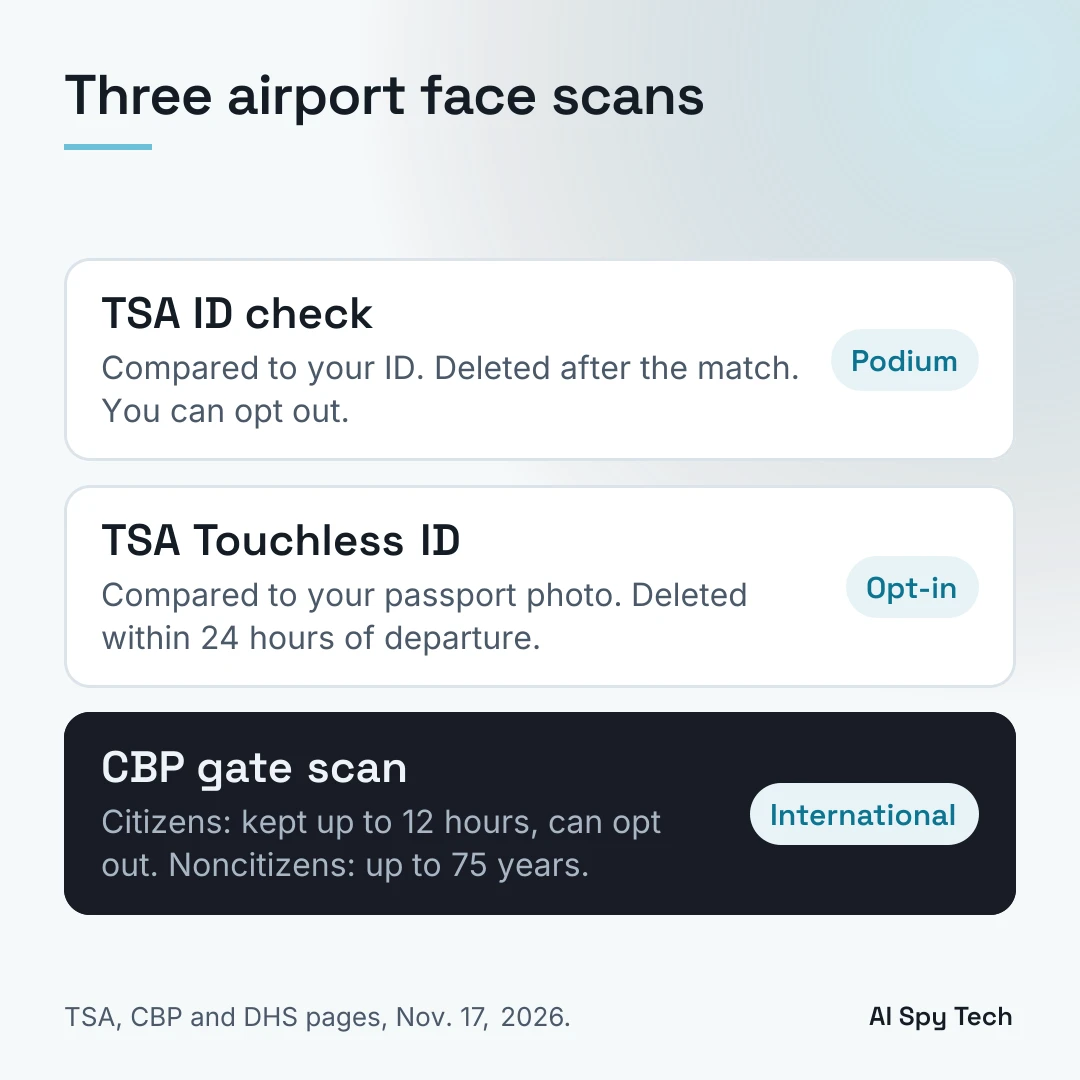
TSA facial recognition is optional for US travelers: you can tell the officer at the ID podium that you do not want your photo taken, and TSA says the manual ID check you get instead will not take longer and you will not lose your place in line. TSA says that under normal operations its camera deletes your photo immediately after your identity is verified, or within 24 hours of your scheduled departure if you signed up for TSA PreCheck Touchless ID.
The rules change at the gate for an international flight. There the camera may belong to the airline or airport, and U.S. Customs and Border Protection (CBP) runs the match. US citizens can still say no. Under a DHS rule that took effect December 26, 2025, CBP can photograph all noncitizens when they enter and leave the country.
Every rule below comes from TSA, CBP and DHS pages, DHS Privacy Impact Assessments, congress.gov, and airline and Google help pages, all read on November 17, 2026.
Airport facial recognition: three scans, three sets of rules
A US traveler can meet three separate face scans: TSA's camera at the ID podium, the TSA PreCheck Touchless ID lane you sign up for, and CBP's camera at the gate or at arrival for international flights. People often mix them up, and the rules for each one differ.
TSA credential authentication technology (CAT-2) at the ID check
This is the camera most domestic flyers see. TSA's second-generation Credential Authentication Technology, called CAT-2, reads your ID and checks your flight and vetting status, and TSA says the units are deployed at approximately 350 airports. The camera compares a live photo of you with the photo on the ID you hand over. TSA describes this as 1:1 matching that does not require a database of pre-staged images. TSA's fact sheet says travelers under 18 are not photographed.
TSA Touchless ID, and what happened to Delta Digital ID
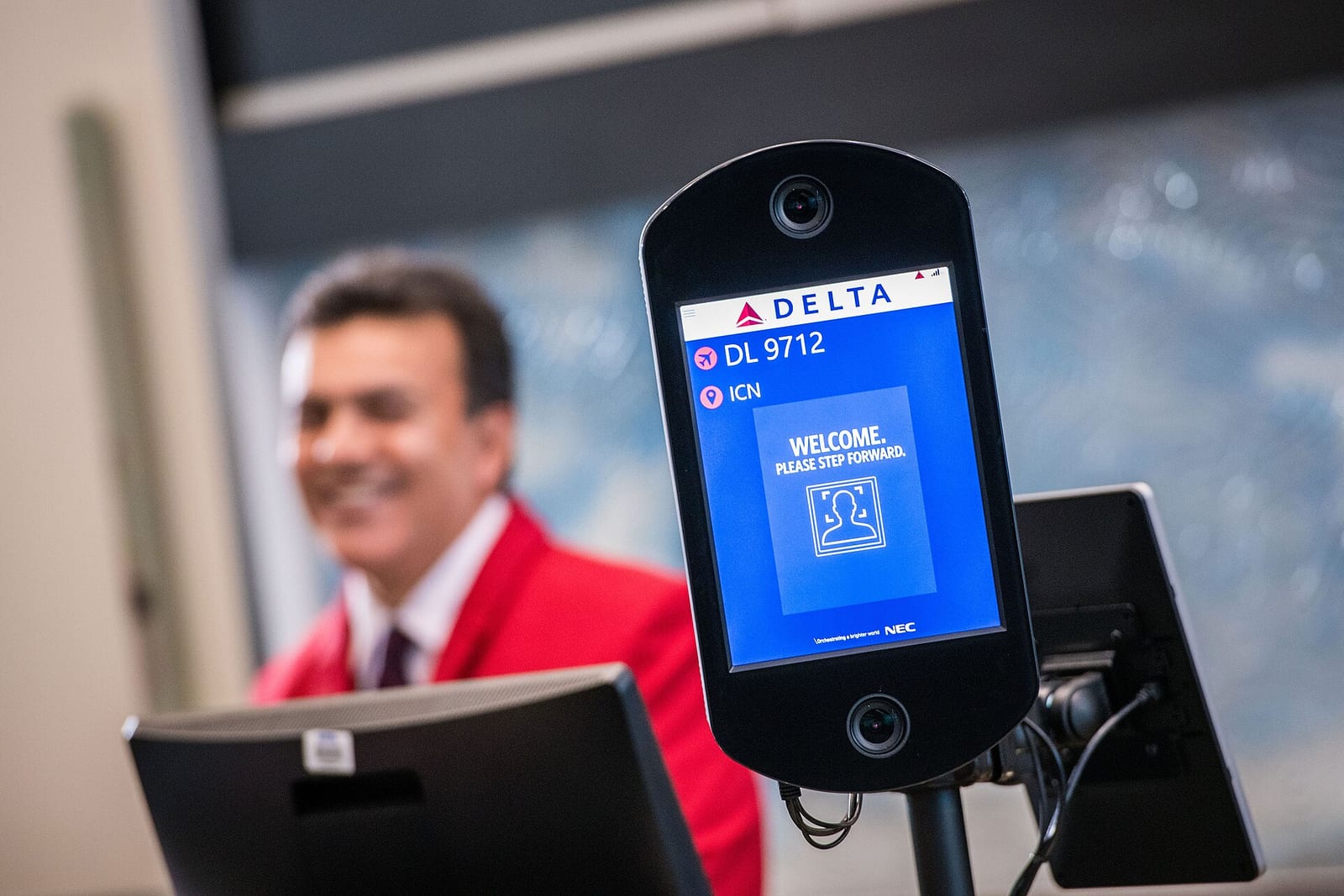
TSA PreCheck Touchless ID is the opt-in version. You walk up to a camera in a dedicated lane and show no ID. Your live photo goes to CBP's Traveler Verification Service, which matches it against the passport or visa photo you already gave the government.
To use it, TSA says you need TSA PreCheck, a valid passport, and a profile with a participating airline or Google Wallet. The airlines are Alaska, American, Delta, Hawaiian, Southwest and United, and Google Wallet was added on June 24, 2026. As of November 2026 it runs at 65 airports.
Delta Digital ID is the same program under an older name. Delta's media kit calls Touchless ID "formerly known to customers as Delta Digital ID", and Delta's old Digital ID web address now opens its Touchless ID page, which lists dedicated Touchless bag drops at 10 airports, including Atlanta, Detroit and Seattle.
CBP facial recognition and biometric boarding on international trips
On international flights, CBP's Traveler Verification Service runs the match. Airlines and airports buy cameras that meet CBP's specifications and send the photos to CBP for matching against photos from your passport, visa or earlier border crossings. That is the camera at the boarding door. CBP says it uses facial biometrics for entry at all international airports and for exit at 66 airports, and that it has processed more than 1 billion travelers this way.
The three scans side by side
Each entry below is sourced in the sections that follow.
| TSA ID check (CAT-2) | TSA PreCheck Touchless ID | CBP gate or arrival scan | |
|---|---|---|---|
| Who runs it | TSA | TSA, matched by CBP's system | Airline or CBP camera, matched by CBP |
| Where | ID podium, about 350 airports | Dedicated lanes, 65 airports | Exit at 66 airports, entry at all international airports |
| Your face is compared to | The ID you hand over | Your passport photo on file | Passport, visa or past border photos for that flight |
| How you end up in it | Offered at the podium | You opt in first | Offered at the gate or arrival |
| What is kept | Deleted after the match, except during announced tests | Deleted within 24 hours of departure | US citizens: up to 12 hours. Noncitizens: up to 75 years |
| Can you opt out | Yes | Yes, at any time | US citizens yes. Noncitizens can be required |
Does TSA keep your photo?
Under normal operations, no. TSA says its face camera deletes traveler data and images immediately after your identity is verified, and its fact sheet says photos are not stored after a match except in a limited testing environment.
Touchless ID keeps data a little longer. The newest version of TSA's Privacy Impact Assessment for Touchless ID, DHS/TSA/PIA-046(e), first dated November 2022 and updated January 2026, says TSA purges your name, date of birth, flight details, passport information and checkpoint photos within 24 hours after your scheduled departure, in case you need rescreening or leave the secure area before your flight.
Announced test periods are the exception. TSA says these start with passenger notification signs, and you can decline without losing your place in line. Test data goes to the DHS Science and Technology Directorate, which deletes it within 180 days. If you opted in to Touchless ID and skip the camera on the day, your previously provided photo template may still be staged in the gallery.
TSA states that the images are "not used for law enforcement, surveillance, nor shared with other entities", though its Privacy Act notice allows sharing with CBP, DHS S&T or others as necessary under published records notices. These scans compare you with a government photo, unlike face search sites such as PimEyes and Clearview AI, which search photos posted online.
CBP facial recognition: citizens and noncitizens are treated differently
CBP discards US citizens' new photos within 12 hours. Noncitizens' photos go into the DHS biometric database, IDENT, which keeps them for up to 75 years, according to CBP.
CBP's privacy policy says it keeps a citizen's photo no more than 12 hours after identity verification and only for continuity of operations purposes, which its privacy assessment explains as in case of an extended system outage.
For noncitizens, the final rule published October 27, 2025 says DHS may require all noncitizens to be photographed when entering or leaving the United States. CBP says the rule, effective December 26, 2025, removes earlier exemptions, including diplomats and most Canadian visitors.
Global Entry members are a special case. CBP's Traveler Verification Service assessment says CBP sends photos to IDENT for people in its Trusted Traveler programs, including US citizens. That document dates from 2018, and the DHS page listing it was last updated in April 2025.
What the airline keeps
Under CBP's rules, airlines and airports that take gate photos may not keep them. The Traveler Verification Service assessment says partners must immediately purge the photos following transmittal to CBP, may not retain them for their own business purposes, and must let CBP audit compliance.
The Government Accountability Office found that CBP had audited only one of its more than 20 airline partners as of May 2020. In a later update on its recommendations, GAO reported that CBP ran one partner assessment in fiscal 2020, assessments at five locations in 2021 and four assessments in 2022.
For Touchless ID, Delta says it does not store or save any customer biometric information, and that your image is encrypted and stripped of biographic information before it goes to CBP. United asks members to read its privacy policy and give United permission to use their facial scan as identification. American says TSA manages all biometric data in the program. United's, Southwest's and Alaska's Touchless ID pages do not say whether the airline keeps face images. The airline does keep what you typed into your profile to sign up: your passport number and Known Traveler Number.
TSA facial recognition opt out: what TSA and CBP say
Both agencies say the face scan is voluntary for US citizens, and both describe the same fallback: an officer checks your ID or passport by hand.
TSA's exact words: "Tell a TSA officer if you do not wish to participate. The officer will use the standard ID verification process." Its fact sheet says travelers may decline the photo "without recourse" and that there is "no issue and no delay" in doing so.
TSA says the right to decline appears on checkpoint signs, passenger-facing screens and in officer advisements. A May 2025 staff report from the federal Privacy and Civil Liberties Oversight Board (PCLOB) found evidence that these policies have historically not been implemented consistently, so speak up whether or not you see a sign.
Opting out does not cost you PreCheck. Touchless ID members who skip the camera go through the standard identity check by an officer, and Delta says there is no penalty for not opting in. TSA requires Touchless ID users to carry a REAL ID-compliant physical ID anyway.
CBP's wording for US citizens: they "may simply notify a CBP officer or airline representative and undergo manual inspection of their passport". CBP's privacy policy calls this "alternative processing". For noncitizens, the December 2025 rule lets DHS require the photo, and CBP's announcement gives no opt-out for them.
How to turn off TSA Touchless ID or Delta Digital ID
TSA says people who opted in to Touchless ID may choose to opt out at any time, but neither its Touchless ID page nor its January 2026 Privacy Impact Assessment gives steps for withdrawing consent. The airline and Google pages below are the guide, and they differ. Delta and Alaska keep you enrolled until you opt out. American says members who opted in before September 24, 2026 stay enrolled for 12 months, and members who opted in after that date stay enrolled until they opt out.
- Alaska and Hawaiian: you opt in under Add TSA PreCheck Touchless ID in your Atmos Rewards account, and Alaska says you stay enrolled for all future trips until you opt out.
- American: you opt in under Information and password in your AAdvantage profile, and American's Touchless ID page says you can opt out anytime in your AAdvantage profile. If you have already checked in for an eligible flight, Touchless ID still applies to that trip.
- Delta: Touchless ID becomes part of your SkyMiles profile, and you may opt out at any time. Delta's Touchless ID page describes opting in within your SkyMiles profile on delta.com or the Fly Delta app and gives no separate opt-out steps.
- United: United's page says you opt in on the TSA PreCheck and travel documents page of your MileagePlus account in the United app. It does not describe opting out.
- Southwest: Southwest's Touchless ID page describes opting in under TSA PreCheck Touchless ID in your Rapid Rewards account in the Southwest app. It does not describe opting out.
- Google Wallet: Google's help page describes setting up Touchless ID "for your upcoming flight" from a boarding pass saved in Google Wallet, and TSA says you agree to share your ID pass and the boarding pass for your upcoming trip. Neither page describes withdrawing that consent.
To check that it worked, look at your next mobile boarding pass. TSA says the Touchless ID indicator must appear on your mobile boarding pass to enter the dedicated lane, so no indicator means no Touchless lane.
What to say at the checkpoint
Speak up before you insert or hand over your ID. TSA's own process chart, published in the PCLOB report, says travelers who opt out should notify the officer before inserting their ID so the camera can be turned off.
Short lines you can use:
- At the TSA podium: "I'd like to opt out of the photo. Can you check my ID by hand?" Then hand over your physical ID.
- In a Touchless ID lane: "I'd like the standard ID check instead of the camera." Have your physical ID ready.
- At an international gate, as a US citizen: "I'm a US citizen and I'd like to opt out of the photo. Can you check my passport?" Say it to the gate agent or CBP officer before you reach the camera.
Is TSA Touchless ID safe? Accuracy and error data
NIST testing placed both algorithms TSA uses among the most accurate it measured, and DHS testing found both TSA systems more than 99% accurate across demographic groups, according to the PCLOB staff report.
The same report cites tests by the National Institute of Standards and Technology (NIST). For the 1:1 algorithm at the ID podium, false positives were at or below 0.001% and false negatives below 1%. For the 1:N algorithm behind Touchless ID, false positives were 0.3% and false negatives ranged from 0.07% to 4.4%.
Across the wider market, results vary more. NIST's 2019 study of 189 algorithms from 99 developers found false positives for Asian and African American faces often 10 to 100 times higher than for white faces in 1:1 matching, depending on the algorithm. NIST also found the most equitable algorithms ranked among the most accurate.
If the camera cannot match you, TSA says the officer uses standard identity verification procedures. PCLOB noted that TSA has no metrics on how many impostors the cameras catch. It recommended that TSA publish usage and performance data, keep live photos no longer than matching requires, and issue one comprehensive Privacy Impact Assessment.
Laws and oversight as of November 2026
As of November 17, 2026, the Traveler Privacy Protection Act of 2025 (S.1691), the federal bill written to limit TSA's face scans, has not passed either chamber. Its latest action on congress.gov is still its referral to the Senate Commerce Committee on May 8, 2025.
Sen. Jeff Merkley introduced it with cosponsors from both parties. Under the bill text, trusted travelers would get an opt-out, everyone else would have to opt in before each use, and TSA could not use facial recognition to track passengers outside the screening location. The committee listed it for a July 30, 2025 business meeting, but congress.gov records no vote. Unpassed bills must be reintroduced in the next Congress, Biometric Update noted.
Meanwhile the programs grew. DHS moved Touchless ID from pilot to Full Operational Capacity on March 28, 2024, according to a January 2026 note on its PIA page, and it reached 65 airports by June 2026. The PCLOB staff report, filed May 9, 2025, made 13 recommendations, and one board member endorsed keeping the program voluntary for all passengers.
FAQ
Can I opt out of facial recognition at the airport?
At TSA, yes: tell the officer before you insert your ID. At CBP gates, US citizens can notify a CBP officer or airline representative and have their passport checked by hand. Noncitizens can be required to be photographed.
Does TSA keep your photo?
Not after the match, under normal operations. TSA says photos are deleted immediately after verification, or within 24 hours of departure for Touchless ID, with test data kept up to 180 days.
Is TSA Touchless ID safe?
DHS testing found it more than 99% accurate across demographic groups, and TSA deletes the data within 24 hours of departure. While you are opted in, CBP pre-stages templates of photos you previously gave the government, such as your passport photo, for matching.
Does a TSA photo opt out slow you down?
TSA says no. Its fact sheet states the alternative ID check will not take longer and you will not lose your place in line.
Every rule, number and quote on this page was read on TSA, CBP, DHS, congress.gov, GAO, NIST, PCLOB, airline and Google pages on November 17, 2026. TSA and CBP programs change often; check the linked pages before you fly.