
On Monday, November 16, the websites of 178 organizations, including CNN, Fox News, the BBC, NPR, Zoom, Equifax, HSBC, IKEA and Alaska Airlines, served malicious code to their visitors. The code came through Optimizely, a tool companies use to test versions of their web pages, according to security researcher Scott Helme of Report URI, who found it. The code tried to take cryptocurrency payments and card numbers, and it sent attack code to older iPhones and iPads.
From November 12 to 17, Microsoft 365, the Federal Aviation Administration (FAA), JPMorganChase, United Airlines, the National Security Agency (NSA) and Apple each had a service outage. Each organization, or in the NSA's case the White House, said the outage was not a cyberattack or that there was no evidence of one.
Facts are current as of the evening of November 17, 2026.
What happened on the websites
Optimizely posted on its status page early on November 17 (UTC): "an unauthorized party exploited a vulnerability in Experimentation and used it to add malicious JavaScript to some customer projects. We've fixed the vulnerability and removed the injected code from affected projects."
Report URI checked 1,611 Optimizely code files and found 188 with the malicious code, belonging to 178 organizations. "The real number is likely higher," Report URI wrote. Banks and finance companies were the largest group, with 32 organizations. Ten were news and media sites: CNN, BBC, Fox News, NPR, CTV News, Fox Sports, BNN Bloomberg/CP24, TSN, Top Gear and BBC Earth. On some sites only one part of the site carried the code. For NPR, Report URI lists only legacy-s1.npr.org, legacy.stage.npr.org, media.stage.npr.org and s-s1-origin.npr.org, not www.npr.org. For IKEA, it lists only client.home-design.ikea.com.
Report URI's timeline, in Eastern time:
- 11:21 p.m., Sunday, November 15: first malicious code seen, in the BBC's Optimizely file.
- 8:43 a.m., Monday, November 16: a card skimmer is added. A skimmer is code that copies card numbers as you type them.
- 12:13 p.m. to 12:57 p.m.: a second iPhone attack server is added, and the Coruna kit is loaded for every visit from iOS 18.6 or earlier.
- About 3:40 p.m. to 4:10 p.m.: most files are cleaned.
- 6:11 p.m.: all files clean.
That is an exposure window of about 16 hours for most sites, The Times reported. Security firm Hudson Rock reported related code on three other web services (Kissmetrics, StorifyMe and minute-ly) as early as November 13. Hudson Rock wrote that the shared setup does not prove one operator or one way in.
What the code did
Report URI describes four parts:
- Cryptocurrency address swap. When a visitor copied a wallet address from an affected page, the code put the attacker's address in its place. It covered Bitcoin, Ethereum and other EVM chains, TRON, Solana, TON, Litecoin, Bitcoin Cash and Dogecoin. The attacker's wallets had received about $7,040 by 2:25 p.m. Eastern on November 16, all within roughly nine hours that day, Report URI wrote.
- Card skimming. From 8:43 a.m. Eastern, the code copied card number, expiry date and security code when all three were typed into a site's own form. "Cards entered in hosted payment iframes (Stripe, Adyen and similar) were out of its reach," Report URI wrote. A hosted payment box is a payment form loaded from the payment company, not from the site.
- Cookie and screenshot theft. It took some cookies, the page address and a screenshot, but only when it had swapped an address next to wallet or payment words.
- iPhone and iPad attack code. It sent devices on iOS 13 to 17 to an exploit kit called Coruna and devices on iOS 18 to a kit called DarkSword. From 12:13 p.m. Eastern, visits from iOS 18.6 or earlier also got Coruna. Report URI wrote that the kit's own comments list iOS 18.7.3 and later and iOS 26.3 and later as patched. On iOS 26 the code only recorded device details.
Report URI wrote there is "no way to see how many credit cards were skimmed" or how many iPhones were infected. Hudson Rock wrote that it "has not independently reproduced those stages or demonstrated compromise of a real victim's iPhone," and that "public evidence does not yet establish a campaign-wide total of stolen cards, compromised devices or losses."
What the companies said
- Equifax stopped using Optimizely. "We have not identified evidence of any compromise to our systems," it told Reuters.
- Salesforce turned off its Optimizely scripts. It told BleepingComputer it "will notify affected customers without undue delay if we identify unauthorized access to their data."
- HSBC told Reuters that unauthorized scripts were not active on its websites. Report URI wrote that HSBC's security settings blocked the main file and the data theft, but a backup copy of the code still ran.
- Optimizely told BleepingComputer it "notified all affected customers."
- Apple, Zoom and CNN did not immediately respond to Reuters' requests for comment.
What a visitor can check
These steps come from Report URI, BleepingComputer, Google's threat team, Apple and Chase.
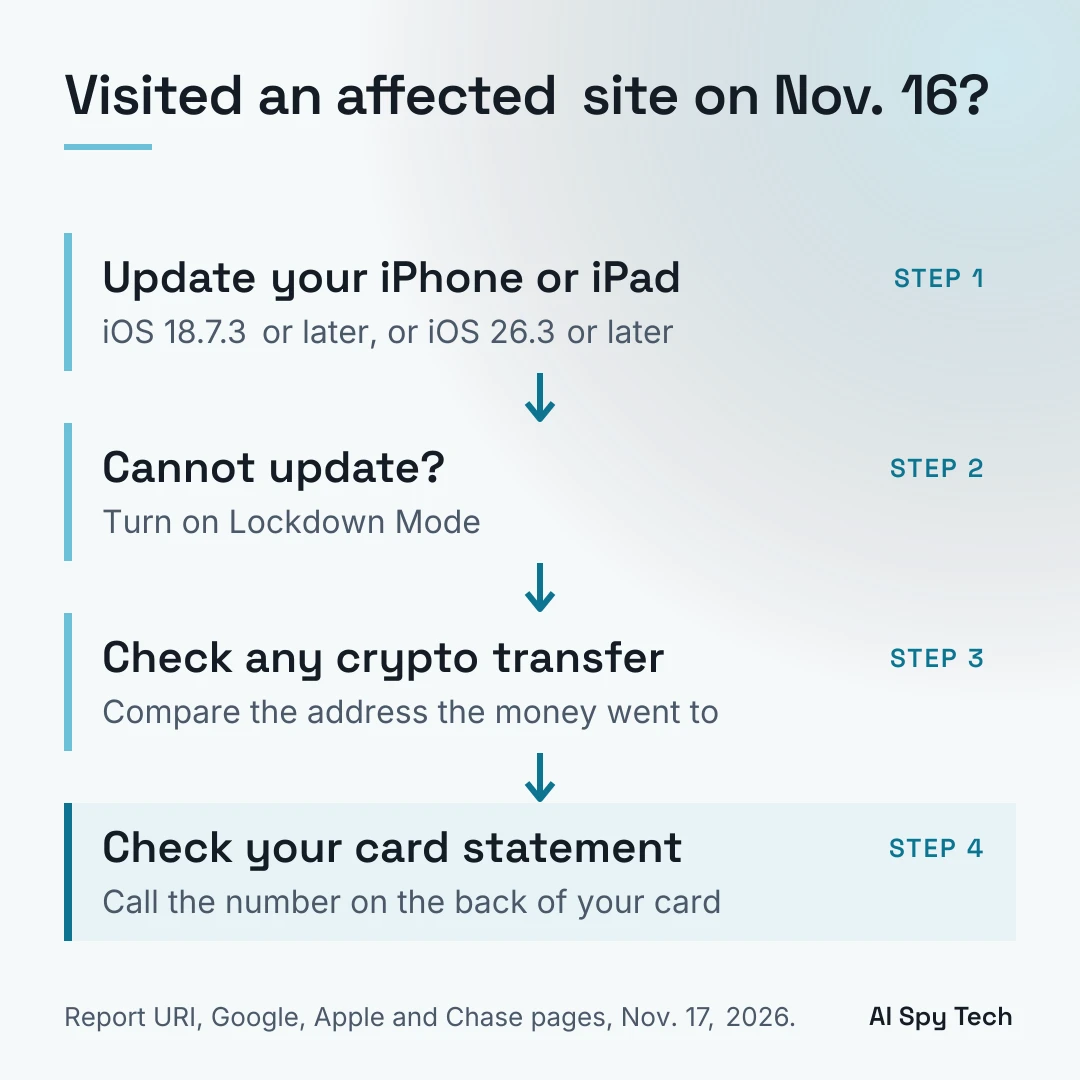
- Update your iPhone or iPad. Report URI's advice: "Update your iPhone or iPad to iOS 18.7.3 or later, or iOS 26.3 or later." Apple's current versions are iOS 27.2.1, iOS 26.7.3 and iOS 18.7.12, all released November 9, 2026, per Apple's security releases page. To check yours, go to Settings, then General, then About. To update, go to Settings, then General, then Software Update.
- If you cannot update, turn on Lockdown Mode. Google's threat team gave that advice for DarkSword in its March 2026 report. Lockdown Mode is in Settings, then Privacy & Security.
- Check any crypto transfer you made on November 16. Report URI: "Check any crypto transfer you made." Compare the address the money went to with the address you meant to use.
- Check your card statement if you paid on an affected site. Report URI: "Watch your card statements if you paid by card on an affected site." BleepingComputer adds: contact your card issuer if anything looks wrong. Chase advises calling the number on the back of your card.
- Watch your accounts. BleepingComputer advises visitors to "watch for suspicious account activity, particularly if they were logged into sensitive services." For signs that a phone is being tracked or misused, see our guide on how to know if your phone is being tracked.
The outages, and what each organization said
| Date | Outage | Cause, as stated | Cyberattack? |
|---|---|---|---|
| Thu, Nov 12 | Microsoft 365, Outlook, Teams | "A latent defect" in a networking fix, plus extra load and "nearly 14% of server capacity" out, Microsoft's Charles Lamanna posted | "a technical issue not related to cyber or AI/agents," Microsoft told Wired |
| Fri, Nov 13 | FAA nationwide ground stop, about 3:30 p.m. to 8:15 p.m. ET | Data "flooding the FAA FTI network." The FAA's initial investigation points to two potential locations, a radar site in Amarillo, Texas, and a radio site in El Dorado, Arkansas, where a new router was being installed | "no indication that this was a cyberattack," the FAA said |
| Mon, Nov 16 | JPMorganChase online banking, with delays at other banks | "a software bug in on-premise hardware systems," Chase told Wired | "no evidence this is cyber-related," Chase said |
| Mon, Nov 16 | United Airlines departures | United said a technology issue delayed departures for about an hour, per Reuters | "There is no indication that this was a cybersecurity-related issue," United said, per Reuters |
| Tue, Nov 17 | NSANet, the NSA's classified internal network | "temporary degradation during scheduled routine maintenance," the NSA said, per CNN | "We see no evidence that this was a cyberattack," White House spokesperson Lauren Bis said on Newsmax, per CNN |
| Tue, Nov 17 | Apple App Store, iCloud, Apple Pay | "an internal update caused some outages," Apple said, per 9to5Mac | "Company says this wasn't a cyberattack," reporter Mark Gurman posted, per 9to5Mac |
Separately, on November 13 the FBI published a FLASH alert about ARTEX, an AI-driven penetration testing tool that threat actors have used in intrusions. The FBI wrote that some intrusions went "from initial targeting to privileged access in under three hours." The alert does not mention any of the outages above.
Scam messages about the outages
Microsoft reported on November 16 that phishing emails posing as Microsoft 365 "Outage Notification" messages went out on November 13. The emails said held mail would be deleted in 24 hours and showed a "RESTORE MESSAGES" button. Microsoft wrote that real Microsoft 365 service messages "do not direct them to non-Microsoft domains to recover held mail."
Chase's scam page says: "Legitimate banks will never ask you to move money to resolve a fraud issue." It says to call the number on the back of your card. For texts about cancelled flights, see our guide to the flight cancellation text scam.
Frequently asked questions
Was CNN hacked?
Report URI found the malicious code in the Optimizely file that CNN's site loads. These files normally come from Optimizely's servers, though Report URI notes some customers serve them from their own domain. "A website can be compromised through a third-party dependency without its own code or infrastructure ever being breached," Report URI wrote.
Was the NSA outage a cyberattack?
The NSA said it "experienced temporary degradation during scheduled routine maintenance" and that "some internal systems were affected." The White House said it saw no evidence of a cyberattack. CNN's sources said there was "no evidence of a cyberattack" at that point.
I visited one of these sites on November 16. Am I affected?
Report URI wrote that it cannot tell how many visitors had cards skimmed or devices infected. The card skimmer ran from 8:43 a.m. Eastern and needed a card typed into the site's own form. The iPhone code was aimed at iOS 13 through iOS 18. A phone on iOS 18.7.3 or later, or iOS 26.3 or later, is on a version the kit's own comments list as patched, Report URI wrote.
Is the full list of sites public?
Yes. Report URI's post lists the 178 organizations and, for most, the web addresses where it found the code.