
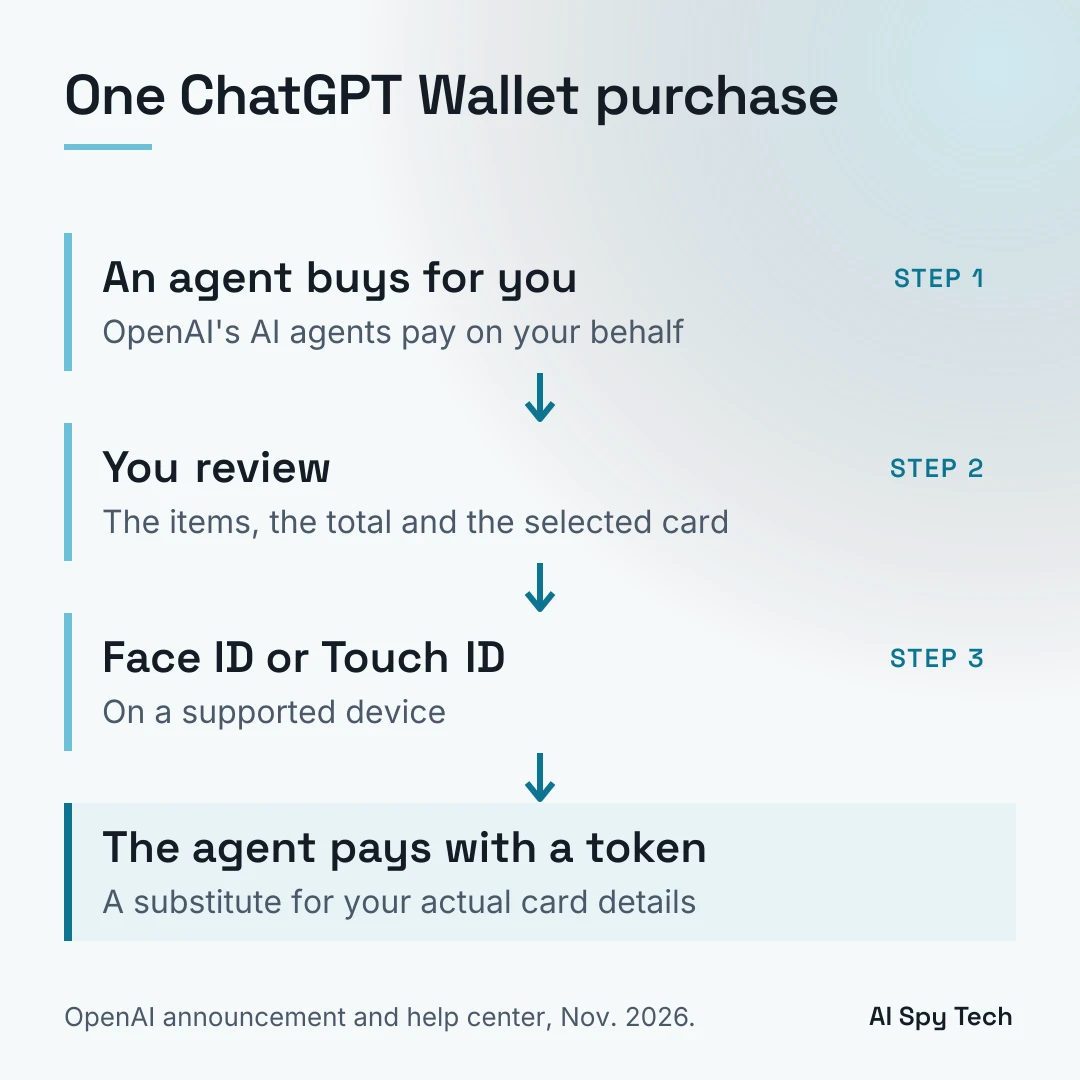
OpenAI launched ChatGPT Wallet on November 13, 2026. It lets OpenAI's AI agents pay for things on a user's behalf, and the user approves every purchase with "a security check such as Face ID or a fingerprint scan," according to OpenAI's announcement. OpenAI's help center says "Approving a purchase requires biometric verification, such as Face ID or Touch ID, on a supported device."
Facts are current as of November 18, 2026.
Who can use it
OpenAI says Wallet is for "ChatGPT Pro subscribers aged 18 and older in the US with eligible US-issued cards". The help center says Wallet "is rolling out gradually." It lists "eligible US-issued American Express, Chase, Mastercard and Visa cards" and says "ChatGPT Wallet doesn't support debit cards" and "Virtual cards are not supported at launch." It also says "Wallet isn't available in Chat, Work, or standalone Codex threads."
If you can't approve on the device you are using, OpenAI's help center says to "follow the link or QR code to continue on a supported device signed in to the same ChatGPT account."
How a purchase is approved
Before each purchase, OpenAI says, the user "reviews the items, total, and selected card, then approves it" with the security check. The agent pays with "a payment token" that OpenAI describes as "a substitute for the user's actual card details," with its own card number, security code and expiration date.
What OpenAI receives
OpenAI's ChatGPT Wallet privacy notice lists "the authentication result" and "passkey or authentication assertions" among the data it collects. The same notice says OpenAI "receives a tokenized payment credential and limited card details", such as the last four digits, and "does not receive the full credit card number or security code."
Face ID and Touch ID run on the device. Apple says "Face ID data doesn't leave your device, is never available to iOS or iPadOS, apps, or Apple" and that apps "are notified only as to whether the authentication is successful." OpenAI's pages do not say in those words that it receives no biometric data.
What you can do
- Read each approval screen. OpenAI shows the items, total and card before you approve.
- Check the card on file. Only eligible credit cards work, and each approval screen shows the selected card.
- Read the privacy notice before you turn Wallet on: openai.com/policies/chatgpt-wallet-privacy-notice.
- Wallet is optional. OpenAI's privacy notice says "You can choose whether to add a card or approve a purchase."
Our guide explains what a digital ID is, what each kind shares and how to stay in control.