
The State Department began a pilot on November 16, 2026 that lets some adults apply for a US passport online instead of in person, according to its notice in the Federal Register (91 FR 73629). Applicants prove who they are through Login.gov, which captures a live photo and then "compares the identity to the application's information using a variety of tools, including facial recognition to the identification documents provided," a footnote in the notice says. The pilot runs until November 20, 2027, "unless further extended."
Facts are current as of November 18, 2026.
Who can use the pilot
The notice limits the pilot to people "age 18 and over, who have an identification document accepted by Login.gov, excluding mobile driver's licenses." It starts with two groups, both located in the United States:
- adults who were "previously issued a fully valid U.S. passport who are not eligible for a DS-82 renewal application," and
- first-time adult applicants "using a Certificate of Naturalization issued by USCIS as evidence of U.S. citizenship."
The State Department says it "anticipates later expanding the pilot" to first-time applicants with a certified US birth certificate from a state that elects to take part, a Certificate of Citizenship, or a Consular Report of Birth Abroad, and to eligible applicants overseas. The notice states that "the $35 execution fee will still apply."
The notice says "Interested applicants will be able to visit America.gov to check their eligibility," and that "Applicants who do not meet the criteria for this pilot will be redirected to the appropriate application process." In-person applications continue: the State Department's adult passport page says "First-time adults and those who do not qualify for renewal must apply in-person at an acceptance facility."
How the face check works
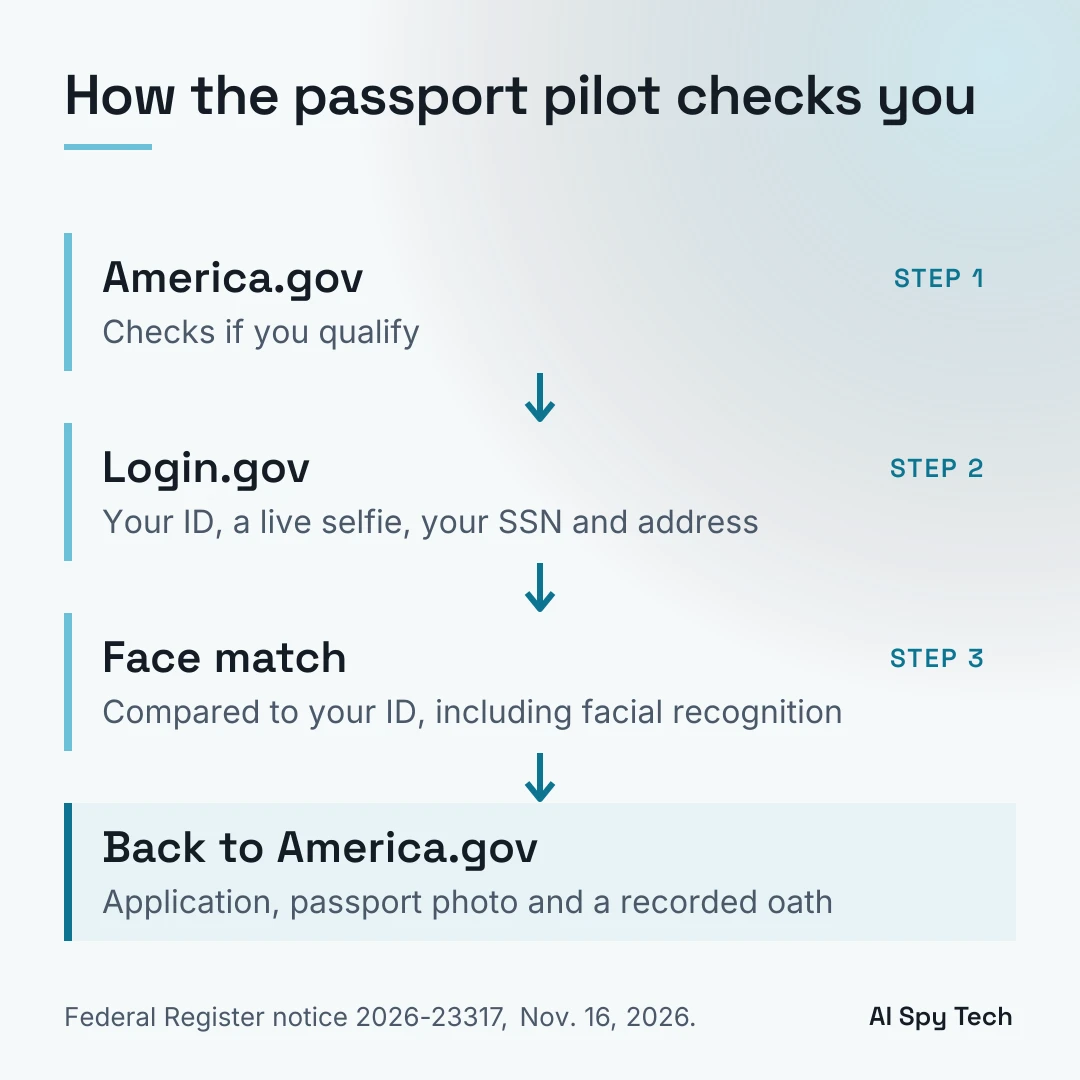
The notice lists the Login.gov steps: applicants "provide an ID for verification, pass a liveness detection check, enter their Social Security Number, put in their address, and verify the information provided." A footnote describes liveness detection as "capturing a live photo of the applicant using Login.gov's technology that confirms the applicant's live presence in front of the camera." After Login.gov, applicants return to America.gov and submit a passport photo. The notice also says applicants "will fulfill the oath requirement by recording themselves stating the oath."
On July 2, Secretary of State Marco Rubio said applicants would be able to take their picture on their own device and, in real time, "verify the facial ID". On September 29 he said the goal is for "the vast majority of Americans" to be able to apply on America.gov by the end of 2027.
What Login.gov says it keeps and shares
Login.gov's privacy page says:
- the selfie is compared "to the portrait on your government-issued ID, which is also done by our service providers."
- "For the first year, authorized personnel can also access the identity documents you submitted; after one year, Login.gov can no longer access them."
- "The information you give Login.gov will be shared with the applicable partner agency." (The Federal Register notice says the applicant's information "will be provided to the Department of State.")
- if a partner agency receives verification information to help prevent fraud, "information about your identity - including attempts you do not complete - is shared with that agency at the time of your attempt."
The Federal Register notice does not say how long the State Department keeps the live photo.
What you can do
- Check the steps before you start. America.gov shows whether you qualify before you begin.
- Know that unfinished attempts can be shared. Login.gov says attempts you do not complete may be shared with the agency to prevent fraud.
- Read Login.gov's privacy page before you upload an ID: login.gov/policy.
- Renewing, not applying? Today's online renewal is a separate program. Its photo goes through an automated quality check, and then "An employee will review your photo".
Digital IDs and face checks now show up at the airport, in phone wallets and in apps. Our guide explains what a digital ID is, what it shares and how to stay in control.